
Amgen Inc.: Navigating Innovation Amid Patent Expiries and Competitive Pressures
A deep dive into Amgen's R&D prowess, financial resilience, and strategic challenges in the evolving biotechnology landscape.
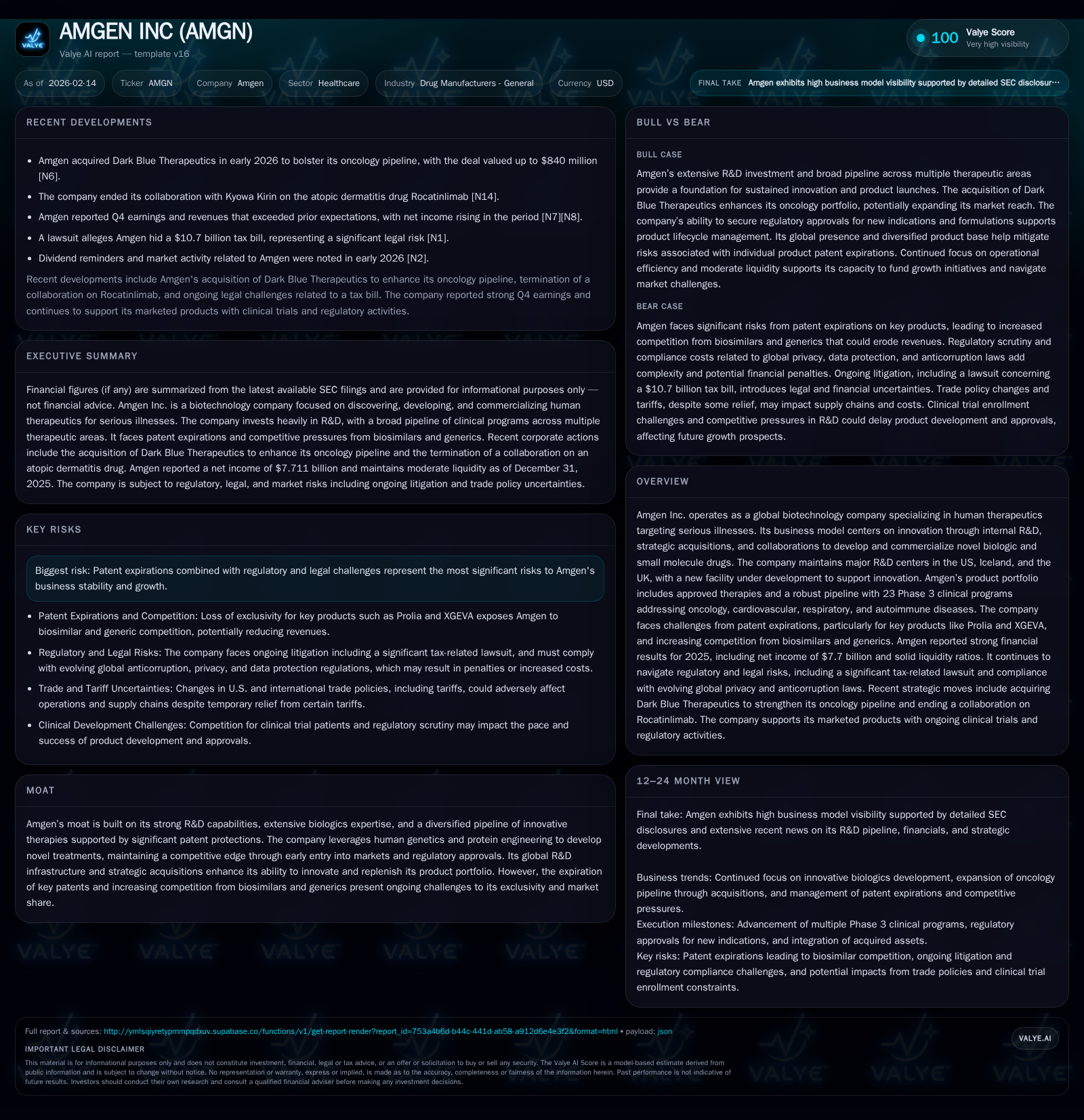
Amgen Inc. stands as a leading global biotechnology company known for its innovative therapeutic products targeting serious illnesses, with a strong emphasis on biologics and protein engineering. The company boasts robust R&D infrastructure across multiple geographies and maintains a diverse late-stage pipeline, positioning itself to offset revenue impacts from recent patent expirations on key products like Prolia and XGEVA. While fiscal 2025 results underscore solid profitability and liquidity, Amgen faces headwinds from biosimilar competition, patent cliffs, and intensifying regulatory scrutiny globally. Strategic investments in research facilities and a commitment to integrating human genetics into drug discovery underline Amgen’s approach to sustaining its competitive moat.
Company Overview and Business Model
Amgen Inc. is a preeminent biotechnology company specializing in the development of human therapeutics to address serious diseases. Rooted deeply in biologics innovation, Amgen leverages its strengths in human genetics, novel biology exploration, and protein engineering to create differentiated therapies. Its business strategy combines organic R&D advances with strategic acquisitions and collaborations to enhance its product portfolio continuously [S1]. This model has historically allowed the company early market entry advantages bolstered by patent protections.
The company's global footprint encompasses principal R&D centers in Thousand Oaks and San Francisco (California), Iceland, and the United Kingdom — an infrastructure designed to foster scientific collaboration across borders. In 2025, Amgen initiated construction of a new state-of-the-art R&D facility in Thousand Oaks aimed at further fostering synergistic innovation among its discovery research teams [S1].
Product Portfolio and Pipeline
Amgen's existing marketed products include several high-impact biologics impacting oncology, bone health, cardiovascular conditions, respiratory ailments, and autoimmune diseases. Of particular note are Prolia and XGEVA — RANKL antibody therapies that have been significant revenue contributors but faced U.S. patent expiration in February 2025 and Europe later that year [S1]. Consequently, these products have encountered increasing pressure from biosimilar entrants.
To sustain growth momentum amid such patent cliffs, Amgen maintains a robust clinical pipeline featuring 23 Phase 3 trials encompassing diversified modalities such as large molecules and small molecules across core therapeutic areas. The emphasis on genetics-based target selection aims to heighten clinical success probabilities [S1].
Financial Performance Highlights
Reflecting operational resilience amid patent losses and competitive pressure, Amgen reported net income of approximately $7.7 billion for fiscal year 2025 [F1]. Current assets stood at $29.1 billion against current liabilities of $25.4 billion at year-end 2025, yielding a current ratio of roughly 1.14 — indicative of solid liquidity management [F1].
Quarterly earnings beats reported in early 2026 affirmation provided robust commercial performance driven by both legacy products holding market share despite generics encroachment and earlier-stage launches [N2][N3]. These results illustrate how Amgen balances maturation-phase franchises with pipeline maturation.
Competitive Landscape and Patent Challenges
The expiry of patents on RANKL-targeting antibodies represents a notable inflection point. Biosimilars' entrance in multiple jurisdictions threatens pricing power historically enjoyed by Amgen's biologics [S1]. Industry-wide shifts toward biosimilar adoption heighten competitive intensity not unique to Amgen but stressing margins across peers.
Moreover, legal challenges surrounding tax liabilities have emerged recently with lawsuits claiming concealed obligations totaling billions — this adds complexity to financial planning amid ongoing litigation risk management [N7]. Regulatory scrutiny continues on multiple fronts including drug approval processes and post-market safety monitoring.
Regulatory Environment
Amgen navigates an evolving regulatory mosaic encompassing anticorruption statutes such as the Foreign Corrupt Practices Act (FCPA) given global operations involving interactions with healthcare professionals abroad [S1]. Data privacy compliance has grown increasingly complex with layered legislation enacted across multiple U.S. states (CCPA amendments, California Privacy Rights Act) alongside European GDPR mandates.
Recent health data-focused statutes such as Washington’s My Health My Data Act underscore the sensitivity surrounding patient information use in biotech contexts [S1]. Furthermore, the EU's Artificial Intelligence Act introduces stringent governance around AI applications — potentially impacting Amgen’s digital development activities within research pipelines.
Trade Policy Considerations
In response to uncertain tariff environments exacerbated by trade tensions globally, Amgen secured temporary relief from Section 232 tariffs tied to its investments in U.S.-based manufacturing facilities through late 2028 [S1]. This reprieve offers a moderating impact on cost inflation related to import tariffs encountered elsewhere.
Nevertheless, proposed sector-specific tariffs remain an ongoing risk factor that could affect supply chain economics depending on geopolitical developments.
Corporate Sustainability & Human Capital
Beyond scientific innovation imperatives, Amgen publicly commits to ambitious sustainability goals targeting carbon neutrality along with substantial reductions in water usage (40%) and waste disposal (75%) by 2027 [S1]. These targets align with broader investor interest in ESG considerations encompassing environmental stewardship alongside operational excellence.
Human capital management also figures prominently; attracting scientific talent worldwide underpins the company’s capacity for continued innovation especially amid fierce competition for biotech expertise.
Strategic Outlook & Risk Factors Analysis (Non-Exhaustive)
Innovation Continuity: With a solid pipeline guided by genetic insights driving potential breakthroughs, maintaining momentum through clinical trial success remains critical. Failure or delay of late-stage assets could impair future growth decks.
Patent Expiry Consequences: The loss of exclusivity on key biologics risks erosion of revenue pools via biosimilars — necessitating aggressive market defense strategies including patient support programs or lifecycle extensions.
Regulatory Complexities: Heightened scrutiny coupled with intricate privacy laws demands agile compliance frameworks to mitigate legal exposure risks.
Litigation & Taxation: Ongoing suits alleging hidden tax obligations could lead to significant financial penalties affecting net profitability if outcomes are adverse [N7][S1].
Geopolitical & Trade Risks: Tariffs or trade disruptions impact supply chains; while short-term relief exists through tariff exemptions due to domestic investments, long-term uncertainties prevail.
Industry Contextual Analysis (Independent Commentary)
The pharmaceutical/biotech landscape increasingly favors companies that combine deep biologic expertise with agile adoption of advanced technologies such as AI-guided drug discovery and real-world evidence generation. Firms like Amgen that integrate human genetics into candidate validation may enhance probability of clinical success compared to purely empirical methods.[Analysis]
Globally aging populations elevate demand for therapies addressing chronic conditions such as osteoporosis (Prolia indication) and cancers targeted by Amgen’s pipeline candidates.[Analysis]
Biosimilar penetration varies regionally; markets like Europe adopt more rapidly than the U.S., influencing competitive dynamics unevenly requiring tailored commercial strategies.[Analysis]
Patent expirations constitute a cyclical hurdle for large-cap biotech firms; successful transitioning toward next-generation products or new modalities often defines long-term survivability.[Analysis]
Conclusion
Amgen Inc.'s standing as one of biotechnology’s stalwarts rests on decades of focused investment in protein-engineering driven human therapeutics complemented by geographic diversification of research capabilities. Despite headwinds presented by patent expirations on marquee biologic agents triggering biosimilar rivalry pressures starting in 2025, the company exhibits resilient financial metrics supported by ongoing product sales alongside an expansive Phase 3 clinical portfolio.
Legal complexities involving tax-related litigation alongside an increasingly regulated global environment impose downside risks but also catalyze disciplined compliance vigilance within the organization. Strategic capital expenditures such as advanced R&D facilities reinforce Amgen’s intention to secure future innovation pipelines pivotal for sustainable competitiveness.
Environmental sustainability commitments illustrate alignment with broader stakeholder values without distracting from core mission focus—discovering transformative treatments for serious illness worldwide.
Overall, while no company navigating biotech markets can be insulated fully from inherent uncertainties around clinical success rates or regulatory vicissitudes, Amgen's robust scientific foundation coupled with proactive risk management frames it well within a complex healthcare ecosystem.
This analysis is intended strictly for informational purposes reflecting publicly available data as of February 2026. It does not constitute investment advice or recommendations regarding AMGN stock or any other security.
Disclaimer: This is research-only, informational analysis and not investment advice. It may include AI-generated interpretation and general industry context. Always verify important details using primary sources.

Comments