
Trupanion's data-driven pet insurance model navigating growth and leverage challenges
Exploring how Trupanion’s proprietary data, patented technology, and subscription focus intersect with financial risks and market opportunities.
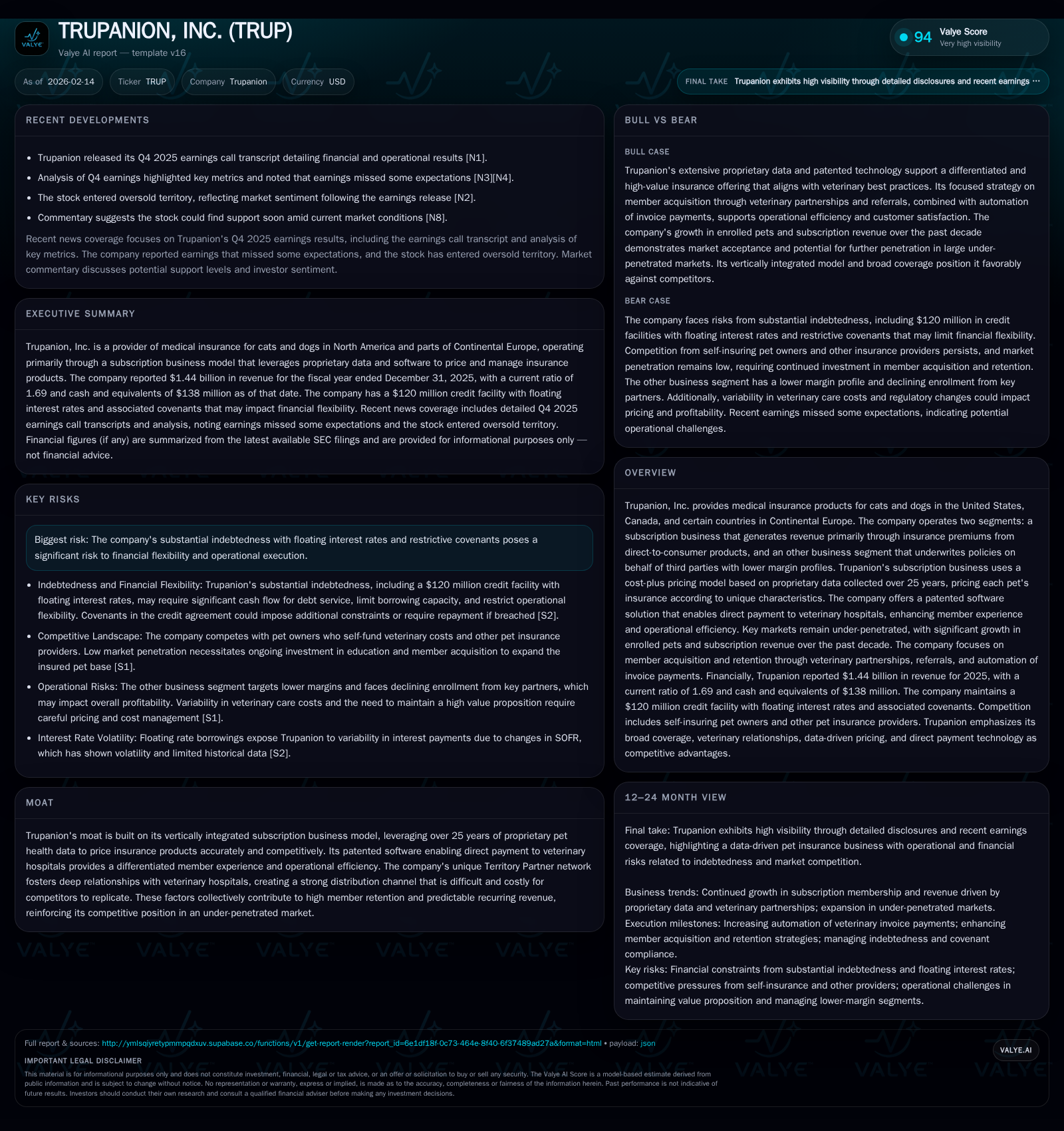
Trupanion, Inc. addresses the unpredictable veterinary cost burden faced by pet parents through a unique subscription-based insurance model powered by over 25 years of proprietary data. Its vertically integrated approach, augmented by patented software enabling direct vet payments and a dedicated Territory Partner network, fortifies its competitive moat despite an under-penetrated market backdrop. However, persistent net losses, high leverage with floating rate debt, and restrictive covenants pose tangible risks to financial flexibility and long-term growth investments. Amid recent Q4 2025 earnings showing strong revenue growth but continued profitability challenges, the company stands at a crossroads balancing innovation-led expansion against financial discipline.
Trupanion’s Foundational Mission: Caring for Beloved Pets through Innovation
Imagine the dilemma facing a pet parent who suddenly faces an emergency surgery costing tens of thousands. Budgeting for such unpredictable veterinary expenses is nearly impossible given the volatility in pet health outcomes — lucky pets might rarely need care beyond routine visits, while unlucky ones rack up bills exceeding $50,000 over their lifetime [S1]. Trupanion was founded expressly to help these responsible pet parents navigate this uncertainty by smoothing out costs through medical insurance products tailored specifically for cats and dogs. This mission is not merely altruistic; it reflects a profound market need amplified as veterinary care inflation consistently outpaces general inflation rates, squeezing budgets further [S1].
By focusing exclusively on pet medical needs in the United States, Canada, and select European countries, Trupanion has developed expertise applying innovative technology and data analytics to address a complex problem that many general insurers avoid or treat superficially.
Decoding the Vertically Integrated Subscription Model and Its Market Edge
At the heart of Trupanion’s business is its subscription segment — a recurring-revenue engine driven primarily by monthly insurance premiums (referred to as "subscription payments") collected directly from consumers [S1]. This model differs markedly from traditional insurance which may operate across fragmented channels without such integration. By owning much of the value chain including underwriting policies themselves or reinsurance arrangements for direct branded products (e.g., Furkin in Canada or offerings in Germany and Switzerland), Trupanion achieves tighter control over margins and customer experience.
Conversely, its "other business" segment — consisting mainly of underwriting policies on behalf of third parties like Pets Best Insurance Services — carries significantly lower margins and is strategically sidelined as non-core given its limited scaling potential [S1]. Through this structure, the company prioritizes high-margin subscription economics while maintaining flexibility elsewhere.
This vertical integration supports revenue predictability and fosters operational synergies difficult for competitors to replicate without substantial investment or disruption.
Leveraging 25 Years of Proprietary Data to Fine-Tune Pricing and Retention
Perhaps Trupanion’s most formidable asset is its proprietary database documenting 25 years of aggregated pet health outcomes feeding into its cost-plus pricing framework [valye_report_excerpt][S1]. Each pet is assessed individually — breed, age, location, treatment variability — allowing premiums to reflect expected claims more accurately than blunt population averages.
This nuanced approach mitigates adverse selection risks common in standard insurance markets since subscribers perceive fairer pricing aligned with their pet's risk profile. Moreover, it drives higher member retention rates as customers experience fewer surprises in coverage shifts or sudden premium hikes.
Retention stability in turn lays groundwork for predictable recurring revenue crucial for sustainable growth despite heavy new pet acquisition spending. The deep data moat also hinders rivals lacking similar longitudinal insights or comprehensive claim exposure.
The Patented Payment Platform: Operational Efficiency Meets Customer Experience
Beyond pricing sophistication, Trupanion offers patented technology enabling direct payment of veterinary invoices by their system instead of requiring pet parents to front costs then seek reimbursement [S1][valye_report_excerpt]. This real-time vet payment mechanism reduces administrative friction, bolsters service satisfaction among so-called "pet parents," and accelerates cash flow processing internally.
Operationally, seamless invoice handling lowers overhead related to claims adjudication errors or disputes while strengthening relationships with partner hospitals. Veterinary clinics become allies within the distribution network rather than mere points of service.
This integration exemplifies how technology elevates user engagement concurrently with efficiency gains — a dual benefit enhancing customer stickiness over competing entities without comparable platforms.
Financial Portrait: Growth in Revenue versus Persistent Profitability Challenges
Trupanion’s revenue trajectory reflects impressive subscriber growth culminating in approximately $1.44 billion reported revenue for fiscal 2025 [F1]. These topline gains underscore solid adoption momentum across its North American markets and early European expansions.
However, the profitability story remains muted. Despite rising top-line figures, Trupanion continues to report cumulative net losses since inception including negative net income pressures reported during Q4 2025 — partially attributed to elevated new pet acquisition expenses outpacing margin expansions [N2][N3][F1][S1]. Net income remains constrained by substantial reinvestments into marketing channels such as social media outreach alongside investments needed to scale infrastructure logically consistent with subscription expansion strategies.
Cash holdings stood reasonably robust at roughly $138 million year-end 2025 [F1], providing runway yet underscoring a delicate balance wherein ongoing operating cash flows must increasingly support debt servicing while investing in growth initiatives.
The juxtaposition highlights classic early-stage subscription business dynamics but invites scrutiny given magnified capital intensity amidst competitive financing cost environments currently prevailing.
Debt Leverage and Covenants: The Double-Edged Sword of Financial Flexibility
Trupanion’s capital structure reveals heightened indebtedness chiefly financed via the PNC Facility comprising a $100 million term loan plus revolving credit lines totaling $20 million at principal amounts [S2]. Importantly, a considerable portion of this debt bears floating interest linked to SOFR rates introducing variability risk into interest expenses as benchmark lending rates oscillate unexpectedly.
This exposure proved acute recently given broader credit market volatility impacting borrowing costs industry-wide [S2]. Importantly, the PNC Agreement imposes various affirmative and negative covenants curtailing operational freedoms — restricting further indebtedness beyond prescribed exceptions and delineating bounds on strategic transactions viewed necessary or beneficial for corporate development.
Consequently, this indebtedness arrangement poses both constraints on resource deployment toward innovation or expansion while amplifying vulnerability should earnings fail to improve steadily enough to cover debt servicing comfortably [S2]. With interest payments potentially consuming significant cash flow shares it places management at a strategic inflection point balancing growth ambitions against financial prudence.
Competitive Landscape and Expansion Hurdles in Under-Penetrated Markets
Despite sizeable addressable markets marked by low overall penetration rates for pet insurance products domestically and abroad [valye_report_excerpt], competition intensifies notably from established insurers like CNO Financial Group or MetLife who have recently posted solid underwriting performances and expanded policy volumes [N4][N5]. Aflac’s mixed results illustrate sector headwinds tied partly to rising claims costs albeit within broader life/health insurance contexts [N6].
Trupanion differentiates itself through an exclusive blend of vertically integrated subscription models combined with its proprietary Territory Partner network that cultivates meaningful ties between independent contractors deeply embedded within local veterinary communities [valye_report_excerpt]. These partners facilitate lead generation and foster trust harder for national insurers reliant mainly on broad advertising campaigns.
Nonetheless scaling these relationship-driven approaches across diverse international regulatory regimes complicates rollouts—demanding localized compliance frameworks plus tailored product adaptations limiting rapid global expansion speed.
Having secured footholds especially in Canada and parts of Continental Europe signals determined incremental progress but also signals sustained efforts required before hitting scale parity comparable with major insurers domestically.
Risks on the Horizon: Regulatory Complexity, Float Interest Rate Exposure, and Market Volatility
Material risk factors inherent within Trupanion’s operation stem from multifaceted legal landscapes governing insurance regulation differing vastly between U.S., Canadian provinces, Germany, Switzerland among others leading to compliance demands challenging even seasoned operators [S1]. Alongside regulatory hurdles exist operational risks tied to managing increasing claims processing loads intensified by growing member bases utilizing direct pay technologies prone to invoicing complexities requiring rigorous validation processes [S1].
Financially significant is sensitivity arising from SOFR-indexed floating rate debt exposed to potential spikes elevating interest burdens unpredictably beyond current forecasts [S2]. Such increasing costs coupled with intense capital needs for continued marketing expenditures raise concerns around financial sustainability absent meaningful profit inflections.
Moreover reliance on key personnel within Territory Partner networks amid intensifying competition adds vulnerability points potentially affecting acquisition funnels critical for future growth trajectories [S1]. Finally evolving claim severity due to shifting animal health trends could pressure loss ratios adversely altering expected margin dynamics.
Altogether these factors collectively caution stakeholders while underscoring nuanced managerial capabilities required navigating uncertain input variables without losing sight of core mission execution priorities.
Investor Sentiment and Stock Dynamics Following Q4 2025 Earnings
Recent Q4 2025 earnings stir mixed reactions among investors emphasizing ongoing tension between encouraging subscriber gains supporting future revenue streams versus immediate net income shortfalls undermining near-term confidence [N1][N2][N3]. The reported misses relative to consensus estimates have propelled TRUP shares into oversold territory reflecting higher perceived execution risk intertwined with reward potential given business fundamentals rooted in differentiated offerings supported by durable consumer demand patterns [N9][N12].
Some market commentary highlights potential technical support levels emerging which might form bases for stabilization should management communicate clear paths addressing profitability hurdles without sacrificing membership growth quality [N10]. Meanwhile trading volumes tied to option expirations suggest speculative positioning adjusting rapidly toward upcoming catalysts possibly linked to margin improvement strategies or incremental geographic expansion announcements [N11].
Investor sentiment thus remains cautious but open-minded contingent on demonstrated delivery aligning operational capabilities tightly around financial objectives without compromising long-term innovation advantages built over decades.
Disclaimer: This analysis is not investment advice or a recommendation. It summarizes public filings, recent news coverage, and general industry context solely for informational purposes.

Comments