Exploring Marine Petroleum Trust’s Governance and Income Model Amid Sparse Transparency
Marine Petroleum Trust operates without traditional management, relying on contractual royalty rights and a trustee to deliver steady dividends despite limited public disclosure.
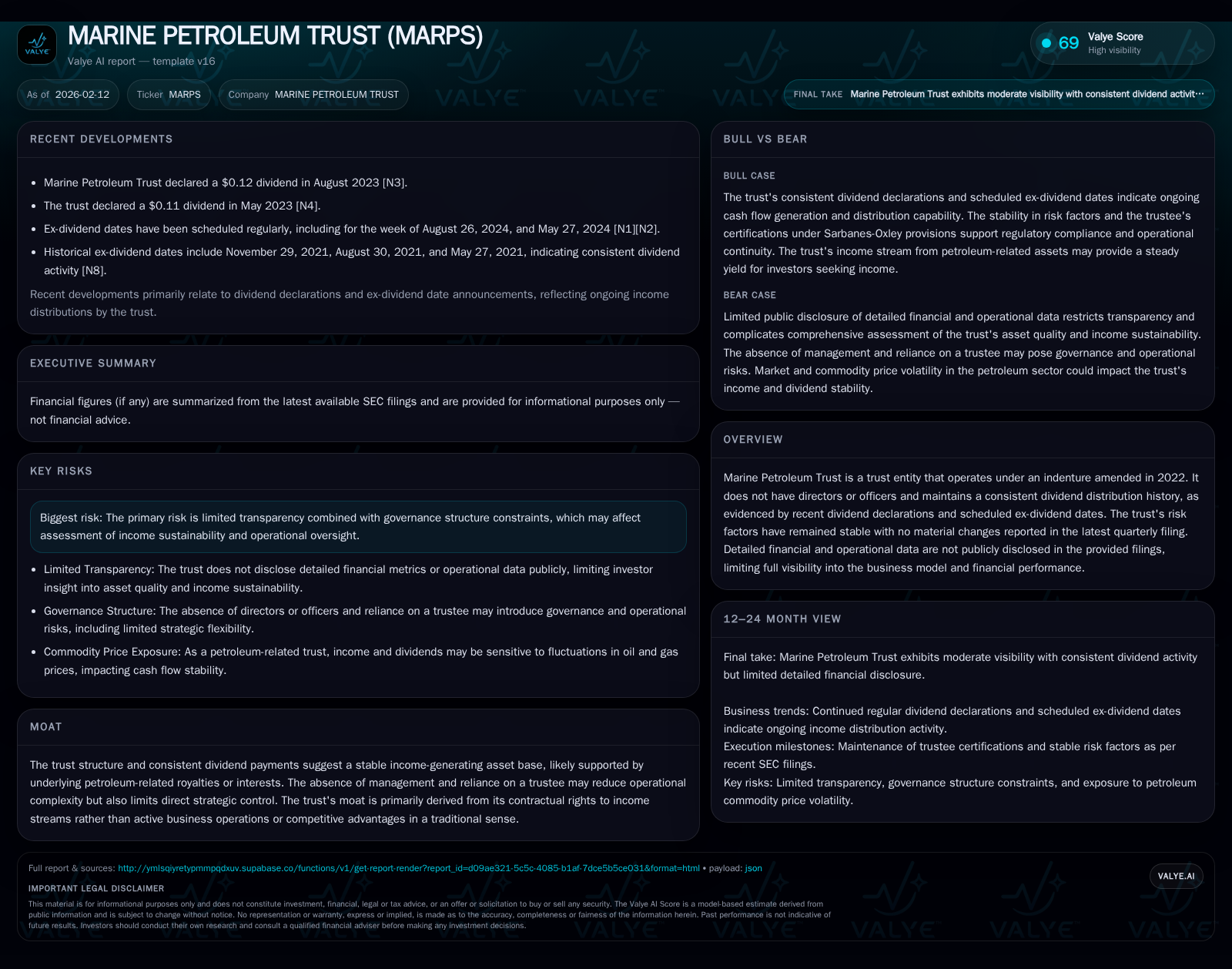
Marine Petroleum Trust (MARPS) stands apart in its governance approach, lacking directors and officers and functioning under a trustee arrangement. This structure emphasizes reliance on contractual royalty streams as its economic foundation rather than operational control or business execution. While dividend consistency remains a core attraction, limited financial disclosures and the absence of active management introduce challenges for evaluating long-term sustainability and growth prospects. The trust’s moat is anchored in legal rights with stability maintained through its trustee's oversight, yet structural constraints pose both risk and opportunity considerations.
A Trust Without Steering Wheel: Understanding MARPS’ Governance Model
Marine Petroleum Trust departs from conventional corporate setups by explicitly lacking any directors or officers—a characteristic that fundamentally shapes its operational dynamics. Instead of executive leadership or a board driving strategy or business development, governance rests with Argent Trust Company acting as the sole trustee under an amended indenture dated 2022 [S2]. This model effectively removes typical managerial discretion and hands primary stewardship to a fiduciary entity tasked with administering the trust's contractual rights and income streams.
Such a governance framework suggests a passive operational posture; decisions about asset management or strategic shifts are either constrained by contract terms or dependent on trustee discretion within those confines. The absence of management may reduce internal complexities but also throttles responsiveness to evolving industry conditions or market opportunities. This unique setup demands investors view MARPS less as an operating concern and more as an investment vehicle reliant on legal entitlements administered by a trustee.
Financial Visibility in the Shadows: Navigating Limited Disclosure
Transparency around MARPS' financials remains exceptionally sparse. Beyond high-level disclosures—largely confined to dividend announcements—the trust provides minimal operational or financial detail in its SEC filings [valye_report_excerpt, S1]. There is no readily available granular data on revenue composition, expense structure, or asset valuations that typically inform deeper fundamental analysis.
This opacity complicates valuation efforts and risk assessments since investors must infer performance trends from indirect signals such as dividend history and static risk factor statements. The consistent reiteration in filings that there have been no material changes in risk factors [S2] offers some stability but does little to expand insight into underlying business health or market exposures. Investors must therefore operate with an elevated degree of uncertainty, balancing the appeal of steady income against informational limitations.
Dividend Reliability: The Backbone of Investor Appeal
Amidst this informational paucity, MARPS’ longest-standing hallmark remains its consistent dividend distribution record [valye_report_excerpt]. Dividend reliability emerges as the cornerstone asset characteristic—effectively transforming market perception of MARPS from an opaque entity into a dependable income stream generator.
For income-focused stakeholders, this dividend consistency offers a measure of predictability rarely matched by typical exploration-dependent energy equities prone to commodity price cycles. It signals underlying royalty contracts produce sufficiently stable cash flows to sustain payout commitments. This feature positions MARPS within a niche investor segment prioritizing yield stability over capital appreciation or active operational engagement.
Moat Analysis: Contractual Income Streams Over Operational Control
MARPS’ economic moat is rooted not in market share battles or innovative capability but in the enforceable contractual claims it holds on petroleum-related revenue streams [valye_report_excerpt]. These legal rights grant preferential access to cash inflows independent from direct asset management or commodity production risks.
This distinction sets MARPS apart from traditional operators; its value resides entirely in these passive royalty interests rather than any competitive manufacturing advantage or dynamic enterprise scalability. Such moats are durable provided contractual frameworks remain intact but inherently fixed—offering neither rapid growth nor strategic adaptation levers common in active businesses.
Risk Assessment: Balancing Limited Oversight and Stability
While no new material risks have been reported since the last annual disclosure [S2], inherent vulnerabilities stem from the trust’s constrained governance model and scant financial transparency. Potential concerns include insufficient operational oversight capabilities by the trustee, unknown exposure concentrations within royalty streams, and risks associated with contract enforcement under shifting economic conditions.
However, these uncertainties are partially offset by historical dividend steadiness serving as an indirect proxy for underlying revenue resilience. The lack of officer-driven decision-making may diminish risk from managerial errors but increases dependence on static contractual structures and trustee fidelity. Prospective investors must weigh these structural trade-offs carefully given the limited capacity for proactive risk mitigation through strategic action.
Trustee’s Role: The Silent Custodian Behind MARPS’ Operations
Argent Trust Company fulfills a pivotal role as MARPS’ sole executive agent under Sarbanes-Oxley Act certifications attesting to stringent oversight responsibilities [S2]. Nancy Willis, Director of Royalty Trust Services at Argent, formally certifies compliance with Sections 302 and 906 of SOX—a regulatory framework emphasizing accuracy of disclosures and internal controls.
This trustee-centric governance acts as both guardian and administrator; Argent executes fiduciary duties including managing royalty income collections and disbursements while ensuring adherence to legal mandates embedded within the trust indenture. This arrangement compensates for absent management layers yet concentrates significant operational responsibility in one entity reliant on prescribed compliance protocols rather than entrepreneurial initiative.
Market Context: Positioning Within Energy-Related Income Assets
Although MARPS lacks explicit industry labeling, its defining characteristics squarely place it among specialized energy-related income vehicles focused on royalty trusts or similar structures [valye_report_excerpt]. This asset class prioritizes predictable yield generation derived from contractual rights linked indirectly to petroleum production revenues.
Investors typically view such entities as alternatives to direct energy equity ownership—providing exposure detached from volatile exploration activities while maintaining association with commodity cycle fundamentals through income dependence. MARPS fits this profile tightly: not an operator exposed to exploration success/failure swings but an income conduit reinforced by embedded legal claims yielding cash flows.
Looking Forward: Implications of Structural Constraints on Growth
Looking ahead, Marine Petroleum Trust’s structural peculiarities imply inherent limits on agile growth or adaptation. Operating without active management constrains ability to pursue new assets or reposition existing holdings dynamically. Contractual entitlements circumscribe revenue sources effectively fixed unless renegotiations occur outside current scope [valye_report_excerpt].
This immutability supports predictable distribution streams yet constrains capital appreciation paths usually derived from expansion initiatives or portfolio diversification. Consequently, MARPS exemplifies an investment balancing act—offering stable income rooted in legal claim durability while trading off growth flexibility inherent in governance architecture.[S2]
Disclaimer: This analysis is informational only and does not constitute investment advice. Readers should conduct their own research before making financial decisions.
Disclaimer: This is research-only, informational analysis and not investment advice. It may include AI-generated interpretation and general industry context. Always verify important details using primary sources.

Comments