NiSource Inc.: Steering through Regulatory Tempests toward 2040 Net Zero Ambitions
NiSource's Q4 2025 surge signals momentum, yet regulatory and financial complexities cloud its utility transition.
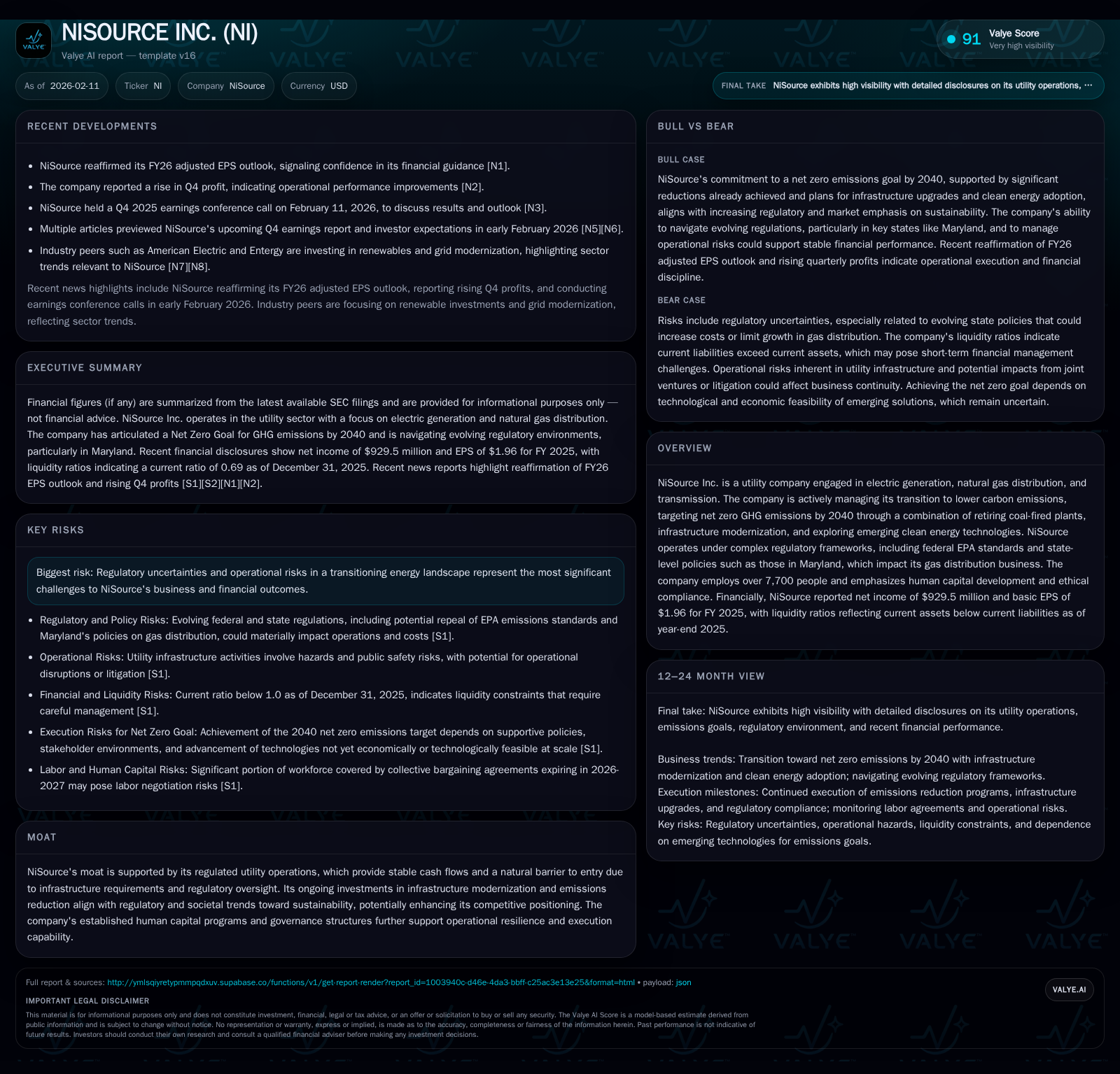
NiSource Inc. recently reported a Q4 2025 earnings beat, reflecting operational resilience amid evolving regulatory challenges at federal and state levels. The company continues advancing its net zero GHG emissions goal by 2040 through coal plant retirements and infrastructure modernization while navigating Maryland’s tough emissions policies. However, liquidity pressures and policy uncertainties pose tangible risks to its capital-intensive transformation. NiSource's defensive moat remains anchored in regulation and infrastructure scale, reinforced by a strong governance framework emphasizing human capital development.
Earnings Beat and What Lies Beneath: Details from Q4 2025
NiSource’s fourth quarter of 2025 revealed an encouraging performance marked by earnings and revenue surpassing market expectations. Reported net income reached $929.5 million for the full fiscal year ending December 31, 2025, complemented by a basic earnings per share of $1.96 [F1][N1][N2][N3]. This growth was largely fueled by the company’s regulated utility segments—electric generation coupled with natural gas distribution—that continue to provide steady cash flows amid the evolving energy landscape.
Yet underpinning this top-line strength is a more nuanced financial condition. The balance sheet paints a picture of liquidity constraints; current assets totaled approximately $2.38 billion against current liabilities of about $3.46 billion at year-end 2025, yielding a current ratio near 0.69 [F1]. Such a position reflects tight short-term liquidity relative to obligations—a situation likely intensified by ongoing capital expenditures tied to infrastructure upgrades and emissions mitigation initiatives [N2]. Market watchers may interpret this as a signal to monitor NiSource’s funding strategies closely as it balances operational needs with debt management.
Regulatory Storms on the Horizon: Federal and Maryland Policy Implications
Regulatory forces loom large over NiSource's strategic horizon. At the federal level, the recent EPA proposal (June 2025) to repeal the carbon emissions standards enacted in May 2024 directly impacts fossil fuel-fired power plant operations — including those within NiSource’s subsidiary NIPSCO [S1]. This rollback removes prior requirements on capacity factors and mandates for carbon capture technology, potentially easing $675 million in projected costs within NIPSCO's integrated resource plan.
However, caution pervades given the uncertainty surrounding final rulemaking and broader marketplace responses.
Compounding this are Maryland’s ambitious climate statutes under the Climate Solutions Now Act of 2022 requiring a steep 60% GHG emission reduction by 2031 from 2006 baselines and legislating net zero by 2045 [S1]. The Maryland Department of the Environment (MDE) has adopted stringent Building Energy Performance Standards targeting net zero direct emissions from large buildings by 2040 or alternatively imposing compliance fees.
Additionally, Maryland moves decisively towards electrification of building heating systems through Clean Heat Standards envisaging transitions from gas furnaces to heat pumps; proposed Public Service Commission regulations threaten traditional cost recovery models by demanding full-cost payments for new gas service extensions [S1]. For NiSource’s Columbia Gas operations in Maryland, these measures sow uncertainty around future growth avenues, cost allocation fairness, and potential stranded asset exposures.
The Energy Transition Journey: Progress Against Net Zero 2040 Goals
Amidst this shifting policy backdrop sits NiSource’s publicly affirmed commitment to achieving net zero greenhouse gas emissions across Scope 1 and Scope 2 by 2040—a notable acceleration relative to many industry counterparts [S1]. Progress is visible; since base year 2005, Scope 1 emissions have declined roughly 72%, underpinned primarily by retirement of coal-fired electricity generation assets.
Continuing methodologies include pipe replacement programs reducing methane leakage—a potent GHG contributor—and rollout of advanced leak-detection technologies that improve both environmental metrics and pipeline safety [S1]. To reach longer-term aspirations, NiSource is exploring emergent low-carbon technologies such as hydrogen blending, renewable natural gas integration, long-duration energy storage solutions, and potential carbon capture utilization when viable economically and technologically.
That said, realization hinges heavily on regulatory support frameworks alongside breakthroughs in cost-effective deployment at scale—variables fraught with uncertainty as markets evolve.
Infrastructure Modernization: Safeguarding Reliability and Reducing Methane
Core to NiSource’s strategy is sustained investment in physical modernization focused on infrastructure reliability enhancements coupled with environmental stewardship [S1]. Legacy pipeline systems undergo comprehensive replacement cycles targeting materials prone to leaks or failures—an initiative aligned both with safety imperatives and methane emission reduction targets mandated by regulators.
This dual benefit effectively shores up the utility’s service quality reputation while preempting fines or penalties linked with non-compliance. With roughly several thousand miles of pipeline assets under management across multiple jurisdictions, executing these programs efficiently constitutes an operational linchpin for maintaining system integrity amidst growing climate-driven scrutiny.
Financial Strength Under Scrutiny: Liquidity Constraints Amid Growth
While operational momentum is evident, financial metrics prompt cautionary analysis. The reported current ratio falling under one—approximately at 0.69—spotlights a scenario where short-term obligations substantially exceed readily liquid assets [F1][N2]. Cash & equivalents hover near $110 million which must be managed tightly against quarterly obligations including vendor payables, debt service costs, and ongoing capital project funding.
Such pressure scenarios are not uncommon in heavily regulated utility sectors undergoing transition but necessitate rigorous treasury oversight. Potential mitigants include phased capital deployment aligned with regulatory approvals or incremental financing instruments contingent on credit standing maintenance.
Importantly, stable regulated revenues alongside supportive governance structures could provide contingency buffers; however, asymmetric risk arises if regulatory delays or cost disallowances impair cash flow predictability.
Competitive Moat: How Regulation and Technology Shape NiSource’s Defenses
NiSource's intrinsic protective wall derives primarily from its highly regulated monopoly status over essential utility services featuring significant infrastructure scale—a classic moat foundation within the utility space [valye_report_excerpt]. Regulatory commission oversight restricts entry from competitors while offering stabilized rate base returns constrained by prudency reviews.
Complementing this structural advantage are technology-driven initiatives enhancing operational efficiency and environmental compliance—pipe replacement programs and emissions management creating incremental value beyond baseline regulatory requirements [valye_report_excerpt].
Nonetheless, this moat confronts headwinds including accelerated decarbonization demands that may compress allowed returns or require investment in novel yet unproven clean technologies. Required agility in strategic adaptation will test management execution disciplines shaped partly through established governance frameworks emphasizing ethical codes and human capital robustness.
Risks That Could Rattle the Framework: Operational and Regulatory Challenges
The main threat vectors coalesce around persistent regulatory ambiguity combined with operational execution risks intrinsic to large-scale energy transitions [S1][valye_report_excerpt]. EPA’s proposed reversals provide some near-term relief but generate uncertainty on compliance roadmaps impacting capital expenditure prioritization.
Maryland’s aggressive policies amplify risk complexity especially where cost recovery methodologies drift away from traditional constructs—raising prospective stranded asset concerns if gas infrastructure investments become unrecoverable due to curtailed expansions or mandated retirements [S1].
Technology adoption timelines further inject risk; breakthroughs needed for hydrogen blending or carbon capture could falter commercially or face slow policy endorsement undermining anticipated benefits embedded into financial modeling.
This confluence demands vigilant scenario planning alongside robust stakeholder engagement to mitigate surprises adversely affecting earnings or credit metrics.
Human Capital and Governance: The Untold Pillars of Execution
Beyond tangible assets lies NiSource’s commitment to strengthening soft pillars vital for navigating transformative industry shifts [S1][valye_report_excerpt]. Workforce development initiatives equip employees with requisite skills tailored for emerging clean energy technologies while embedding safety cultures critical amid evolving operational processes.
Ethical compliance programs reinforce corporate governance practices fostering transparent decision-making essential under heightened regulatory scrutiny. Combined, these initiatives mitigate execution risk enabling sustained progress toward strategic objectives including emission reductions amidst complex external environments.
Such human capital focus often remains understated yet substantially influences organizational resilience especially when external disruptions challenge conventional operating models.
Comparative Industry Outlook: NiSource Amid Peers’ Green Investments and Policy Responses
Against prominent peers like Exelon and Entergy—both actively touting green investment expansions targeting renewables integration plus grid modernization—NiSource presents a nuanced profile [N5][N12][N13]. Its early net zero commitments align it strategically; however, elevated exposure to natural gas distribution confronted by stricter state-level rules (notably Maryland) differentiates its challenge set versus peers more heavily weighted toward nuclear or renewable-heavy portfolios.
While competitors leverage diversified asset bases enabling smoother transition pathways supported by clear policy endorsements in their regions, NiSource’s balancing act entails prudent navigation between legacy asset economics disrupted by electrification trends versus infrastructural upgrade imperatives necessary for compliance.
Consequently, relative valuation of growth trajectories hinges not only on emission targets but also on successful adaptation to localized regulatory matrices impacting revenue certainty.
This analysis synthesizes available data as of February 11, 2026 without projecting beyond documented facts or disclaimers provided by NiSource Inc.'s filings or reputable news sources. It does not constitute investment advice but offers an informed perspective on company positioning amid dynamic sectoral transformations.
Disclaimer: This is research-only, informational analysis and not investment advice. It may include AI-generated interpretation and general industry context. Always verify important details using primary sources.

Comments