
Church & Dwight’s Enduring Resilience Amidst Sector Challenges in 2025
A comprehensive analysis of Church & Dwight’s financial performance, liquidity, and strategic positioning through the lens of recent earnings and industry dynamics.
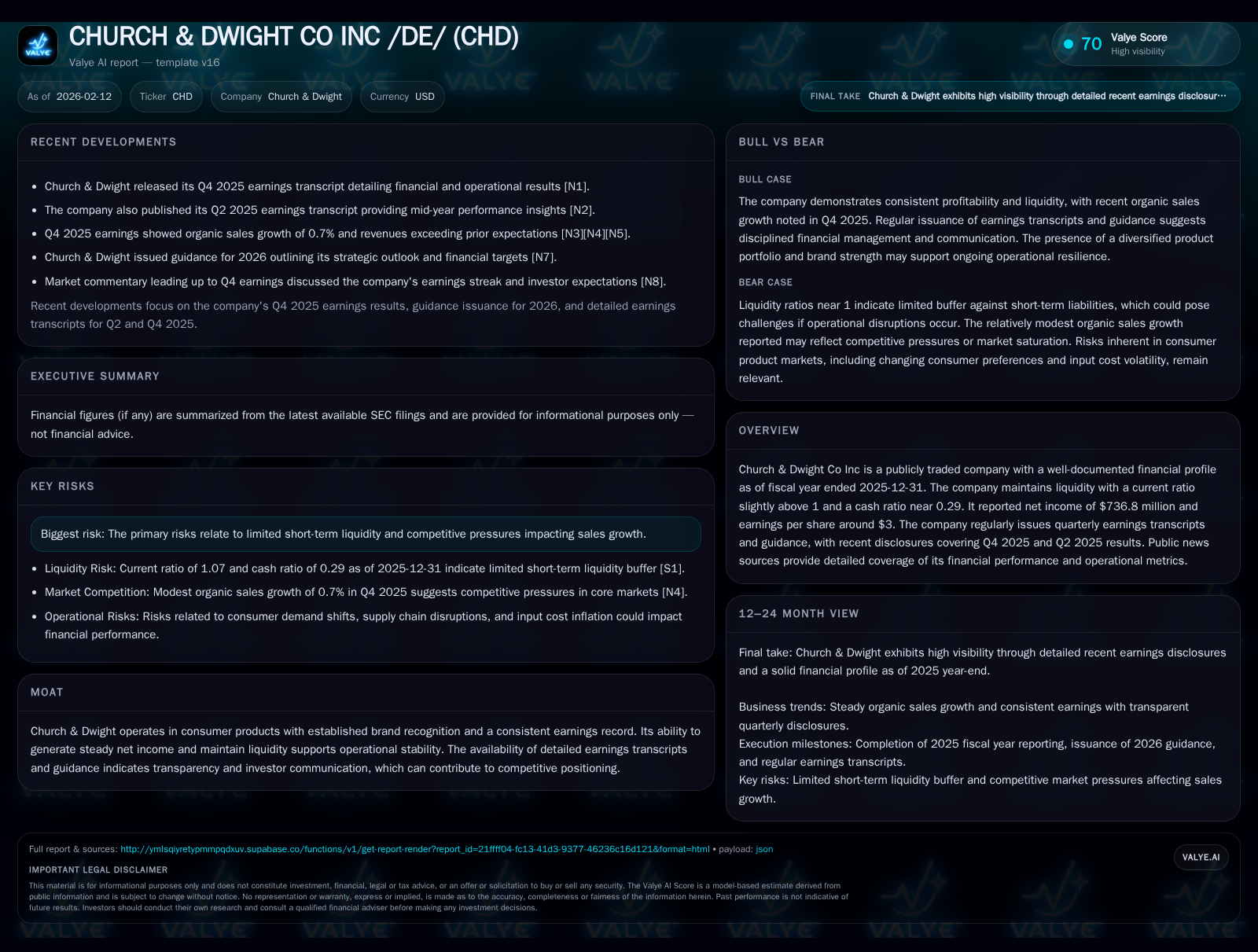
Church & Dwight demonstrated steady financial performance in 2025, reporting net income of $736.8 million and an EPS around $3, supported by a current ratio slightly above one. Despite modest organic sales growth and competitive pressures from larger consumer product firms, the company’s transparent communication and cautious liquidity management underpin its operational stability. Ongoing risks include limited short-term liquidity flexibility and intensifying sector competition, but management’s guidance for 2026 aims to balance caution with continued momentum. Overall, Church & Dwight’s established brand portfolio and consistency position it solidly within a challenging consumer products landscape.
Steady Wins the Race: Church & Dwight’s Financial Pulse in 2025
Church & Dwight closed out fiscal year 2025 with robust indicators of financial health that underline a narrative of stability in an otherwise turbulent consumer products environment. Clocking a net income of $736.8 million and delivering earnings per share hovering around $3, the company anchored its year on steady earnings that reflect disciplined execution and resilient demand for its brands [F1][S1]. The near parity between current assets ($1.597 billion) and liabilities ($1.498 billion) results in a current ratio barely over 1.0 (1.07), revealing tight but positive liquidity cushioning day-to-day operations without signaling distress [F1][S1]. This foundational steadiness sets the stage for assessing how Church & Dwight continues to navigate pressures both internal and external.
Digging Deeper: What Drives Church & Dwight’s Earnings Consistency?
Behind the numbers lies an operational mosaic where established brand equity meets nimble cost management. Organic sales posted a modest increase of 0.7% during Q4 2025, echoing commentary from recent earnings transcripts that emphasize sustained consumer loyalty alongside selective innovation efforts aimed at refreshing key product lines [N4][N1][S1]. Management’s open articulation across multiple quarterly calls highlights priorities such as optimizing supply chains and focused marketing spend—steps intended to buttress margins while driving incremental volume gains [N2]. These threads reveal how the company leverages its portfolio breadth, cutting across household staples known for trustworthiness amid evolving shopper preferences.
Liquidity Examined: Balancing Current Assets and Liabilities
Drilling into Church & Dwight’s liquidity reveals a picture of cautious stewardship reflective of its conservative posture amid sector headwinds. Holding $409 million in cash and equivalents supports operational flexibility yet must be balanced against nearly $1.5 billion owed in current liabilities—a tight alignment that signals vigilance rather than excess runway [F1][S1]. The current ratio near unity suggests limited buffer for unexpected shocks but also indicates effective working capital management designed to avoid overstretching commitments [F1]. This delicate balance is crucial considering ambient pressures such as inflationary cost inputs, underscoring why liquidity metrics warrant close tracking moving forward.
Market Moves: Recent Earnings Surprises and Analyst Upgrades
The quarter-to-quarter narrative reinforces Church & Dwight’s ability to outperform expectations consistently. Q4 2025 earnings not only beat consensus forecasts but did so with sufficient margin to prompt notable analyst upgrades; JPMorgan raised coverage citing improved margin outlooks and resilient top-line drivers as key factors propelling bullish reassessment [N3][N5][N10]. Market reactions have been largely favorable, with the stock breaking above technical benchmarks like the 200-day moving average—an indicator often associated with positive momentum in equity trading circles [N13]. Such developments underscore confidence in execution despite moderate growth rates.
Competitive Landscape: Navigating Pressure in Consumer Products
However, no assessment would be complete without placing Church & Dwight within the broader competitive milieu dominated by giants including Procter & Gamble. Industry observers note increasing pressure stemming from these larger peers’ scale advantages and productivity initiatives amid inflationary environments—factors that test smaller rivals’ agility and pricing power simultaneously [N9][N14]. Church & Dwight faces the challenging task of differentiating its offerings while managing input costs carefully to preserve profitability. The sector-wide debate on whether gains from productivity can offset inflation-driven margin erosion adds context to evaluating future sales trajectories.
Strategic Transparency: Communication and Investor Confidence
One of Church & Dwight’s standout attributes is its commitment to transparency through frequent detailed disclosures. The cadence of quarterly earnings transcripts and accompanying guidance provides investors continual insight into operational realities rather than episodic snapshots alone [N1][N2][N6]. This practice bolsters confidence by openly addressing challenges such as competitive headwinds or supply chain complexities while outlining management’s response framework. In turn, this communication quality contributes meaningfully to maintaining credibility in markets prone to volatility.
Risk Outlook: Short-term Challenges and Their Implications
Despite strengths, risks remain tangible. SEC filings highlight limited short-term liquidity as a vulnerability given the current ratio’s slim margin and ongoing obligations that may constrain discretionary spending or acquisition capacity in adverse conditions [S2]. Competitive pressures also loom large—persistent discounting battles or shifts in consumer behavior could weigh on organic growth potential in ensuing quarters[ valye_report_excerpt ]. Weighing these factors illustrates a measured risk environment where steady fundamentals coexist with vulnerabilities requiring active mitigation.
What Lies Ahead: Guidance and Investor Sentiment for 2026
Looking forward, Church & Dwight issued guidance signaling tempered optimism despite prevailing uncertainties. Management forecasts modest revenue growth supported by steady cost control, yet emphasizes vigilance against macroeconomic fluctuations impacting consumer spending patterns or inflation trajectories [N6][N7][N8]. Investor sentiment appears cautiously constructive as technical chart patterns couple with positive earnings surprises to sustain momentum while acknowledging headwinds may limit upside acceleration.
Final Considerations: Assessing Long-term Moat and Valuation
Synthesizing these threads reveals Church & Dwight as a company characterized by durable brand strength, consistent profitability, and pragmatic financial management that collectively form its economic moat[ valye_report_excerpt ]. While conservative liquidity ratios temper exuberance, they also signal prudent stewardship conducive to sustainable operations amidst sector volatility[F1][S1]. Competitive pressures necessitate ongoing innovation and efficiency improvements but do not overshadow the company’s core narrative—a steady performer with transparent governance maintaining relevance in a crowded marketplace.
This analysis is based on publicly available data as of early 2026 from SEC filings, quarterly earning transcripts, industry reports, and news sources cited herein. It does not constitute investment advice or recommendations.
Disclaimer: This is research-only, informational analysis and not investment advice. It may include AI-generated interpretation and general industry context. Always verify important details using primary sources.

Comments