
Advanced Biomed Inc.: Integrating Semiconductor Precision with Biotech Innovation in Early Cancer Detection
Advanced Biomed combines microfluidic semiconductor technology and biotechnology for novel cancer diagnostics amid early commercialization challenges.
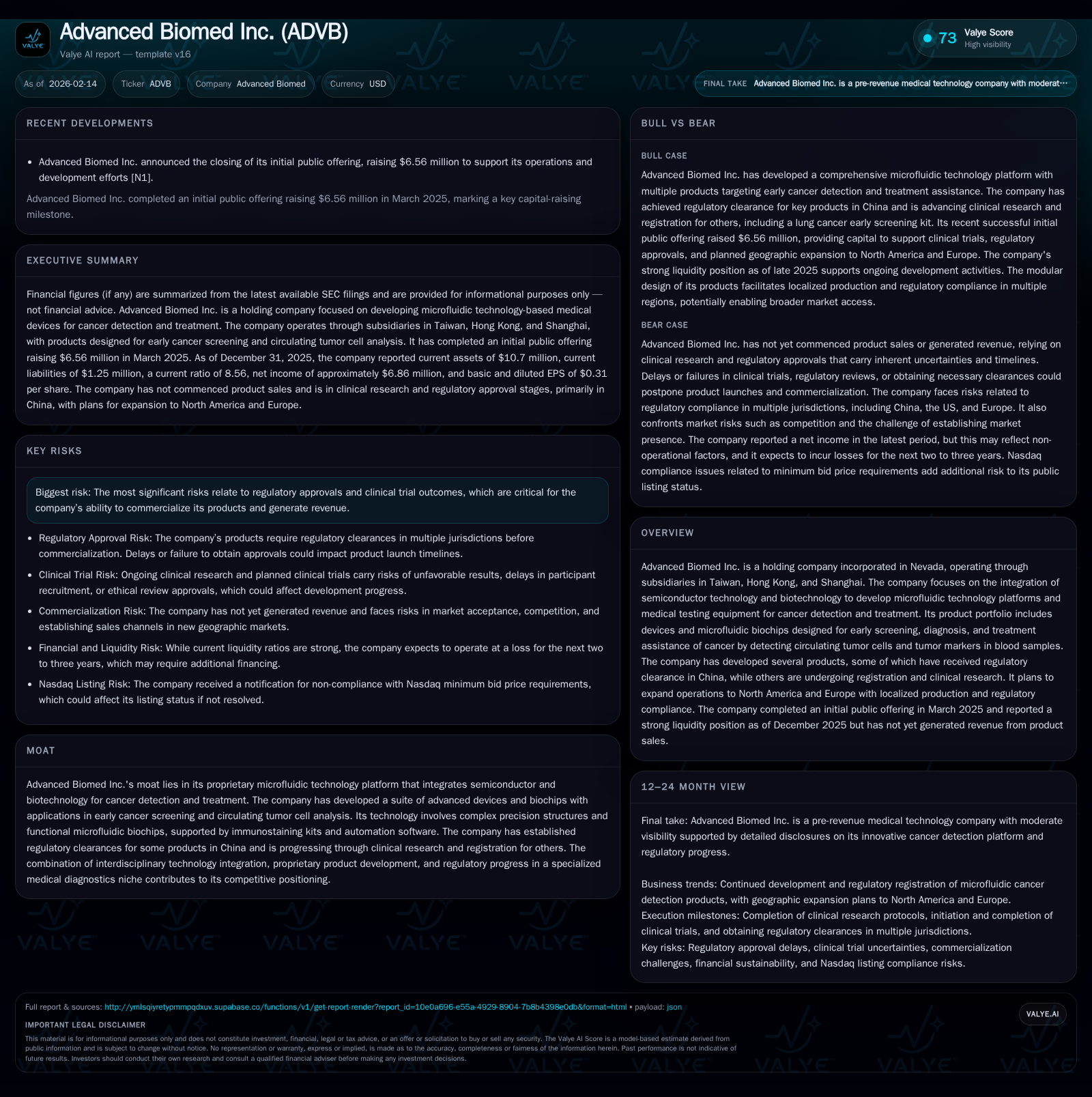
Advanced Biomed Inc. stands at a unique intersection of semiconductor and biotechnology innovation, developing proprietary microfluidic platforms enabling early cancer detection through circulating tumor cell analysis. With operations anchored in Asia and aspirations for Western market expansion, the company’s portfolio includes multiple specialized devices and biochips at various regulatory stages. Despite demonstrating positive initial financial metrics post-IPO, commercialization remains nascent and execution risks tied to regulatory approvals and clinical validations are pronounced.
Fusion at the Frontier: Semiconductor Meets Biotechnology
Advanced Biomed Inc. represents a pioneering fusion of semiconductor technologies with biotechnology applied toward oncology diagnostics [valye_report_excerpt][S1 Item 1 Business]. Founded in 2014, it has developed sophisticated microfluidic platforms that physically harness semiconductor precision engineering techniques alongside molecular biological methods to detect circulating tumor cells (CTCs) and tumor markers in blood. This interdisciplinary approach transcends traditional diagnostic methodologies by integrating complex precision structures such as dielectric sensors embedded within microfluidic biochips, supported by immunostaining kits and automated analytical software.
This combined technological blend creates a distinctive value proposition: precise capture, isolation, sorting, and molecular characterization of rare cancer cells in blood — a critical step toward enabling early detection, accurate staging, and treatment personalization. Such fine-grained resolution at the cellular level is challenging to achieve by biotech or semiconductor fields alone; Advanced Biomed’s platform thus positions itself strongly as an innovative bridge between complementary domains [valye_report_excerpt].
Charting the Product Arsenal: From Microfluidic Chips to Organoid Cultures
At the heart of ADVB's product ecosystem lies a series of integrated devices accompanied by corresponding microfluidic biochips tailored to specific diagnostic functions [valye_report_excerpt][S1 Item 1 Business]. The A+ Pre device conditions blood samples by lowering viscosity to enhance downstream processing efficiency. Following this, the AC-1000 enriches CTCs and targeted tumor cells extracted from the blood. The A+ CellScan facilitates fluorescent labeling alongside automated scanning for cell identification, while A+ SCDrop preserves single-cell viability essential for further analyses.
A recent innovation—the A+ PerfusC™ system—advances beyond single-cell analysis into functional three-dimensional cell culture. This compact incubator replicates human physiological conditions allowing formation of tumor spheroids or organoids over extended periods with minimized contamination risk. Its perfusion-based design sustains nutrient delivery uniformly while preventing waste buildup; these features collectively enhance viability and drug response predictability of cultured samples.
Further complementing hardware are four immunostaining kits — A + CTCE, A + CTCM, A + EMT, A + CM — which employ fluorescently tagged antibodies binding specific protein targets on/in CTCs. Observation of fluorescent intensity under microscopy yields insights into biomarker expression pertinent to diagnosis or prognosis. Some devices possess regulatory clearances in China; others remain under clinical evaluation or registration processes necessary before broader commercial deployment.
Collectively, these offerings span critical points along the diagnostic workflow—from initial sample preparation through single-cell characterization to advanced culture systems enabling preclinical research applications—an approach reflecting deeper understanding of oncological workflows.
Bridging East and West: Operational Footprint and Market Ambitions
Advanced Biomed’s corporate structure extends across geopolitical hubs pivotal to its strategic roadmap [valye_report_excerpt][S1 Item 1 Business]. Taiwan headquarters spearheads R&D and primary technology development. Hong Kong subsidiary focuses on localized manufacturing aligned with Chinese regulatory requisites alongside market operations there. Shanghai unit owns key patents/equipment dedicated chiefly to conducting clinical trials via contract research organizations (CROs) within Mainland China.
China’s approval landscape is central to near-term revenue generation due to established clearances on select products; however, translating success beyond East Asia requires adept navigation of contrasting regulatory frameworks as ADVB targets North American and European expansions. This scaling demands not only local production facilities but also fresh regulatory submissions evidencing product safety and efficacy under foreign authorities.
Such international ambitions inherently elevate operational complexity: supply chain logistics must synchronize with divergent quality standards; marketing strategies require cultural adaptation; legal compliance entails continuous monitoring of shifting policies. Consequently, while geographic diversification potentially buffers regional risk concentration—it also exposes ADVB to incremental challenges incompatible with its relatively limited operating history.
Financial Snapshot: Navigating Early Commercialization Metrics
Though Advanced Biomed remains firmly at startup-stage commercialization without mature product sales [S1 Risk Factors], its financial indicators as of year-end 2025 convey promising liquidity and modest profitability [F1]. The reported net income stood at approximately $6.86 million USD with current assets around $10.7 million versus liabilities near $1.25 million—translating into a robust current ratio over 8x signaling strong short-term solvency.
This financial positioning supports ongoing R&D efforts while cushioning operational expenses typical in an early stage medtech enterprise. Nonetheless, lack of established revenue streams imposes uncertainty on extrapolations about sustainable earnings power or expansion funding availability absent external capital infusions or successful product commercialization.
Investors must weigh these solid figures against inherent unpredictability tied to nascent markets wherein adoption velocity depends substantially on cumulative regulatory achievements and customer acceptance dynamics.
Regulatory Gauntlets and Clinical Trial Hurdles
Regulatory approval pathways constitute one of Advanced Biomed’s most consequential risk vectors [S1 Risk Factors]. The company acknowledges delays or failures within clinical validation or registration processes could materially disrupt timelines for market entry or limit geographic availability.
The dependence on third-party entities—including CROs managing clinical protocols—adds layers of execution risk especially if data integrity or adherence falters. Unanticipated demands for additional trials or extensions compound time-to-market complications. Moreover, evolving regulatory requirements necessitate vigilant adaptability lest compliance gaps invalidate progress made.
Given oncology diagnostics’ high safety standards and the intricate technical nature of ADVB’s integrated devices plus biochemistry kits, negotiating these gauntlets calls for robust internal expertise complemented by strategic partnerships with regulators.
Competitive Terrain: Moat Strength and Technological Challenges
ADVB’s competitive advantage fundamentally derives from the complex union of semiconductor fabrication techniques with biotechnological insight resulting in proprietary microfluidic platforms difficult for competitors to replicate quickly [valye_report_excerpt]. The integration encompasses functional biochips embedded with precise dielectric sensors combined with software automation enhancing throughput and accuracy.
This multidisciplinary complexity crafts barriers against new entrants emphasizing either biotech assays lacking hardware sophistication or semiconductor firms devoid of biological domain expertise. However, rapid advancements in both fields dictate relentless innovation cycles lest rivals erode privileged positioning through alternative emerging technologies or more agile development approaches.
Consequently maintaining moat requires sustained investment in R&D coupled with proactive patent protections alongside continuous validation through clinical partnerships.
Leadership in Uncharted Waters: Management and Talent Imperatives
The advanced technical demands spanning microfluidic engineering, immunochemistry, software automation, plus clinical research impose significant pressures on recruitment strategies [S1 Risk Factors]. Attracting highly specialized research scientists, engineers adept in semiconductor-biotech convergence, experienced regulatory affairs professionals, as well as quality assurance personnel remains critical for advancing milestones efficiently.
Talent acquisition is compounded by competition from established medtech firms offering greater stability or resources. Inadequate staffing risks delaying product development cycles or compromising quality controls vital for regulatory submissions.
Leadership effectiveness will be reflected not only in technical accomplishments but also organizational capacity-building—fostering knowledge transfer internally while leveraging external collaborators judiciously.
Investor Crossroads: Interpreting Risks and Growth Trajectories
For stakeholders evaluating Advanced Biomed's trajectory, enthusiasm about transformative potential aligns uneasily with stark early-stage uncertainties [S1 Risk Factors][valye_report_excerpt][F1]. The company embodies cutting-edge interdisciplinarity promising meaningful improvements in cancer diagnostic sensitivity through microfluidic precision integrated with biological specificity.
Yet execution risks hover large—regulatory delays could stall revenue recognition; clinical outcomes may necessitate program adjustments; scaling international operations introduces new complexity layers; competition relentlessly evolves technology frontiers. Initial financial strengths underscore operational prudence but cannot yet confirm sustainable profitability absent expanded commercial traction.
Ultimately ADVB’s story remains unfolding — a blend of scientific promise entwined with classical startup volatility demanding patient appraisal grounded equally in technical merit appreciation alongside rigorous risk scrutiny.
This report synthesizes publicly available information as of February 2026 without forward-looking investment recommendations. Readers should consider all business risks carefully before forming conclusions.
Disclaimer: This is research-only, informational analysis and not investment advice. It may include AI-generated interpretation and general industry context. Always verify important details using primary sources.

Comments