
Advance Auto Parts’ Transformative Restructuring Amid Macroeconomic Challenges
Analyzing how Advance Auto Parts navigated a pivotal reshaping of its business to emerge with improved earnings despite revenue pressures.
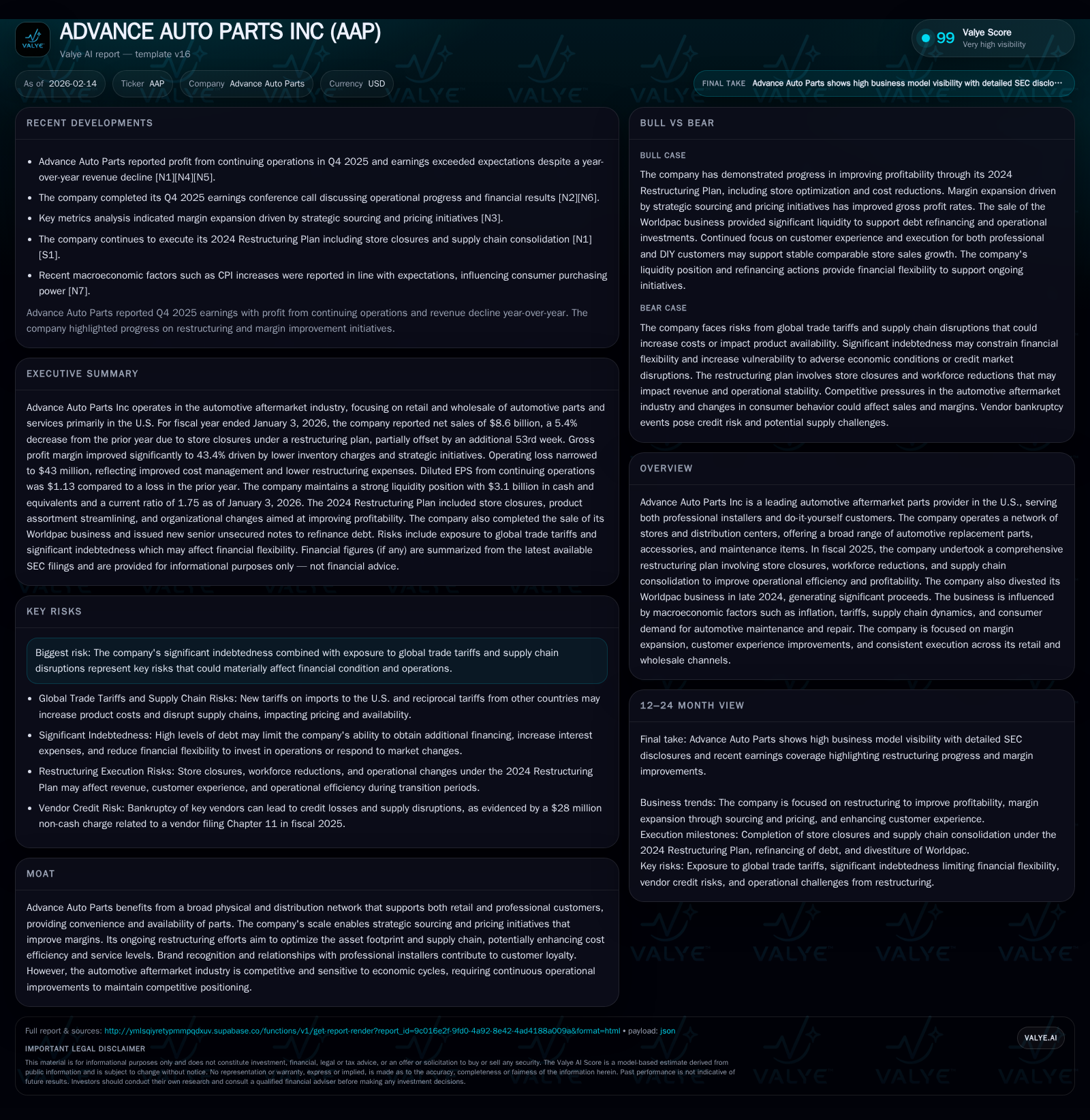
Advance Auto Parts executed a significant restructuring plan across 2024-25 involving store closures, supply chain consolidation, and workforce adjustments, which laid a foundation for margin expansion and operational efficiency. Despite a 5.4% revenue decline driven largely by the closure of stores, the company posted strong earnings gains and turned to profitability in fiscal 2025 supported by improved gross margins and lower restructuring charges. Advances in vendor management, distribution network optimization, and strategic divestitures like the Worldpac sale have bolstered liquidity but high leverage and exposure to global trade uncertainties remain notable risks. Macro factors including inflation, tariffs, and cyclical consumer demand continue to shape the outlook as management prioritizes execution discipline and asset productivity enhancements.
Navigating Restructuring: The Blueprint for Renewal
Advance Auto Parts executed a decisive restructuring plan in fiscal years 2024-25 aimed at reshaping its asset footprint and streamlining operations amid challenging market conditions [S1]. This multi-faceted program incorporated closing underperforming stores, consolidating distribution centers into more efficient market hubs, reducing workforce levels, and streamlining supply chain logistics.
The company recognized impairment charges on inventory totaling $18 million as part of restructuring-related writedowns during fiscal 2025 compared with $256 million in the prior year also linked to the restructuring plan [S1]. This stark difference signals progress toward stabilizing inventory quality after years of excess stock associated with the store closures. The amortization of right-of-use assets linked to operating leases also factored into restructuring expenses but was lower than prior periods.
Management emphasized the rationale behind optimizing the store base: removing locations that dilute overall margin performance while repositioning the network toward higher productivity outlets improves service levels for customers and creates economies of scale within logistics [S1]. The completed consolidation efforts support faster replenishment cycles and reduced transportation complexity.
Importantly, these moves reduce ongoing cash outflows related to maintaining an oversized footprint burdened with outdated inventory and overlapping facilities. While acknowledged as painful—involving severance costs and exit fees—the restructuring is foundational for sustainable margin expansion moving forward.
Financials in Focus: Earnings Strength vs. Revenue Pressure
Fiscal 2025 revealed a nuanced financial picture at Advance Auto Parts. Despite net sales falling 5.4% to approximately $8.6 billion—primarily attributable to closed stores—the company delivered significantly improved profitability [N1][S1][F1]. Comparable store sales edged up slightly by 0.8%, suggesting stabilized underlying demand among remaining locations.
Gross profit margin soared by nearly six percentage points year-over-year to about 43.4%, driven chiefly by a sharp reduction in inventory charges that had dragged margins heavily in fiscal 2024 [S1]. This margin improvement offset much of the top-line weakness.
Operating losses narrowed dramatically from over $700 million negative territory in 2024 down to just $43 million loss in 2025—a swing reflective of lower restructuring costs alongside better operating leverage [S1]. Cash flows used in operating activities from continuing operations reversed some of the prior year's drag but still recorded an outflow around $46 million due partly to payables reductions connected with restructuring payments [S1].
Net income swung from a loss of $9.80 per diluted share in fiscal 2024 into positive territory earning $1.13 per share during fiscal 2025 [F1], partly aided by an additional calendar week (53 weeks vs 52 weeks) during the latest fiscal period which marginally boosted sales volumes [S1][N3].
This juxtaposition—improved bottom-line health amid declining revenues—illustrates how operational efficiencies coupled with disciplined cost management can restore profitability even under revenue headwinds.
Leveraging Scale: Distribution Network and Vendor Dynamics
Advance Auto Parts’ extensive network of stores complemented by strategically positioned distribution centers underpins its ability to serve both automotive professionals and do-it-yourself (DIY) consumers effectively [S1]. Converting certain distribution facilities into market hubs enhances parts availability while optimizing transportation routes fosters cost efficiencies in delivery.
Vendor relationships play an essential role in managing cost structures through volume rebates and promotional incentives accounted for primarily as reductions against inventory costs until product sale [S1]. However, challenges arose when a key vendor—an industry-leading supplier—filed for Chapter 11 bankruptcy protection during the third quarter of fiscal 2025 [S1]. This resulted in a non-cash charge of $28 million reflecting anticipated credit losses on vendor receivables.
Despite this setback, management indicated that historical reserves for vendor funding have been stable overall. Nonetheless, this episode highlights inherent risks tied to supplier financial health within aftermarket sourcing chains where concentration or disruption could influence product flow or pricing dynamics.
Such complexities necessitate constant vigilance over vendor credit exposure and ability to diversify supply sources where feasible without sacrificing scale benefits gained via consolidated procurement practices.
The Debt Cloud: Managing Leverage Amid Trade Uncertainty
A material consideration underlying Advance Auto Parts’ financial profile is its substantial indebtedness which exposes the company both operationally and financially to risk amid volatile macroeconomic backdrops [S2]. During fiscal 2025, Advance issued approximately $1.95 billion in senior unsecured notes while redeeming previously maturing notes near term deadlines—a strategic move designed to extend debt maturities and manage refinancing risk more prudently [S1].
Concomitantly, it transitioned from its historic revolving credit agreement into a new asset-based loan (ABL) revolving facility reflecting changing financing structures better aligned with asset-light inventories post-restructuring [S1].
Trade policy uncertainty compounds leverage concerns given tariffs enacted on imports from countries such as Canada, China, and Mexico—sources significant portions of company merchandise—leading to potential cost inflation or supply disruptions [S2]. Reciprocal tariffs imposed internationally further cloud pricing predictability.
Indebtedness restricts liquidity flexibility limiting discretionary capital deployment towards growth initiatives or cushioning economic downturns; servicing debt obligations consumes cash flow that might otherwise fund operational agility improvements or reinvestment projects [S2]. Ongoing diligence is warranted as management balances debt load against investing capacity.
Macro Crosscurrents: Inflation, Tariffs, and Consumer Behavior
External economic forces notably influence Advance Auto Parts’ business trajectory. Recent consumer price index (CPI) reports showed inflation rising roughly in line with expectations supporting continued pricing pressure throughout retail sectors including automotive parts [N11][N12].
Inflationary impacts elevate replacement part input costs while potentially dampening discretionary spend among do-it-yourself customers who weigh repair versus replacement alternatives based on budgeting constraints.
Tariff changes add further layers of unpredictability; shifts proposed or implemented within U.S.-trade policy reshape cost structures incrementally or abruptly depending on duration or scope particular products endure import levies [S2]. These dynamics ripple through sourcing decisions thereby affecting margins if cost increases cannot be fully passed on.
Moreover consumer maintenance demands remain cyclical influenced by vehicle age profiles but also sensitive to overall economic confidence creating complexity forecasting throughput volumes [S2][N7]. Crucially Advance’s ability to navigate these external headwinds hinges on nimble pricing strategies coupled with marketing innovation tailored distinctly across customer segments.
Customer Segments and Competitive Moats: Pros and DIY Insights
Advance Auto Parts distinctly serves two main customer cohorts: professional installers whose repeat business depends on rapid availability plus technical support; alongside do-it-yourself consumers seeking convenience combined with competitive pricing [S1]. This dual approach leverages scale advantages uniquely across channels fostering brand loyalty especially among professional users reliant on consistent quality parts supply backed by knowledgeable service teams.
Strategic initiatives target enhancing frontline customer experiences fueled by store employees empowered through technology upgrades delivering seamless transaction flows reimbursing varied promotional programs efficiently [S1]. Scale allows volume-driven pricing benefits enabling margin resilience even when individual SKU pricing wrestles with external inflationary inputs.
Yet competitive pressures remain intense within the automotive aftermarket industry characterized by large national chains alongside regional independents plus growing e-commerce penetration necessitating continuous investment into omnichannel customer engagement platforms ensuring relevance across all touchpoints.
Inventory Reserves and Risk Management: What the Latest Data Reveal
Restructuring impacted not only fixed assets but significantly improved inventory risk posture at Advance Auto Parts evidenced by excess and obsolete inventory reserves declining dramatically from over $300 million at end-2024 down to approximately $68 million at start-2026 representing about four-fifths reduction post-restructuring writedowns [S1].
These reserves incorporate granular SKU-level analyses factoring product life cycle stage segmentation—from introduction through disposition phases—and anticipated customer demand changes aiming for tight alignment preventing costly overstocks eroding gross margin prematurely.
Self-insurance reserves also increased moderately reflecting cautious actuarial assumptions linked primarily to liability claims exposures including automobile liability/workers' compensation totaling approximately $156 million at start-2026 versus prior year levels at around $141 million—this variability influences reported operating expenses related partly also to restructuring workforce reductions impacts [S1].
This disciplined approach toward inventory plus reserve calibration supports margin durability by minimizing unexpected write-downs while prudently covering future claim liabilities aligned with historical trends.
Strategic Divestitures: Long-Term Impact of Worldpac Sale
In late fiscal year 2024, Advance Auto Parts divested its Worldpac business—a wholesale distributor focusing on international aftermarket parts—with proceeds described as significant offering important liquidity enhancement allowing deleveraging focus towards core competencies within North American retail aftermarket segments [N14][S1].
Following customary working capital adjustments finalized early January 2026 clarified net balance sheet positioning freeing up capital allocated previously across non-core operations.[S1]
This divestiture aligns with strategic intent emphasizing simplification around domestic asset footprint optimization coupled with enhanced capital returns targeting operational improvements rather than diversification strategies that could distract managerial attention or dilute investment dollars needed elsewhere.
Outlook & Execution Risks: Gauging Resilience in a Cyclical Market
Despite tangible progress underpinning material reduction in restructuring expenses alongside return-to-profitability fundamentals achieved during fiscal 2025, uncertainties remain over several dimensions that could temper forward momentum.[S1][N7]
Management identified "significant uncertainty" surrounding product costs exposed via tariff evolutions weighing variably on gross margins plus unpredictable shifts within consumer maintenance behaviors dependent heavily on broader economic health impacting repair frequency/patterns.[S2]
Leverage levels constrain capacity providing cushion against unexpected demand shocks restricting rapid strategic pivots requiring capital.[S2]
Operational execution consistency will be critical maintaining gains realized thus far particularly concerning asset productivity improvements spanning stores owned directly plus independent retail partners (Carquest Independents) where alignment incentives guard against service level variability.[S1]
Given cyclicality intrinsic within automotive aftermarket spaces compounded lately by macro trade-policy uncertainty plus input inflationary pressures managing these variables demands vigilant cost control mechanisms layered atop a renewed customer-centric strategy ensuring competitive differentiation endures beyond transient turnaround achievements.
In summary, one discerns Advance Auto Parts navigating a transformative phase marked by difficult but necessary structural adjustments yielding healthier earnings profiles despite short-term revenue declines weighed down largely by deliberate contraction moves. How management sustains this trajectory amid persistent external headwinds defines execution challenges ahead requiring balanced optimism informed by pragmatic caution given unresolved leverage constraints coupled with evolving trade policies shaping industry economics uniquely today.
This analysis is for informational purposes only and does not constitute investment advice or recommendations regarding any securities mentioned.
Disclaimer: This is research-only, informational analysis and not investment advice. It may include AI-generated interpretation and general industry context. Always verify important details using primary sources.

Comments