
Decoding Mercer Bancorp’s Financial Transparency Puzzle Amid Sparse Disclosure
An investigative deep dive into Mercer Bancorp, Inc.'s limited public filings reveals the challenges and considerations surrounding investment insight in opaque companies.
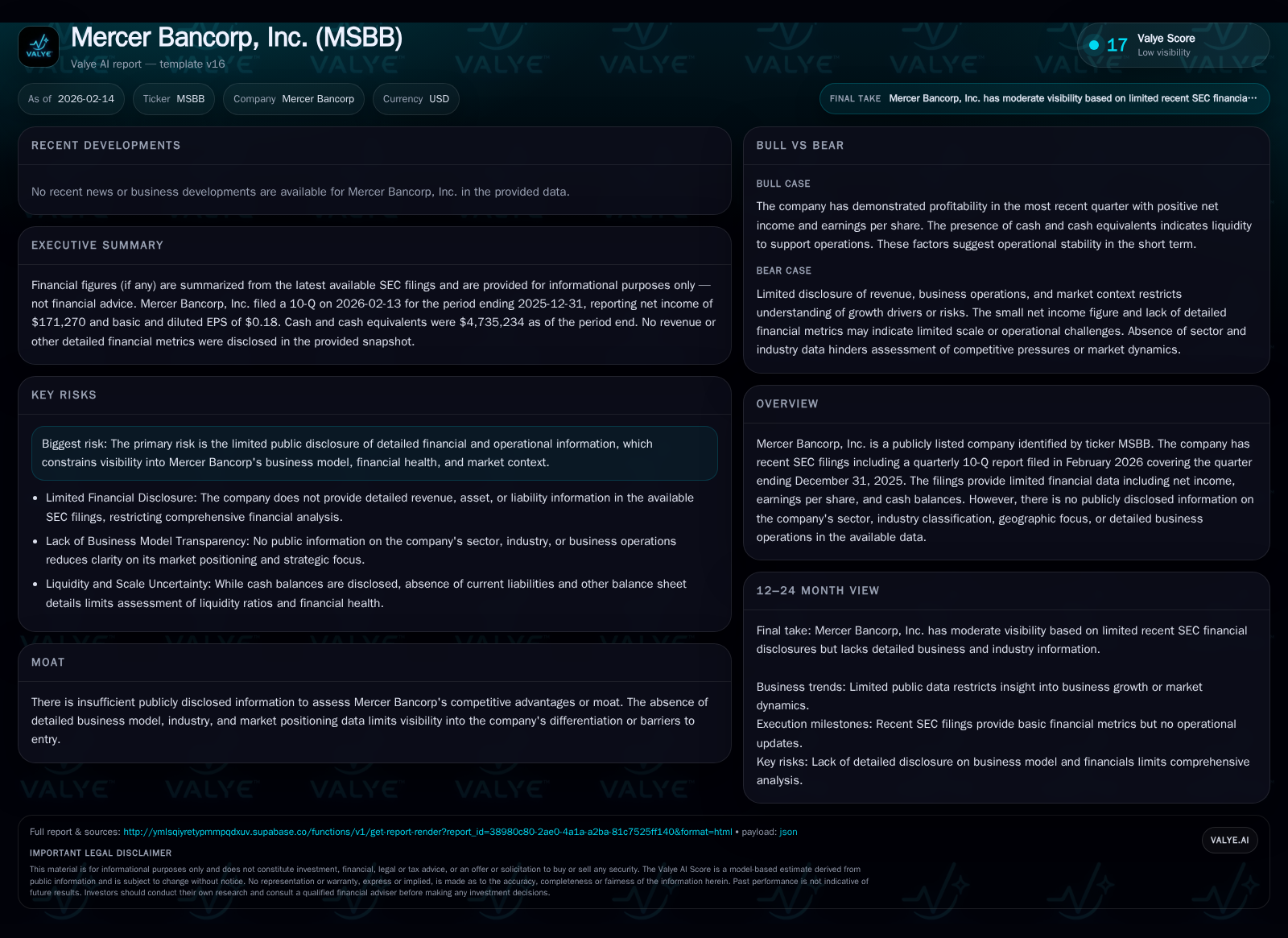
Mercer Bancorp, Inc. (MSBB) stands out for its unusually sparse public disclosure, limiting insight into its business model, sector, and competitive positioning. Analysis of available SEC filings shows modest profitability and solid cash reserves but offers little context on operational dynamics or strategic direction. This opacity imposes meaningful risks and challenges for valuation while leaving open questions about hidden opportunities.
Mercer Bancorp at a Glance: Piecing Together the Puzzle
Mercer Bancorp, Inc., trading under the ticker MSBB, presents a curious case in financial transparency. Despite being a publicly listed entity with recent regulatory submissions, including a quarterly 10-Q filing dated February 13, 2026 covering the period ended December 31, 2025 [S2], basic corporate profiling remains elusive. The company’s filings provide only rudimentary financial metrics without clarifying its sector, industry classification, or even geographical footprint [valye_report_excerpt]. This scarcity challenges analysts attempting to map the firm within broader market frameworks or to benchmark it against peers.
From a high-level perspective, Mercer Bancorp appears to be a single-segment entity per limited disclosures [S1], but what exactly that segment encompasses is left unstated. While many public companies offer narrative context and strategic commentary in their filings, Mercer’s documents omit such detail — forcing reliance solely on numeric data points floating in isolation.
Financial Health Under the Microscope: What the Numbers Reveal
Turning to the most concrete data available from SEC companyfacts [F1] tied to the Q1 2026 filing [S2], Mercer reported a net income of approximately $171,270 for the quarter ending December 31, 2025. In parallel, it holds cash and cash equivalents totaling about $4.7 million. These figures indicate some degree of operational profitability and liquidity buffer despite the company’s small scale relative to many bank holding firms.[F1]
Though net income is positive, its relatively modest level suggests Mercer operates on a smaller scale or with conservative risk appetite. The cash reserve might serve both as a cushion against liquidity shocks or as working capital supporting daily operations. However, without further breakdowns—such as loan portfolio quality, interest margins, or fee-based revenues—the nature of earnings remains opaque.
Furthermore, typical metrics that provide insight into asset quality or capital adequacy are either undisclosed or unavailable publicly. As such, while Mercer’s current earnings snapshot is not alarming per se, it lacks depth needed for robust financial health appraisal.
The Enigmatic Business Model: Navigating Information Gaps
The core difficulty in analyzing Mercer Bancorp lies in its reticence around describing its business operations. There are no explicit disclosures detailing whether it primarily functions as a community bank, commercial lender, specialty finance company, or a diversified financial services provider [valye_report_excerpt]. Similarly absent is any mention of geographic markets served—whether regional concentrations or broader outreach—which matters greatly for credit risk and growth trajectory evaluation.
This vacuum of explanatory content deprives stakeholders of understanding strategic priorities such as deposit gathering tactics, loan origination focus areas, or non-interest income sources among others. For buy-side analysts accustomed to layering qualitative insights atop quantitative data to build investment theses, this represents a formidable obstacle.
Consequently, external observers must acknowledge their perspective on Mercer starts with profound information asymmetry that can mask critical operational vulnerabilities or latent strengths alike.
Risk Exposures and Red Flags in Absence of Transparency
Notably, Mercer’s SEC filings do not flag glaring negative events such as material legal contingencies or adverse regulatory findings [S1][S2]. However, the very absence of detail itself constitutes an implicit risk factor. Without disclosure of potential commitments or contingent liabilities—which may exist but remain unreported—investors bear uncertainty regarding off-balance-sheet risks.[valye_report_excerpt]
Moreover, lack of clarity around loan portfolios or credit quality amplifies credit risk opacity intrinsic to banking entities. If Mercer holds problematic assets unreported in narrative or footnotes sections beyond what numbers reveal superficially, those could adversely impact capital adequacy going forward.
The inability to identify any sustainable competitive advantage through traditional moat analysis further heightens vulnerability since defensive barriers against competition appear unarticulated [valye_report_excerpt]. In sum, while no definitive red flags arise from disclosed data alone, prudent analysis recognizes “unknown unknowns” due to fragmented reporting.
Competitive Landscape and Moat Assessment: What We Don’t Know…and Why It Matters
Competitive moats in banking typically stem from depositor relationships, economies of scale, regulatory licenses, technology platforms, or local brand strength. With Mercer maintaining silence on all these fronts publicly [valye_report_excerpt], external moat evaluation becomes guesswork.
This gap undermines conventional valuation frameworks heavily reliant on assessing durable competitive advantages underpinning future cash flow visibility. For example, buy-side professionals generally discount stocks lacking visible barriers due to heightened risk of disintermediation and margin compression in commoditized banking services.
Absent clear differentiation signals from Mercer’s disclosures raises fundamental questions whether it can sustainably generate returns above cost of capital amid evolving financial landscapes marked by digitization and regulatory complexity.
Investor Implications: Managing Uncertainty in Valuation
For investors engaging with Mercer Bancorp securities under current circumstances, exercising caution is paramount given scarce information hindering comprehensive due diligence. The reported net income and cash balances hint at an operational baseline but do little to clarify growth potential or downside exposures.[F1]
Scenario planning becomes invaluable — estimating ranges based on macroeconomic conditions affecting small-scale banks generally while factoring unknown internal dynamics. Market participants might seek incremental updates or alternative intelligence (e.g., industry rumors, regulator communications) to supplement formal filings before confidence strengthens.
Importantly, any investment approach grounded purely in disclosed facts must include buffers for unresolved risks due to opaque disclosure practices documented by Valye News research.[valye_report_excerpt]
Looking Ahead: Opportunities Hidden in Plain Sight?
Despite current opacity constraining robust analysis, possibilities remain that Mercer Bancorp harbors under-the-radar opportunities dormant beneath surface-level filings. Potential catalysts could include strategic initiatives yet to be revealed publicly—such as targeted acquisitions expanding franchise reach—or operational efficiencies gradually enhancing profitability metrics.
Moreover, if future reporting transparency improves with fuller disclosures and narrative guidance accompanying numerical data upgrades investor visibility meaningfully—potentially attracting more informed capital inflows.[valye_report_excerpt]
Therefore careful monitoring of subsequent SEC submissions alongside any press releases is advisable for stakeholders intent on reassessing Mercer’s investment case dynamically as informational clarity evolves.
Disclaimer: This analysis is based exclusively on publicly available data and does not constitute investment advice nor an endorsement of Mercer Bancorp securities.
Disclaimer: This is research-only, informational analysis and not investment advice. It may include AI-generated interpretation and general industry context. Always verify important details using primary sources.

Comments