
Lear Corp’s Resilience Amid Earnings Beat and Liquidity Strength in Early 2026
Lear Corp defied profit pressures in Q4 2025 with an earnings beat, underpinned by solid liquidity and international revenue growth.
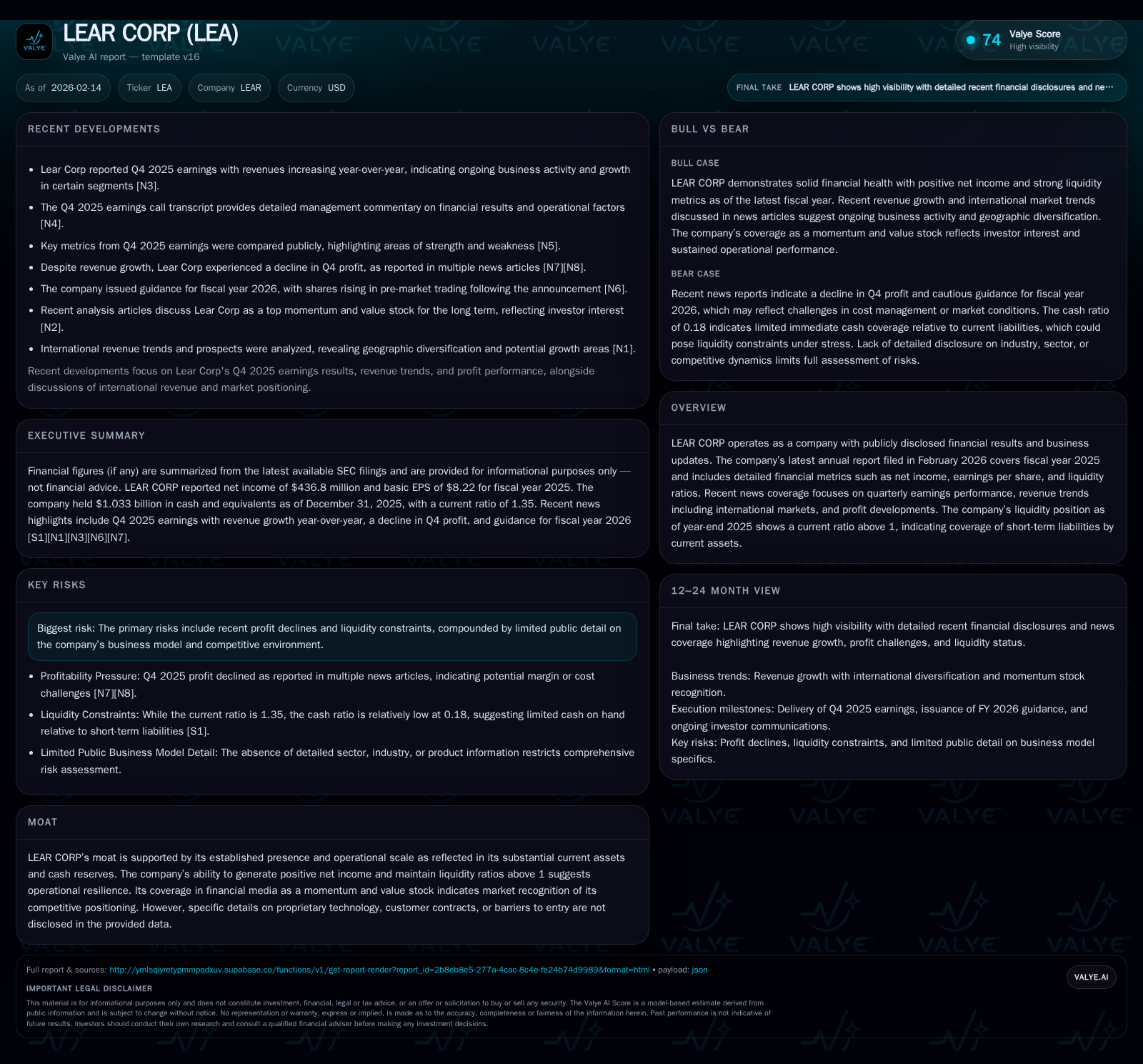
Lear Corp reported a surprising fourth-quarter earnings beat despite an overall decline in net income for fiscal 2025. The company's strong liquidity position, evidenced by a current ratio above 1 and substantial cash reserves, supports its operational stability amid profit margin pressures. International markets have contributed meaningfully to the company’s revenue growth, reinforcing diversified topline momentum. However, opaque disclosures around Lear’s competitive moat and mounting profit risks present challenges for fully assessing future sustainability.
A Closer Look at Lear’s Q4 Earnings Beat and Market Reaction
Lear Corp kicked off 2026 by reporting fourth-quarter results that surpassed consensus estimates, stimulating positive market response despite some contradictory signals within its earnings composition. According to news sources, revenues increased year-over-year while earnings per share exceeded Wall Street expectations [N1][N3]. However, total net income for the full fiscal year showed a decline compared to prior years [N4], illustrating a complex financial narrative.
Pre-market share activity revealed gains anchored largely on this earnings beat even as headline net income acknowledged ongoing pressures within margin profiles [N4]. This juxtaposition suggests that investors are cautiously optimistic about Lear's operational foundation but remain aware of uncertainties ahead. Analyst commentaries prior to the release had set moderately high bars for performance given sector-wide volatility [N8][N9], which Lear managed to surpass in headline metrics.
Such outcomes frame Lear as a company that can deliver surprises positively impacting sentiment despite macroeconomic headwinds affecting the automotive-related supply chain where it operates.
Understanding Lear’s Financial Foundations: Liquidity and Profitability Insights
Diving into the latest SEC filings reveals Lear’s financial underpinnings underpinning its resilience. For fiscal year-end 2025, the company reported net income of approximately $436.8 million—a figure that, while lower than some previous periods, still confirms profitable operations [F1].
Moreover, liquidity ratios reinforce stability: current assets stood at $7.66 billion against current liabilities of $5.67 billion, yielding a current ratio of roughly 1.35, comfortably above the critical threshold of 1 indicating effective coverage of short-term obligations [F1].
Cash and cash equivalents totaled $1.03 billion at year-end [F1], providing a significant buffer for operational needs or strategic flexibility such as investments or debt servicing.
This combination of profitability maintained at moderate levels alongside solid liquidity portrays Lear as financially sound despite downward pressures visible in margins and earnings level.
International Revenue Trends: Unlocking Growth Opportunities Abroad
Lear’s growth narrative increasingly highlights its expanding footprint in global markets as a key factor sustaining revenue momentum. Recent analyses emphasize robust sales growth outside domestic boundaries with particular strength noted across selected international regions [N12].
The diversification across geographies reduces dependence on any single market segment vulnerable to regional downturns or cyclical automotive trends. It also signals that management prioritizes globalization efforts to tap emerging demand patterns [N1], supporting ongoing top-line expansion despite mature market headwinds.
This international dimension complements core product offerings and provides incremental volumes contributing positively to overall company performance.
Moat and Competitive Positioning: What the Numbers Reveal — and What Remains Hidden
While Lear emerges publicly as both a momentum player and value stock reflective of strong financials, deeper moat specifics remain elusive in public disclosures. The company’s established scale evident from substantial assets and liquidity lends some defensive qualities against competitors [valye_report_excerpt].
However, there is scant detail on proprietary technologies, patent portfolios, exclusive supplier agreements, or deep customer tie-ins that typically underpin formidable barriers to entry.
This opacity creates challenges in fully understanding how sustainable Lear’s advantage might be over medium to longer time horizons. Investor recognition seems tied more to demonstrated financial consistency than transparent differentiated capabilities.
Risks on the Horizon: Navigating Profit Declines and Limited Business Disclosure
Several risk vectors surface upon close examination of Lear’s profile. Notably, recently reported profit declines introduce concern about cost inflation pressures or pricing power erosion [valye_report_excerpt]. This trend underscores potential margin squeeze issues that could intensify if macroeconomic or industry factors worsen.
Additionally, limited public information regarding the company’s business model specifics complicates external assessment of competitive dynamics or innovation trajectories that could counterbalance these risks.
Liquidity remains healthy now but cannot be taken for granted if adverse conditions persist or strategic missteps occur.
Valuation Perspectives: Why Market Views Lear as Both Momentum and Value Stock
Market narratives encapsulate dual investment theses for Lear. On one hand, it appeals to momentum investors due to recent beats and growth signals particularly tied to international expansion [N13]. On the other hand, its strong balance sheet and steady profitability attract value-oriented participants seeking fundamental stability at reasonable pricing [N14].
This hybrid positioning potentially broadens investor base but demands nuanced interpretation regarding which elements will drive future returns amid evolving sector cycles.
Investor Behavior Spotlight: Insider Trades Amid Share Price Surge
A noteworthy facet complementing fundamental analysis is insider trading activity — specifically the CFO’s sale of $591K in shares during a period where the stock price has appreciated roughly 30% over one year [N10].
While insider selling can reflect personal portfolio diversification rather than negative outlooks per se, it adds an emotional layer for market observers questioning executive confidence timing.
Contextualizing this within broader operational updates suggests tempered optimism balanced with prudent capital management by insiders.
Synthesizing Outlook: Management’s Guidance Versus Market Expectations
Management's forward-looking commentary during the Q4 earnings call presents guidance calibrated cautiously yet aligned with consensus analyst forecasts [N2][N4]. The outlook acknowledges profit headwinds but underscores focus on operational efficiencies and further international penetration.
This balanced messaging tempers investor enthusiasm with realism about ongoing challenges while highlighting levers available to support performance within FY26.
In sum, Lear Corp demonstrates noteworthy financial resilience bolstered by liquidity strength and international revenue diversification amid an environment marked by profit compression concerns and limited transparency on moat details. The recent Q4 earnings beat instills cautious market optimism though underlying risks warrant ongoing scrutiny. Insider behavior coupled with management guidance further illuminate a measured stance on future prospects without overstating near-term upside potential.
Disclaimer: This analysis is provided solely for informational purposes based on publicly available data as of February 2026. It does not constitute investment advice or recommendations.
Disclaimer: This is research-only, informational analysis and not investment advice. It may include AI-generated interpretation and general industry context. Always verify important details using primary sources.

Comments