
Navigating the Opaque Financial Landscape of Earth Science Tech, Inc.
An investigative review of ETST’s modest financial results and management signals amid limited disclosure.
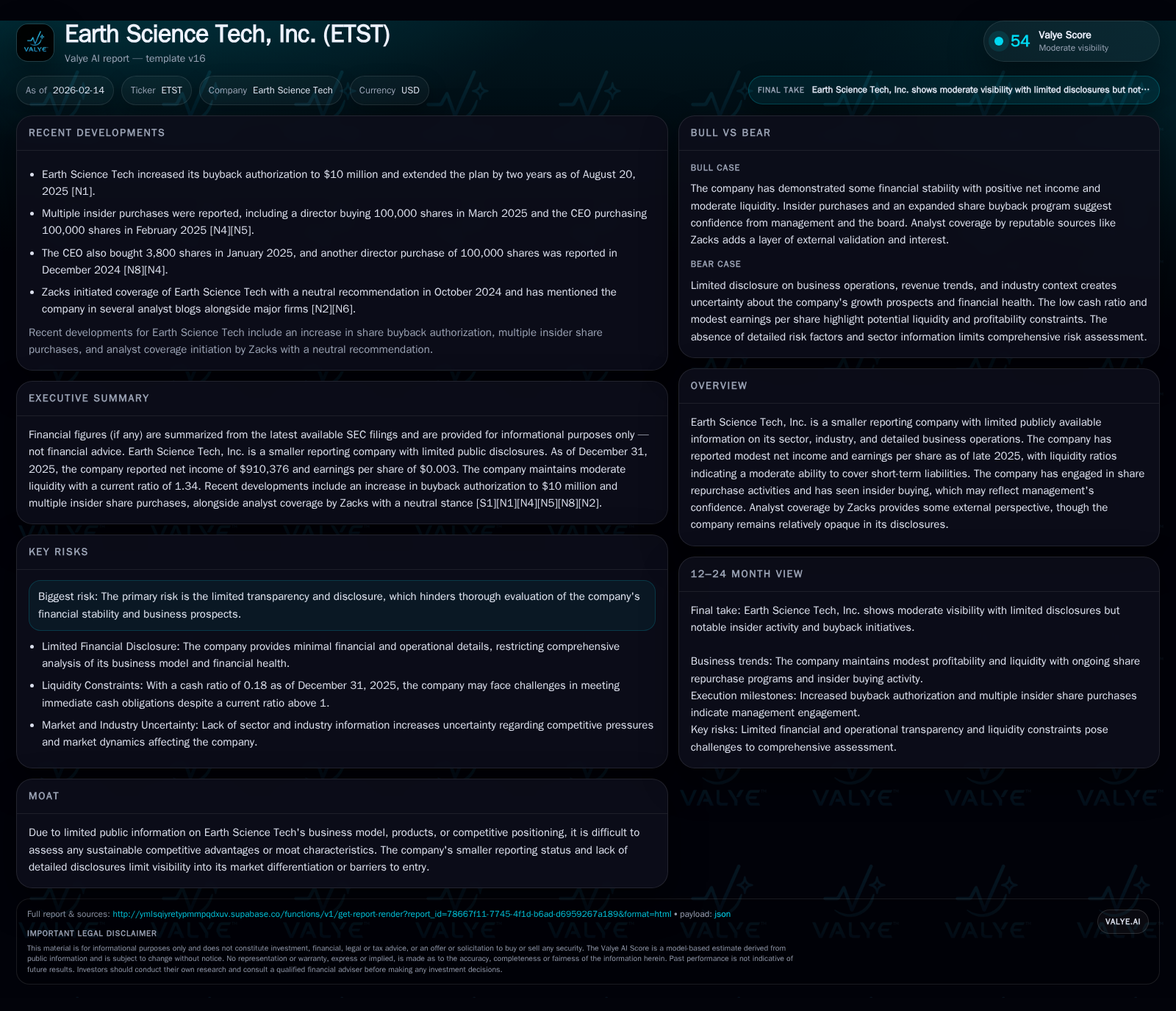
Earth Science Tech, Inc. presents a curious case of modest profitability and insider confidence amid sparse public information. Despite reporting a net income of approximately $910K in 2025 and engaging in share repurchase activities, the company’s small reporting status restricts transparency, complicating comprehensive financial assessment. Analyst insights remain limited, and the absence of detailed operational data leaves questions about its competitive positioning and growth prospects unanswered.
Unearthing Earth Science Tech’s Financial Snapshot
Earth Science Tech, Inc. (ETST) emerges as an intriguing entity within the small-cap universe, posting a reported net income of approximately $910,000 for the fiscal year ending December 31, 2025. This figure stands out against its most recent disclosed revenue number of roughly $203,000 dating back to 2018 — a considerable lag in public reporting that complicates straightforward trend analysis. Current assets total around $3.03 million juxtaposed with current liabilities near $2.26 million, culminating in a calculated current ratio of approximately 1.34. This suggests that at face value, ETST maintains moderate capacity to cover its short-term obligations. However, without detailed disclosures fleshing out asset quality or liability composition, these numbers offer only a skeletal financial portrait [F1][S2].
In essence, the snapshot reflects a modestly profitable entity operating under the veil of limited contemporary data. It invites deeper scrutiny into what underpins this profitability amid such scant top-line information.
Management Moves: Insider Buying and Share Repurchases as Confidence Signals
Unpacking management signals reveals notable insider buying coupled with share repurchase activity. These actions often serve as affirmative gestures by leadership—implicitly communicating confidence in intrinsic company value at prevailing market prices. For ETST, operating in relative obscurity from an information disclosure standpoint, these moves acquire heightened significance.
They suggest that despite the opacity that shrouds operational details and future outlook, insiders perceive upside or at minimum support for current valuations. Yet one must balance this optimism with caution: absent clearer visibility into business segments or growth engines, management’s incentives or timing motives remain uncertain [valye_report_excerpt].
Hence, while such moves are encouraging signals internally, they cannot substitute for transparent disclosure essential to investor due diligence.
The Visibility Gap: Challenges Posed by Limited Disclosure
ETST’s designation as a smaller reporting company affords it regulatory relief from several SEC mandated disclosure requirements under Rule 12b-2 of the Securities Exchange Act of 1934. While beneficial in reducing compliance burdens for ETST, this significantly restricts information flow to the market.
Investors and analysts face hurdles given that typical line-item granularity—from segment data and executive commentary to comprehensive risk factor discussion—is notably sparse or absent [S2]. This opacity hinders effective valuation modeling and risk assessment; it also limits comparability versus peers operating under full reporting standards.
The tradeoff between cost-efficient reporting and market transparency places ETST in a gray zone—where fundamental evaluation becomes more speculative due to lack of verifiable operational insights.
Revenue Trends and Profitability: Parsing the Numbers Behind the Curtain
With revenue figures publicly available only through FY2018 (~$203K), juxtaposed against a reported net income nearing $910K in FY2025, an apparent discrepancy warrants careful interpretation. On surface level, this suggests either a significant shift in business operations or accounting dynamics not captured by disclosed sales data.
Such divergence could stem from diverse factors—non-operating gains, cost controls improving margins substantially, or changes in business focus adding new revenue streams unreported openly so far. The absence of updated sales details post-2018 forces reliance on net income as a proxy for operational success—a less than ideal scenario.
Investors thus face a puzzle: profit gains without transparent supporting sales context challenge conventional trend extrapolation techniques [F1].
Liquidity Analysis: Assessing Short-Term Financial Health Despite Ambiguities
Reviewing ETST’s short-term liquidity position reveals current assets outpacing liabilities by nearly $770K (approximately $3.03 million vs $2.26 million), yielding a current ratio around 1.34. Such a ratio generally connotes sufficient working capital buffer to meet upcoming obligations without significant distress.
Yet liquidity quality remains an open question—how much is cash versus receivables or other potentially illiquid assets? How sustainable are these levels given unclear revenue inflows? Absent detailed balance sheet notes elaborating asset composition or maturity schedules for liabilities, stakeholders must be wary about overestimating liquidity resilience [F1].
Summary: liquidity appears adequate but calls for granular clarity to confirm robustness under varied scenarios.
What Zacks Analysts Are Observing: External Perspectives Amid Gaps
Among scarce external voices covering Earth Science Tech is analyst commentary from Zacks Investment Research—a recognized platform offering independent equity insights. Their coverage underscores some degree of external validation albeit limited by the same scarcity challenges that hamper all observers.
The acknowledgment by Zacks provides investors with at least one reputable lens considering ETST’s reported metrics and disclosures [valye_report_excerpt]. While not exhaustive analysis, their perspective enriches understanding beyond company-generated filings alone.
Consequently, Zacks’ presence acts as an anchor point amidst broader informational voids but does not eradicate underlying uncertainties.
The Moat Mystery: Can a Competitive Edge Exist Without Transparency?
A defining feature investors seek is sustainable competitive advantage—a moat that shields profits over time through barriers like brand strength, patents, scale economies or high switching costs.
In ETST’s case, lack of detailed description regarding products offered or market positioning precludes firm conclusions on any moat attributes. The absence of industry classification further cloaks competitive dynamics in darkness [valye_report_excerpt].
This opacity translates into difficulty assessing long-term durability of earnings or defensibility against competitors—a critical component when weighing risk-adjusted appeal.
Hence without richer disclosures unfolding business strategy elements or innovation drivers, moat existence remains hypothetical rather than demonstrable.
Risks Center Stage: Evaluating Unknowables in Small Reporting Companies
While operational risks cannot be pinpointed explicitly due to limited data granularity, one risk category unequivocally dominates: transparency—or lack thereof.
ETST’s smaller reporting status exempts it from significant disclosure items normally aiding investment appraisal [S2]. This informational asymmetry elevates uncertainty regarding ongoing viability factors such as revenue sustainability, customer concentration exposures, regulatory impacts or contingent liabilities.
Ultimately, shareholders confront greater unknowns simply because requisite facts remain undisclosed—not necessarily due to known business failings [valye_report_excerpt]. Careful consideration must weigh how this opacity influences risk tolerance thresholds.
Future Outlook: Reading Between the Lines on Growth Potential
Looking ahead requires cautious conjecture grounded neither in wishful thinking nor speculation devoid of evidence.
Profitability approaching nearly $1 million hints at operational momentum yet is unaccompanied by accompanying revenue transparency or directional guidance preventing robust forecasting [F1]. Insider stock purchases and share repurchases may reflect confidence but could also relate to capital structure optimization absent clear organic growth narratives.
Given these factors alongside restricted disclosures permeating all facets—from competitive positioning to end-market opportunities—the growth trajectory remains ambiguous. Prospective investors or partners must await fuller elucidation before assigning definitive forecasts or valuations [valye_report_excerpt].
Disclaimer: This analysis is intended solely for informational purposes reflecting disclosed facts and publicly available data as of February 2026. It does not constitute investment advice or recommendations regarding Earth Science Tech Inc., its securities or operations. Readers should consult additional sources and professional advisors before making decisions related to ETST.
Disclaimer: This is research-only, informational analysis and not investment advice. It may include AI-generated interpretation and general industry context. Always verify important details using primary sources.

Comments