
Kun Peng International Ltd.: Navigating Declining Revenues and Regulatory Complexities in Health Care Retail
Kun Peng International contends with steep revenue declines, regulatory entanglements, and critical liquidity issues amid structural shifts.
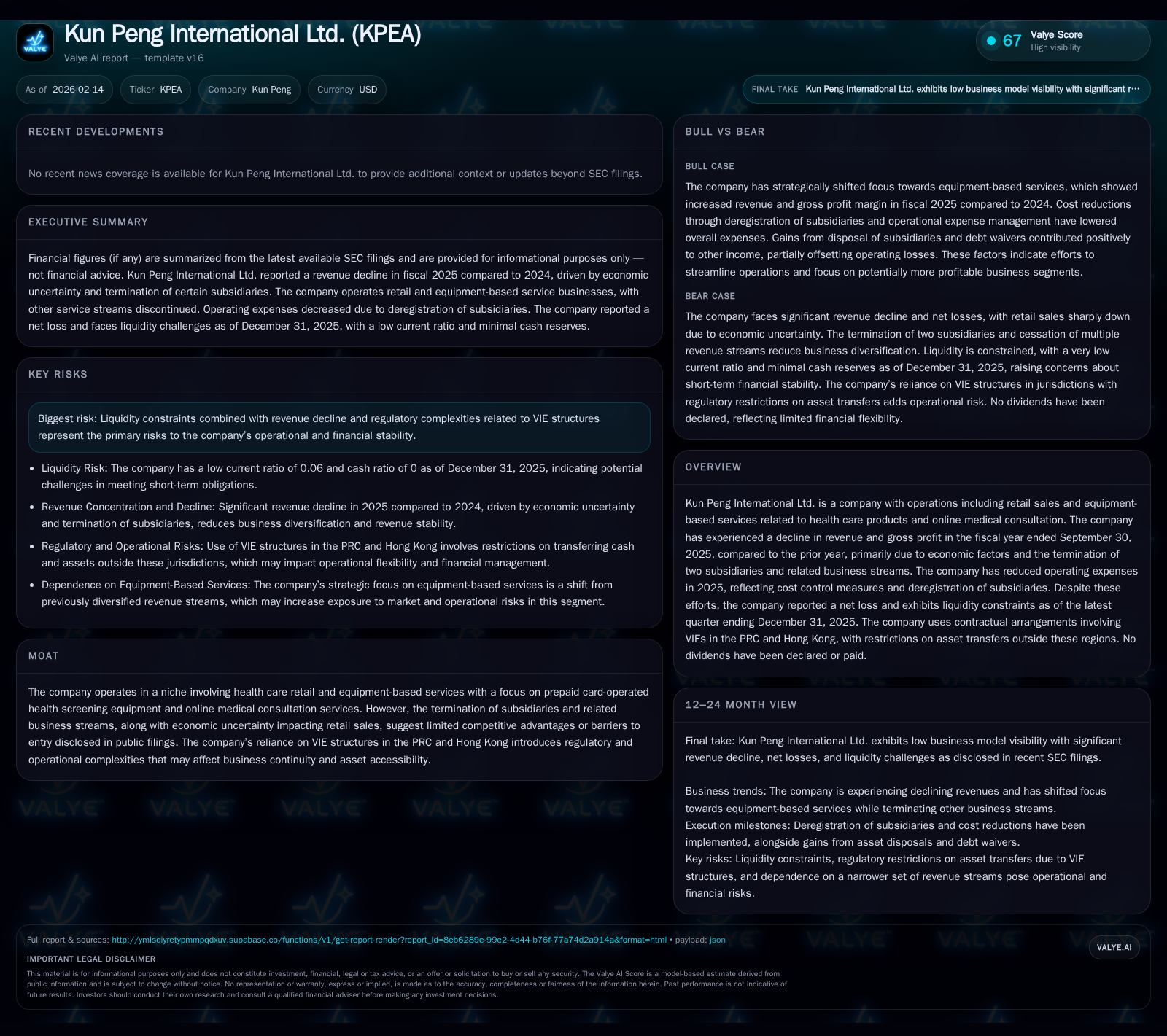
For the fiscal year ending September 30, 2025, Kun Peng International Ltd. faced a substantial 30% drop in revenues accompanied by a contraction in gross profit margins, driven by economic headwinds and the closure of two subsidiaries. Despite aggressive cost-cutting measures reducing operational expenses by over $700,000, the company reported a significant net loss and severe liquidity constraints, with a current ratio plunging to 0.06 as of December 31, 2025. Compounding these financial challenges are structural complexities tied to its Variable Interest Entity (VIE) contracts in China and Hong Kong, presenting material regulatory risks and cash transfer restrictions. These factors collectively cast uncertainty over the firm’s near-term stability and operational viability.
Revenue Retreat: The Waning Pulse of Operations
Kun Peng International Ltd.’s top-line trajectory during fiscal year 2025 paints a stark picture of contraction within its health care retail and services operations. Revenues plummeted by nearly 30%, descending from $2.08 million in the prior year to approximately $1.44 million [S1; F1]. This steep decline is attributable principally to economic headwinds dampening overall retail activity and the strategic winding down of two subsidiaries integral to its health care equipment business.
Gross profit followed suit, shrinking by some 35% from $1.47 million to under $960,000. This resulted in a gross margin downturn from roughly 70.9% to about 66.6%—reflecting both diminished sales volumes and possibly less favorable sales mix after exiting those subsidiaries [S1]. The figures underscore a diminishing pulse at Kun Peng’s operational heart.
While these raw numbers reveal immediate pressure on core commercial streams, they also hint at deeper vulnerabilities stretching from market demand softness to structural shifts within its business portfolio.
Takeaway: The significant revenue retreat coupled with gross margin erosion reveals foundational operational strain exacerbated by macroeconomic volatility and trimming of business units.
Cost Control vs. Cash Crunch: Anatomy of the Financial Strain
In response to declining revenues, Kun Peng implemented decisive cost-control measures resulting in operating expense reductions of approximately $735,900—from nearly $3.47 million down to about $2.74 million [S1; F1]. These cuts primarily stemmed from lower selling expenses ($1.19 million vs. prior $1.65 million) and trimmed general & administrative costs ($1.55 million vs. prior $1.82 million).
However, despite this prudence on spending fronts, the firm posted a hefty net loss near $1.27 million in FY25 —a marginal narrowing from FY24 but indicative of continuing unprofitability [F1]. Such persistent losses have not translated into better liquidity; instead, Kun Peng confronts acute cash shortfalls as proxied by an alarmingly low current ratio around 0.06 (current assets ~$600K dwarfed by current liabilities above $9.5M) [F1]. Cash on hand barely reached $32K at the end of December 2025, underscoring a precarious financial footing.
The juxtaposition between meaningful expense discipline and the ongoing net losses alongside liquidity scarcity sketches a portrait of operating cash flow stress that extends beyond mere earnings volatility.
Takeaway: Expense trimming has alleviated cost pressures but failed to reverse deep cash drain nor bridge widening liquidity gaps—exposing fragile financial resilience.
VIE Contractual Web: Structural Complexities and Regulatory Implications
Kun Peng International functions through contractual arrangements involving Variable Interest Entities (VIEs) located within the People's Republic of China (PRC) and Hong Kong [S1]. These structures facilitate compliance with PRC foreign investment restrictions but inherently impose limitations on asset transfers outside these jurisdictions.
These contractual constructs expose Kun Peng to multifaceted regulatory risks—domestic PRC controls might intervene or impose restrictions on cross-border cash flows, complicating liquidity management for the holding company headquartered elsewhere [S1]. Moreover, as geopolitical tensions persist between China and the U.S., increased scrutiny on U.S.-listed Chinese firms amplifies uncertainty regarding the enforceability of such agreements.
The possibility that audit documentation may be held offshore yet still subject to review or restriction under acts like the Holding Foreign Companies Accountable Act further intertwines regulatory risk with operational continuity [S1]. The layered complexity curtails transparency around true asset accessibility, impairing straightforward capital deployment or dividend distributions.
Takeaway: Kun Peng’s reliance on VIE frameworks imposes hefty regulatory hurdles that may disrupt capital flows and jeopardize business continuity amid changing policy landscapes.
Liquidity Constraints: The Stress Test of Survival
Liquidity emerges as perhaps Kun Peng’s most formidable challenge heading into calendar year 2026. With less than $600K in short-term assets pitted against more than $9.5 million in current liabilities as of December 31, 2025, the company faces a highly imbalanced balance sheet structure [F1]. This yields a current ratio shockingly low at just 0.06—a critical red flag for solvency considerations.
Cash reserves evaporated down to an alarming level of approximately $32,430 end-2025 [F1], undermining routine operational funding possibilities absent near-term external financing or asset monetization events.
Such liquidity deficits constrain maneuverability to address payable obligations or invest in growth initiatives while increasing dependence on uncertain internal transfers restricted by VIE constraints.
Takeaway: The pronounced liquidity shortfall poses an existential threat requiring urgent mitigation lest insolvency risks intensify further.
Subsidiary Shutdowns: Strategic Retrenchment or Warning Sign?
The fiscal year witnessed termination of two key subsidiaries along with their affiliated business lines related to prepaid card-operated health screening equipment and online medical consultation services [S1]. While streamlining efforts can sometimes signify prudent re-alignment toward core competencies or asset preservation during turmoil, these closures in Kun Peng’s case align temporally with revenue decline and heightened financial pressures.
The cessation likely contributed materially to top-line erosion yet also removes segments that could have been pillars for future recovery as health care demand rebounds post-pandemic disruptions.
Whether this represents calculated pivoting toward sustainable units or a distress-driven contraction remains ambiguous without clearer strategic disclosures.
Takeaway: Subsidiary exits reduce operational breadth but simultaneously suggest vulnerability within core service segments compounding overall business fragility.
Geopolitical Crosswinds: Navigating China-Hong Kong Political Risks
Operating predominantly through PRC and Hong Kong entities embroils Kun Peng in ongoing geopolitical friction impacting regulatory environments and market sentiment [S1]. Political uncertainties—ranging from policy shifts affecting foreign-invested entities to tighter controls on capital movement—pose continuous challenges.
U.S.-listed Chinese companies endure increased scrutiny encompassing reporting obligations, audit inspections, potential delisting threats, and reputational risks underscored by recent government interventions targeting compliance enforcement [S1]. Given that Kun Peng’s auditor is located outside mainland China but registered with PCAOB raises additional questions amid evolving legal interpretations around audit transparency.
These geopolitical crosswinds threaten not only day-to-day operations but also investor confidence critical for capital access.
Takeaway: Regional political risk adds a volatile overlay complicating governance adherence and threatening uninterrupted business operations.
Financial Transparency under Scrutiny: Auditor and Compliance Landscape
Kun Peng’s independent auditor “J&S,” headquartered in Malaysia yet registered with U.S.-based Public Company Accounting Oversight Board (PCAOB), provides some measure of inspection credibility yet is situated outside China’s direct jurisdiction [S1]. Although currently unaffected by stringent provisions under the Holding Foreign Companies Accountable Act (HFCAA), no assurances exist that future legislative amendments won’t place audit documentation or company disclosures under restrictive scopes potentially triggering delisting actions.
This tenuous balance reveals inherent vulnerabilities tied to auditing transparency—a cornerstone for investor trust and exchange requirements amid heightened U.S.-China regulatory tensions.
Takeaway: Auditor location coupled with regulatory ambiguity around HFCAA serve as latent risk factors possibly imperiling market presence if adverse enforcement unfolds.
Dividend Silence and Capital Flow Blockades: Impact on Investors
No dividends have ever been declared or distributed since inception nor are there intentions foreseen for near-term payouts [S1]. This aligns with the company's need to preserve capital internally given its liquidity squeeze but deprives shareholders of any income streams potentially diminishing attractiveness to income-focused investors.
Further complicating shareholder returns are statutory barriers preventing free remittance of funds across borders due to PRC/Hong Kong governmental controls embedded within VIE structures restricting asset transfers beyond their locales [S1]. These constraints prevent efficient capital redeployment back upholding company-level obligations or distributing excess earnings if any materialize.
Takeaway: Dividend absence paired with cross-jurisdictional payout restrictions limits investor monetization avenues steepening investment risk profiles.
Outlook Ambiguity: Can Operational Adjustments Stem the Tide?
Management’s efforts toward curbing operating expenses did stem some degree of financial hemorrhaging; however, broad operational headwinds persist as net losses linger close to $1.27 million even after cutbacks [F1]. On top lie daunting liquidity shortages intertwined with geopolitical uncertainty surrounding China-Hong Kong business integration through VIE contracts.
With no visible catalyst heralding revenue stabilization or meaningful capital inflows evident yet—and compounded by political risks—it remains unclear whether current restructuring efforts suffice to halt deteriorating conditions or merely delay reckoning points ahead.
Continuous monitoring will be vital as ambiguities over recovery timelines coexist uneasily alongside mounting leverage pressures on fragile finances.
Takeaway: Despite tactical expense reduction maneuvers, persistent losses coupled with regulatory complexities focus attention squarely on near-term viability questions amid opaque growth visibility.
This analysis serves as an informational overview based solely on publicly available filings without constituting investment advice.
Disclaimer: This is research-only, informational analysis and not investment advice. It may include AI-generated interpretation and general industry context. Always verify important details using primary sources.

Comments