
NeoVolta Inc.: Strategic Expansion and Battery Innovation Amid Financial Pressures and Leadership Changes
NeoVolta’s focused Texas solar market growth and battery technology acquisitions collide with liquidity challenges and executive reshuffles.
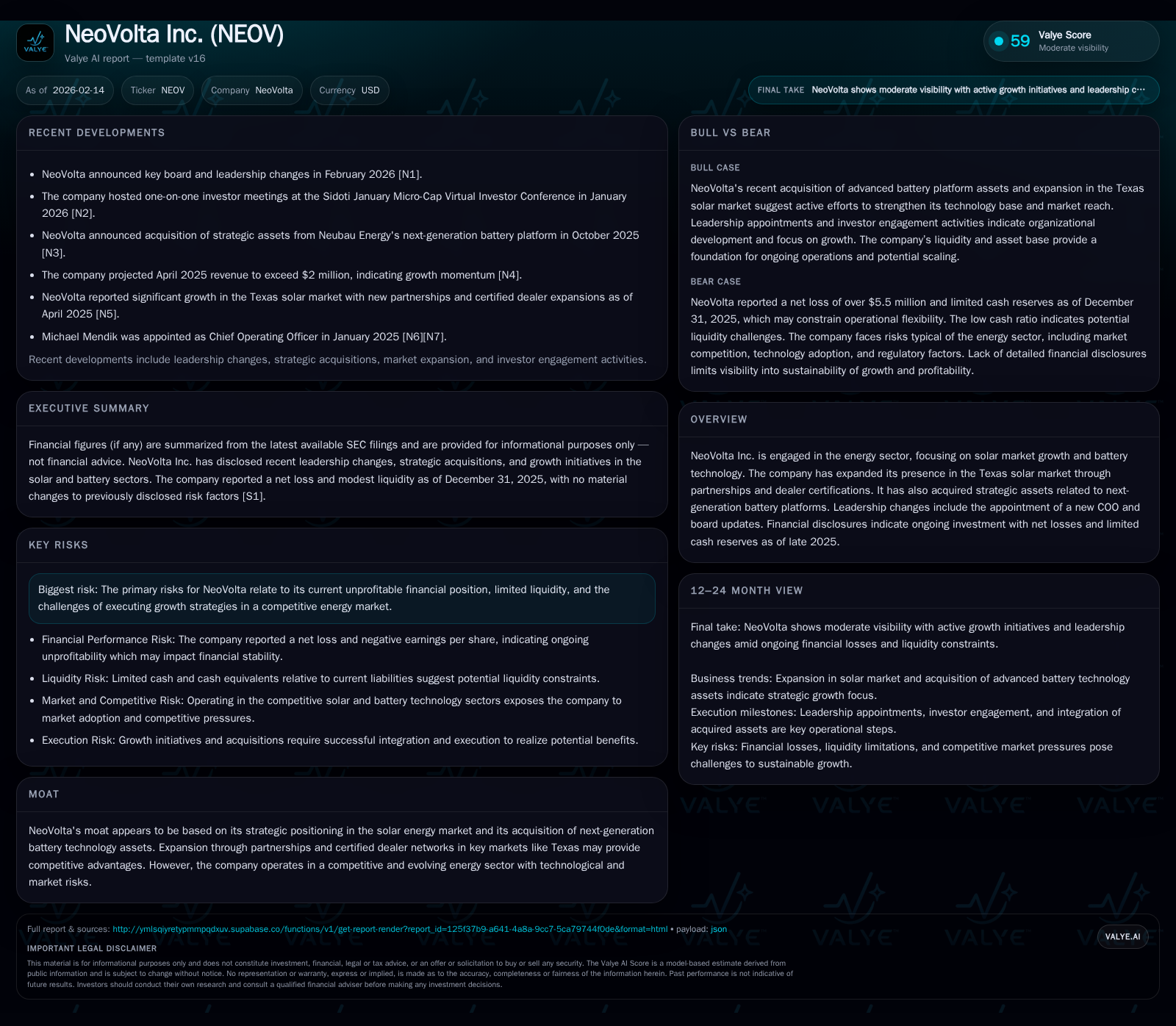
NeoVolta Inc. is pursuing aggressive expansion in the Texas solar energy market through certified dealer partnerships while advancing next-generation battery platforms via strategic asset acquisitions. These moves coincide with notable leadership updates, including a new COO appointment and board restructuring aimed at reinforcing governance and execution. Despite early-stage promise, the company faces financial headwinds highlighted by sustained net losses and constrained cash reserves. This analysis explores NeoVolta’s position at this critical inflection point, balancing its innovative growth initiatives against the realities of competitive pressures and capital limitations.
Harnessing the Texan Sun: Market Expansion and Partnership Strategy
NeoVolta Inc. is strategically targeting Texas—one of the fastest-growing solar markets in the United States—to cement its position within the renewable energy landscape. By pursuing partnerships that lead to dealer certifications, NeoVolta aims to create an ecosystem of trusted installers who can accelerate product deployment at a local level [valye_report_excerpt]. This approach serves multiple purposes: it facilitates customer acquisition by leveraging localized expertise, spreads operational risk across multiple service points, and potentially reduces upfront capital expenditures compared to direct sales or sole proprietary channels.
Expansion through these certified dealers is a sensible tactic given Texas's favorable solar policies and high insolation rates fostering demand. However, certification programs must be tightly managed; ensuring quality control across an expanding dealer network can strain resources, particularly in the context of limited financial bandwidth. While these partnerships may solidify NeoVolta’s competitive foothold regionally, scaling beyond this will require investment in training infrastructure, supply chain coordination, and after-sales service networks.
Moreover, operating within Texas exposes NeoVolta to local market dynamics—regulatory changes, utility rate structures, and competitor maneuvers—which could impact adoption curves. Yet winning early traction here can build brand recognition pivotal for broader geographic penetration.
What it means: NeoVolta’s dealer certification strategy plausibly enhances market access without immediate heavy capital outlays but raises questions about operational scalability and quality assurance amid tight liquidity.
Next-Generation Battery Technologies: A Double-Edged Sword?
Parallel to its solar market push, NeoVolta has acquired assets related to next-generation battery platforms—a move designed to strengthen its technological foundation and differentiate from commoditized solar product offerings [valye_report_excerpt]. Energy storage remains a critical enabler for solar adoption due to intermittency concerns; thus, controlling advanced battery technology could provide a defensible moat.
Yet this arena is notoriously complex. Innovations must overcome integration challenges, cost targets, safety standards, and rapidly evolving competitor innovations from established energy storage firms to startups backed by deep pockets or established supply chains.
While possession of such assets indicates ambition and potential for creating vertically integrated solutions combining generation and storage, there is scant detail on commercialization timelines or developmental stage status. The inherent risk is that capital-intensive R&D efforts could drain limited resources without guaranteed successful product-market fit.
What it means: Battery technology acquisition may eventually underpin competitive advantage but currently represents both an innovation opportunity and a notable execution risk given fast-evolving technical landscape coupled with NeoVolta’s financial profile.
Leadership Reset: What Recent Board and COO Changes Signal
In February 2026, NeoVolta announced key leadership transitions including appointing a new Chief Operating Officer alongside several board updates [N1]. Such changes often reflect attempts to enhance governance frameworks or bring fresh operational disciplines necessary for scaling businesses facing critical inflection points.
A new COO typically signals sharpened focus on execution capabilities—translating strategic plans into operational realities amid expansive growth efforts. Board restructuring can also be aimed at improving oversight during times requiring stringent capital allocation decisions or strategy pivots.
The timing aligns closely with the company’s ongoing efforts in market expansion and battery tech development amidst financial pressure points, which implies management recognizes internal gaps needing correction. While leadership refreshes can inject momentum, they can also imply prior challenges with execution or strategic clarity.
What it means: The leadership overhaul appears engineered to strengthen operational execution and investor confidence during a delicate phase; success will hinge on how quickly new leaders embed their mandates amid complexity.
Financial Ground Check: Navigating Losses with Limited Liquidity
Analyzing NeoVolta’s most recent quarterly report reveals significant net losses totaling nearly $5.54 million as of December 31, 2025 [F1]. Concurrently, cash and cash equivalents stand at roughly $242K—a notably tight reserve relative to burn rate concerns [F1]. The current ratio is about 2.1 (current assets vs liabilities), indicating that near-term liabilities are covered by liquid or near-liquid assets [F1].
However, this snapshot suggests constrained runway absent substantial funding inflows. Operating losses underscore that revenue generation has yet to sustainably offset operating expenses linked with scaling sales efforts and technology investments. Cash scarcity compounds risks as it limits flexibility for pivotal activities like inventory purchases, production scale-up, or R&D advancement.
Furthermore, without clear disclosure of capital raising plans or committed financing sources within this filing period [S2], the sustainability of ongoing operations comes under scrutiny—especially given the competitive nature of renewable energy sectors where speed-to-market can dictate survivability.
What it means: Financial fundamentals reflect a company investing aggressively but burning cash faster than replenished; liquidity management will be critical to maintain growth momentum beyond early-stage initiatives.
Moat in the Making? Evaluating Competitive Advantages Amidst Industry Headwinds
NeoVolta touts its combined solar market positioning in Texas alongside next-gen battery technologies as components of a nascent moat [valye_report_excerpt]. In theory, integrating downstream customer access with upstream technological differentiation creates barriers for competitors reliant solely on commoditized panels or generic storage units.
Yet industry realities complicate this narrative. Solar markets see intense competition from entrenched incumbents scaling nationwide plus emerging players innovating constantly. Price pressures remain persistent due to commoditization trends for solar modules themselves. Battery technology race involves firms with deep R&D budgets and supply chain sophistication few small-cap entities can match easily.
Hence while NeoVolta’s ambitions are credible on paper—focusing where high-growth intersects with tech innovation—the actual moat durability depends heavily on effective commercial execution, intellectual property protection around battery technologies if any exist beyond asset acquisition rights, and ability to navigate regulatory changes impacting subsidy regimes or interconnection policies.
What it means: The asserted moat rests precariously on multiple fronts that require simultaneous success; isolated wins will do little unless embedded within broadly scalable competitive advantages resistant to disruption.
Risks Under the Microscope: Unprofitability, Capital Constraints, and Growth Execution
Reflecting consistent disclosures from prior periodic filings [S2], key risks reaffirmed include sustained unprofitable operations accompanied by limited liquid resources at present [valye_report_excerpt]. These conditions elevate dependency on external capital markets—a challenging proposition given micro-cap status—and expose NeoVolta to dilution risks if equity financings occur under duress.
Additionally, successfully executing ambitious expansion strategies across geographically diffuse dealer networks demands managerial bandwidth often underestimated amidst tight fiscal circumstances. Operational disruptions could erode market confidence just as competitors accelerate their own deployments.
Investors must note transparent mention in official filings cautioning that actual outcomes may materially deviate based on known or unknown factors affecting business fundamentals—including technological feasibility hurdles—as outlined in risk sections of recent 10-Q [S2]. Such candor highlights governance standards though also underscores fragility intrinsic to early-stage energy companies battling multi-dimensional uncertainties.
What it means: Risk profile remains elevated with clear acknowledgment from management; this requires constant monitoring as strategic milestones unfold alongside cash management initiatives.
Investor Engagement in Micro-Cap Territory: Insights from Sidoti Conference Participation
In January 2026 NeoVolta leveraged investor conference platforms such as the Sidoti January Micro-Cap Virtual Investor Conference by hosting one-on-one meetings aiming to elevate corporate visibility among institutional participants focused on smaller capitalization companies [N2].
This proactive investor relations outreach signals awareness by management that securing growth capital will increasingly depend upon attracting informed micro-cap specialists capable of valuing underlying technology prospects against financial constraints. It also reflects efforts to broaden shareholder base beyond retail or passive holders often associated with small public entities.
Such conferences provide venues for candid dialogue about roadmap clarity while enabling feedback loops helpful for managing expectations around timing for revenue scalability or profitability inflections—critical variables when operating under limited liquidity buffers.
What it means: While micro-cap engagement cannot replace broader capital market access altogether, active participation suggests management prioritizes transparency and market intelligence gathering essential for future funding rounds.
Looking Ahead: Strategic Priorities and Potential Catalysts for NeoVolta
NeoVolta stands at a crossroads where its aspirations for transformative growth via Texas solar expansion combined with next-gen battery innovations face immediate test cycles shaped strongly by liquidity constraints posed by recent financial results [valye_report_excerpt][F1][S2].
Key catalysts likely include:
- Progress reports detailing successful onboarding of dealers within Texas translating into tangible revenue streams;
- Milestones achieved around commercial viability or pilot deployments leveraging newly acquired battery technologies;
- Demonstrable improvements under new COO stewardship reflecting accelerated operational throughput;
- Financing developments securing adequate capital injections allowing continuation without dilutive stress;
- Regulatory developments enhancing favorable conditions either through subsidies or grid integration facilitation impacting sales velocity;
Conversely setbacks might arise if technology development timelines slip considerably due to resource limitations or if market competition accelerates cost deflation making differentiation harder than anticipated. Leadership effectiveness will be equally instrumental; misalignment or failure to integrate fresh perspectives risks internal inefficiencies just as external pressures mount.
Stakeholders should weigh these intertwined dimensions carefully when assessing NeoVolta’s path since momentum generated today can either foreshadow eventual sustainable niche carving or underscore vulnerabilities leading to repositioning requirements longer term.
What it means: Success depends on balanced navigation across operational execution excellence,vigilant financial stewardship,and pragmatic pace-setting aligned with sector evolution dynamics embodied by both opportunity-rich yet volatile renewables landscape.
Disclaimer: This analysis is provided solely for informational purposes reflecting publicly available data and should not be construed as investment advice. Readers are encouraged to conduct their own due diligence considering risk factors detailed herein.
Disclaimer: This is research-only, informational analysis and not investment advice. It may include AI-generated interpretation and general industry context. Always verify important details using primary sources.

Comments