
Whirlpool Corp’s Strategic Resilience Amid Q4 Setbacks and Long-Term Growth Layers
A nuanced exploration of Whirlpool Corporation’s recent earnings shortfall, operational restructuring, and strategic imperatives shaping its future trajectory.
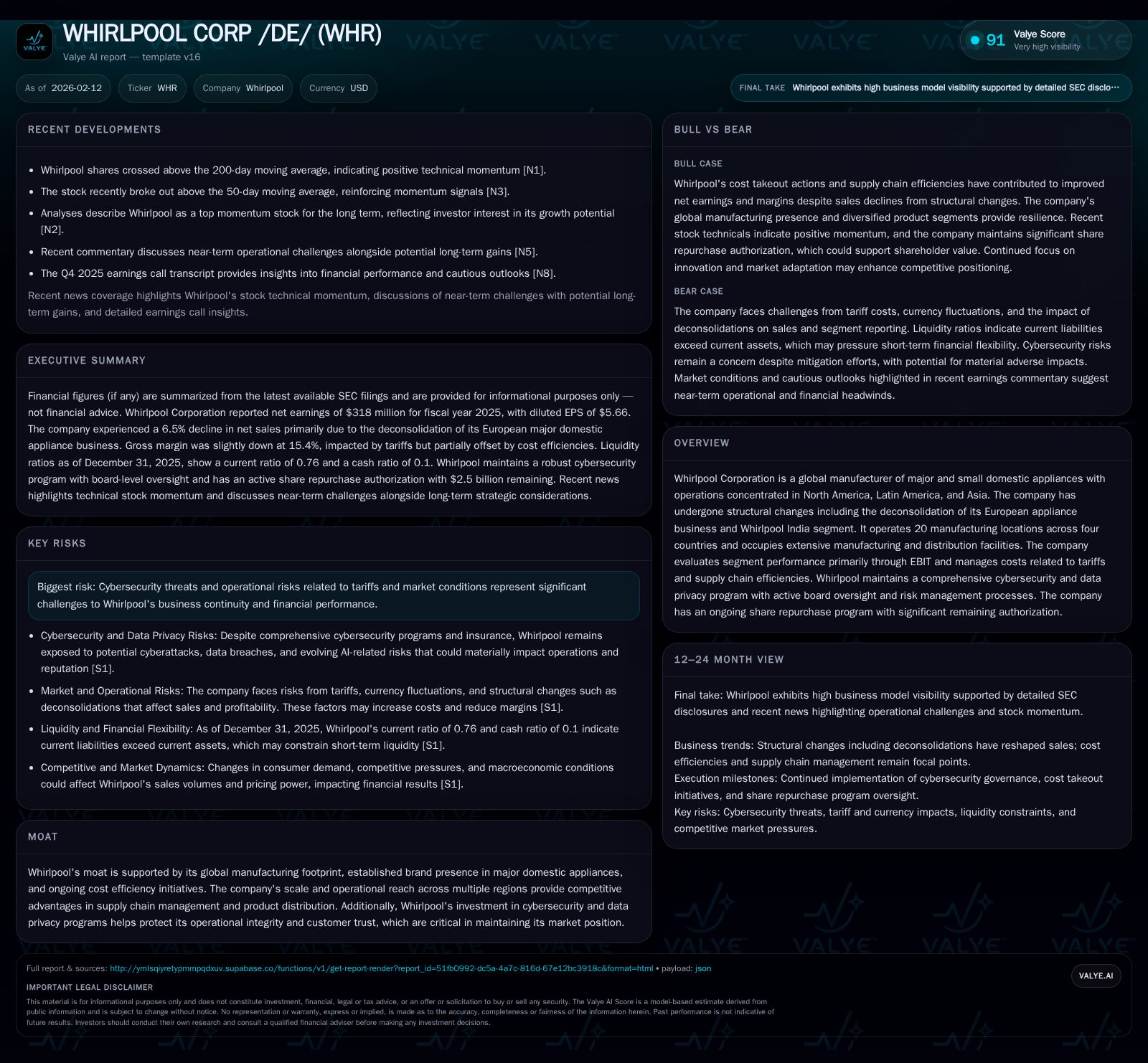
Whirlpool Corp recently reported a Q4 2025 earnings miss that triggered a notable dip in its stock despite technical indicators suggesting emerging momentum. The company’s strategic deconsolidation of its European and Indian appliance segments signals a sharpened geographic focus, while its global manufacturing footprint and cost optimization efforts remain key competitive pillars. Proactive cybersecurity governance further reinforces Whirlpool’s operational moat amid rising digital risks. However, tariff pressures and supply chain challenges persist as near-term risks. Whirlpool’s ongoing share repurchase program underscores management confidence even as cautious guidance tempers immediate outlooks.
Navigating Turbulence: Dissecting Whirlpool’s Recent Earnings and Market Reaction
Whirlpool’s Q4 2025 earnings report delivered a jarring surprise to value-focused observers. Despite sturdy topline fundamentals noted in prior quarters, the company missed consensus earnings expectations, initiating an immediate selloff in its shares ([N3], [N5]). In the earnings call transcript ([N2]), management underscored cost pressures from tariffs and supply disruptions as key contributors to margin erosion. This cautious tone contrasted with the upbeat narratives floating in some corners of the market about Whirlpool’s long-term momentum.
Contextually, the broader market environment was already jittery following mixed big tech earnings reports which dampened sentiment overall ([N1]). Additionally, concerns about rising AI-related spending weighed on equities more broadly ([N7]). Within this complex backdrop, Whirlpool’s miss added fuel to near-term skepticism despite fundamentally sound business dynamics.
Management’s unwillingness to aggressively guide beyond modest improvements reflects prudence but also heightens investor wariness regarding cyclical headwinds. Yet the juxtaposition against the stock technicals—breaking above both the 50- and 200-day moving averages—invites a narrative tension between immediate pain and latent strength ([N8], [N10]). This duality sets the stage for discerning investors to parse near-term volatility from structural durability.
Structural Shifts: Strategic Impact of Deconsolidation Moves in Europe and India
A defining aspect of Whirlpool’s recent corporate evolution has been the deliberate deconsolidation of its European appliance operations along with the exit of its Whirlpool India segment ([valye_report_excerpt]). These moves tighten the company’s operational focus around North America, Latin America, and Asia while substantially reducing legacy geographic spread.
This recalibration aligns with management's approach of evaluating segment performance primarily through EBIT contributions, favoring regions where competitiveness is strongest. While exiting Europe reduces exposure to a historically fragmented and low-margin market, it simultaneously concentrates reliance on fewer geographies—a trade-off balancing increased focus against diminished diversification.
From an operational standpoint, this streamlining can enhance resource allocation efficiency and deepen market penetration where scale advantages exist. However, it also means Whirlpool faces intensified competitive risks if macroeconomic or policy shocks hit these core markets disproportionately.
Global Manufacturing and Cost Efficiency: Whirlpool’s Competitive Backbone
At the heart of Whirlpool's moat is an extensive global manufacturing footprint comprising 20 strategically located facilities distributed across four countries ([valye_report_excerpt], [S1]). This network fosters significant economies of scale while enabling rapid response to shifting demand patterns.
Such operational scale is critical in controlling costs amid volatile raw materials pricing and tariff environments detailed in SEC filings ([S1], [S2]). For instance, managing shipping logistics domestically and internationally benefits from proximity to end markets and supplier clusters. Operational excellence programs targeting cost reduction have been emphasized repeatedly by management during recent earnings dialogues.
This multidimensional manufacturing reach not only drives margin resilience but also forms a formidable barrier for smaller competitors lacking similar infrastructure. Further efficiencies are being pursued via technology integration in production lines although details remain guarded.
Cybersecurity as Moat Reinforcement: Board Engagement and Risk Management Practices
Beyond physical operations, Whirlpool demonstrates advanced governance in information security—a domain increasingly relevant given contemporary threat landscapes ([S1], [valye_report_excerpt]). The establishment of a Cybersecurity, Privacy, and AI Steering Committee at the board level underscores leadership’s prioritization of safeguarding operational integrity.
This committee regularly reviews vulnerabilities and guides mitigation tactics such as mandatory global cybersecurity training for salaried employees with annual content refreshes addressing emerging risks like phishing or AI-related threats. Quarterly reporting by the CIO and CISO to the Audit Committee assures transparency into evolving cyber risks.
Additionally, simulated phishing exercises and active insurance coverage buttress readiness against potential breaches. This proactive stance is illustrative of how digital risk management is integrated into Whirlpool’s broader enterprise risk framework—supporting customer trust while preventing costly disruptions.
Tariffs, Supply Chains, and Operational Risk: Challenges Underpinning Near-Term Pain
The intersection of tariffs and supply chain volatility continues to challenge Whirlpool's near-term operating environment ([valye_report_excerpt], [S1], [N14]). Increased duties on imported inputs elevate production costs while global logistics bottlenecks raise inventory expenses.
Management acknowledges these headwinds candidly yet balances this outlook by highlighting ongoing efforts to optimize sourcing strategies, enhance supplier partnerships, and improve internal productivity metrics ([N2]). However, as tariffs can shift unpredictably with geopolitical developments, this remains an external risk factor beyond full company control.
Moreover, heightened market expectations around product quality and delivery timelines amplify these pressures amidst consumer spending uncertainties. Such factors explain why even well-entrenched incumbents like Whirlpool must adopt cautious near-term guidance despite underlying business resilience.
Capital Allocation: The Share Repurchase Program and Financial Positioning
Against these operational challenges stands Whirlpool's robust capital return philosophy backed by healthy cash inflows ([valye_report_excerpt], [F1]). The company maintains a sizeable share repurchase authorization with significant capacity still available to fuel buybacks amid prevailing valuation dislocations.
Interestingly, financial data reveals a current ratio below 1 (0.76), indicating current liabilities exceed current assets at fiscal year-end ([F1]). Yet cash & equivalents totaling $669 million provide ample liquidity buffers to support buybacks without compromising working capital needs.
This capital allocation mix signals management's confidence in intrinsic value while balancing prudent liquidity management. The buyback program is also tactical amid market volatility—potentially enhancing upside if operational headwinds abate more swiftly than feared.
Technical Momentum vs. Market Skepticism: Share Price Dynamics in Early 2026
Early 2026 has seen Whirlpool shares exhibit intriguing technical behavior driving discussion among momentum-focused traders ([N8], [N9], [N10]). The stock recently cleared resistance levels at both its 50- and 200-day moving averages—typically bullish signals in price action analysis.
Contrasting this rise are bearish narratives casting doubt on sustainability given persistent macro uncertainties highlighted earlier. Some analysts frame current valuations as reflecting “beaten down” status prone to traps amid cyclical recovery doubts ([N12]). Yet others position Whirlpool as a compelling ‘top momentum stock’ based on improving operating metrics and relative strength indicators ([N9], [N11]).
Such bifurcated perception mirrors broader investor tension between embracing cyclical rebounds versus guarding against potential setbacks—underscoring the nuanced balance founders must maintain when interpreting technical cues alongside fundamental realities.
Whirlpool’s Future Outlook: Balancing Cautious Guidance with Growth Potential
Synthesizing these strands yields a portrait of a company navigating transitional turbulence while building durable competitive advantages ([N3], [N14], [S1]). Management openly concedes near-term profitability constraints tied mainly to tariffs and supply chain friction but expresses conviction in longer-term growth trajectories grounded in operational fundamentals.
Evolving cybersecurity threats including those emergent from AI technology introduce new risk dimensions actively addressed via governance processes—a reflection of forward-looking risk awareness uncommon among peers. Meanwhile, focused regional strategy post-deconsolidation concentrates leadership efforts where scale can be best leveraged for margin expansion.
Despite inherent risks common across industrial sectors today—from inflationary environments to geopolitical uncertainties—Whirlpool’s blend of structural realignment, rigorous cost discipline, enhanced cyber defense mechanisms, and confident capital stewardship sets meaningful foundation stones for sustained competitiveness.
Investors attuned to this interplay between immediate caution and strategic patience will find Whirlpool an instructive case study on managing complexity at scale within mature industries undergoing transformative pressures.
Disclaimer: This report is intended solely for informational purposes without any explicit investment advice or recommendation. Readers should conduct their own independent analysis before making financial decisions.
Disclaimer: This is research-only, informational analysis and not investment advice. It may include AI-generated interpretation and general industry context. Always verify important details using primary sources.

Comments