Waste Connections' Integrated Model and Market Focus Drive Resilience Amid Industry Shifts
Waste Connections, Inc. leverages vertical integration and exclusive contracts to dominate secondary North American waste markets.
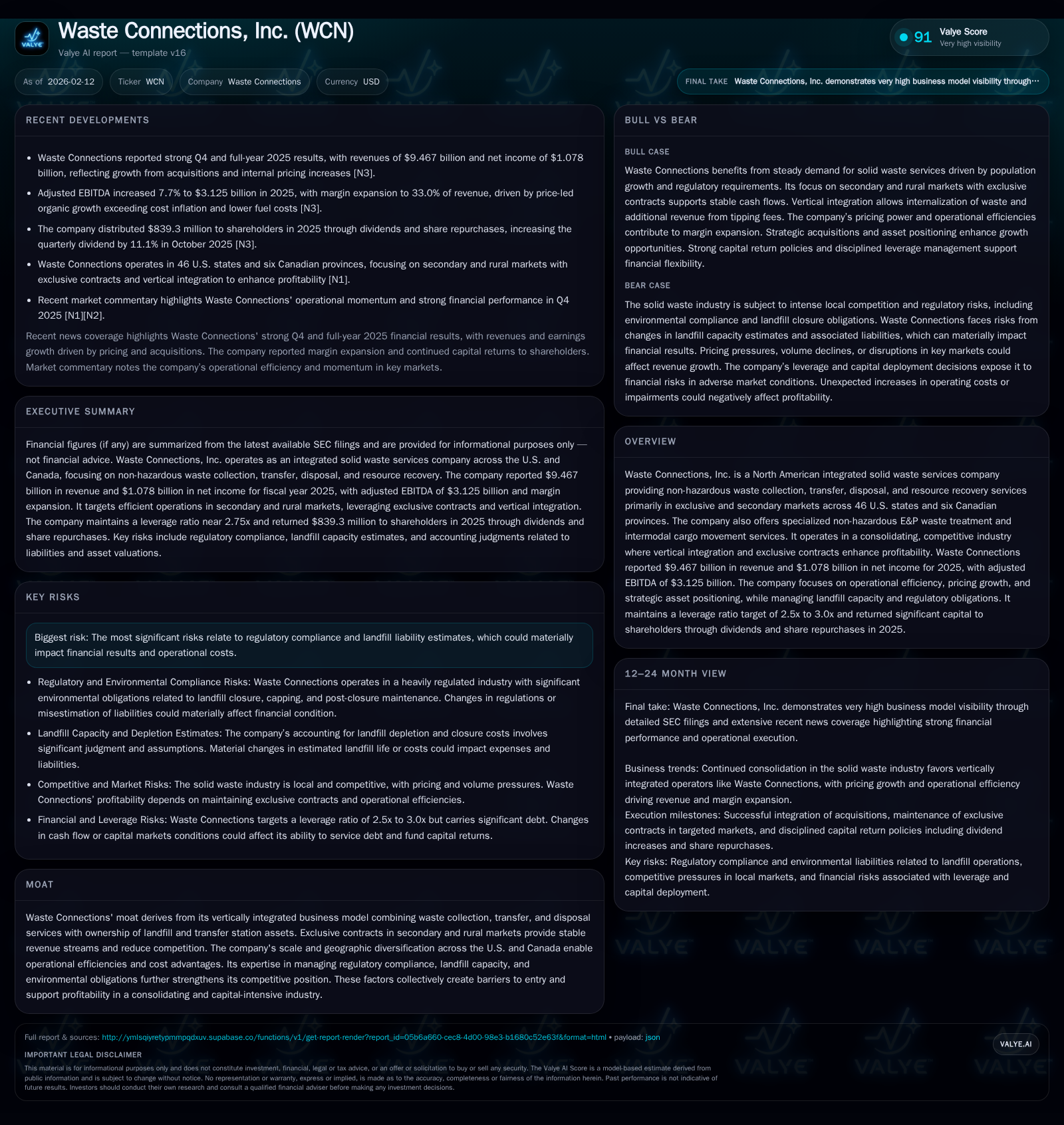
Operating across 46 U.S. states and six Canadian provinces, Waste Connections (WCN) has carved out a distinctive niche by focusing on secondary and rural markets where exclusive contracts mitigate competition. Its vertically integrated model—encompassing collection, transfer, disposal, and landfill ownership—creates operational efficiencies and stable cash flows in a consolidating solid waste industry. Despite volume pressures from contract pruning, the company’s strong pricing power fueled revenue growth to $9.467 billion in 2025, highlighting disciplined capital management amid growing regulatory demands.
Strategic Footprint: Navigating North America's Secondary Markets
Waste Connections operates across a vast geographic canvas stretching over 46 states in the U.S. and six Canadian provinces, with a deliberate focus on secondary and rural markets—a segment often overlooked by larger urban-centric competitors [S1]. This choice is strategic rather than incidental; targeting these regions affords Waste Connections considerable advantages in establishing exclusive contracts that limit market entry for competitors and create stable revenue streams [valye_report_excerpt]. Unlike densely populated metropolitan areas where competitive intensity can erode margins, WCN’s presence in less contested locales allows for stronger pricing power and fewer disruptions from rival haulers.
The company’s emphasis on exclusive service agreements further fortifies its market position. These agreements frequently grant long-term collection rights or preferential access to disposal facilities within defined territories, establishing natural barriers against competition [S1]. This contract-driven moat coupled with the rural footprint translates into operational predictability and reduces the need for aggressive price competition commonly observed in urban settings. Overall, this geographic targeting underpins WCN’s ability to maintain steady growth trajectories amidst industry consolidation.
Vertical Integration as a Profitability Engine
Waste Connections’ integrated business model unites non-hazardous waste collection, transfer operations, disposal services, and ownership of landfill assets under one umbrella [valye_report_excerpt; S1]. This vertical integration is a core source of profitability and competitive advantage. By controlling the flow of waste from initial pickup through final deposition, Waste Connections captures revenue at multiple service points—from collection fees charged to customers to tipping fees earned at company-owned landfills.
Moreover, internalizing these processes avoids third-party markups and inefficiencies inherent in fragmented waste logistics systems [S1]. The company benefits from economies of scale achieved by aggregating refuse at transfer stations, which optimizes transportation costs before routing to landfills—often located away from collection zones due to zoning or environmental restrictions.
As landfills continue to close industry-wide or shift locations further from urban centers, owning strategically situated disposal assets becomes ever more valuable [S1]. This asset positioning also facilitates third-party hauler relationships where Waste Connections charges tipping fees at its facilities without commensurate collection responsibilities [S1]. Such versatility in revenue streams cushions against fluctuations in any single segment of the waste value chain.
Financial Pulse: Analyzing 2025 Revenue and Profit Trends
Fiscal year 2025 demonstrated Waste Connections’ capacity for top-line expansion anchored by pricing discipline amid modest volume headwinds. Revenues rose 6.1% year-over-year to $9.467 billion from $8.92 billion in 2024 [F1; S1], visibly outperforming organic growth rates thanks partly to acquisitions contributing approximately $377 million incrementally [S1]. Excluding acquisition effects, internal growth was still positive at roughly 1.9%, primarily driven by solid waste price increases averaging around 6.4% [S1].
Net income totaled about $1.078 billion with adjusted EBITDA reaching $3.125 billion for the year [F1]. These figures reveal an enterprise effectively balancing revenue quality enhancements—even as volumes declined roughly 2.8%, largely due to an intentional shedding of lower-margin or lower-quality hauling contracts including selective residential accounts [S1; N1]. The trade-off here reflects management’s deliberate pivot toward contract profitability over mere tonnage growth.
This nuanced financial picture highlights how pricing leverage can offset volume softness, sustaining earnings momentum while cleansing the customer base of less lucrative engagements [N2; N3]. It also underscores the capital-intensive nature of Waste Connections’ model where steady cash flow supports reinvestment into asset maintenance alongside acquisition-driven growth strategies.
Pricing Power and Volume Dynamics: Balancing Growth with Quality Contracts
A striking element in Waste Connections’ recent performance is its ability to raise pricing approximately 6.5% on core services amid overall negative volume trends [S1; N2]. The company consciously chose not to renew certain residential contracts deemed less profitable or operationally burdensome—actions that led to a measured decline in collected volumes but improved unit economics [S1; N8].
This approach reflects a prioritization of sustainable margins rather than short-term market share gains that might dilute profitability. Concurrently, environmental surcharges and recycled commodity revenues declined slightly—by about 0.1%—indicating some pressure on ancillary fee components but not enough to offset core price gains [S1].
Such contract quality refinement suggests WCN focuses on long-term contract stability with clients who accept consistent pricing paradigms rather than transient volume boosts from discounting or high-churn accounts. The resultant cash flow profile is arguably more resilient amid market uncertainties or fluctuating commodity values tied to recycling streams.
Regulatory Risks and Environmental Stewardship Challenges
A recurring theme across Waste Connections’ disclosures is the significant exposure to regulatory risks related primarily to landfill liabilities and environmental compliance costs [S1; valye_report_excerpt]. Landfill operations are subject to evolving federal and state regulations governing emissions, groundwater protection, closure procedures, and liability estimates—all factors that inject uncertainty into cost forecasts.
Although WCN has expertise managing these obligations through proactive stewardship programs, shifts in regulatory policy or unforeseen compliance expenses could materially affect operating margins or capital allocation priorities [S1]. More broadly, intensive regulatory oversight adds complexity requiring ongoing investment in monitoring systems and legal risk management.
Investors should observe how changes in liability estimations or remediation obligations might amplify future costs or necessitate reserve adjustments—elements that can influence reported earnings volatility despite stable underlying operations.
The Role of Exclusive Contracts and Asset Positioning in Market Defense
Exclusive collection contracts constitute a critical pillar reinforcing Waste Connections’ defensive moat across its served territories [valye_report_excerpt; S1]. These agreements often confer semi-captive customer bases within defined geographic boundaries—especially true in secondary markets lacking numerous alternative competitive providers.
Separately, WCN’s ownership of strategically located landfills enables vertical control not just over collection but also ultimate disposal—a differentiator that restricts competitor access insofar as hauling routes funnel toward company-operated sites where tipping fees enhance revenue capture [S1]. This convergence of contractual exclusivity with tangible asset control limits entry threats from both new haulers seeking collection rights and outside landfill operators vying for disposal business.
Consequently, these factors play an outsized role in generating predictable cash flows insulated from volatile bidding processes or transient commodity cycles common elsewhere in the industry.
Capital Strategy: Leverage Targets and Shareholder Returns
Waste Connections maintains a targeted leverage ratio between 2.5x and 3.0x net debt to EBITDA—a range signaling prudent balance between financial flexibility and growth funding capacity [S1]. Adherence to this policy allows simultaneous investment in organic expansion initiatives as well as opportunistic acquisitions without compromising credit metrics.
Complementing this leverage discipline is a robust commitment to returning capital via dividends and share repurchases noted around late-2025 declarations [S1; N5]. Such shareholder distributions underscore confidence in free cash flow generation while providing returns aligned with long-term value creation objectives.
This capital stewardship reflects an awareness of cyclical pressures inherent in solid waste processing businesses alongside an emphasis on sustaining financial strength through economic cycles.
Exploring Niche Diversification: E&P Waste and Intermodal Services
Beyond traditional municipal solid waste activities, Waste Connections has invested meaningfully into niche segments such as non-hazardous exploration & production (E&P) waste treatment along key basins in North America as well as intermodal cargo movement services centered primarily in the Pacific Northwest region [valye_report_excerpt].
These specialized areas provide higher-margin opportunities linked closely to energy sector dynamics or increasing logistical complexity around multimodal freight transport. By diversifying beyond core MSW streams, WCN hedges exposure somewhat against localized demand fluctuations or regulatory constraints impacting conventional solid waste currents.
Additionally, intermodal expertise opens potential operational synergies facilitating efficient containerized waste movements that dovetail with existing infrastructure assets—further leveraging fixed-cost absorption while broadening addressable markets.
Sustainability Prospects within Solid Waste Consolidation
In response to mounting sustainability imperatives across industrial sectors including waste management, Waste Connections has intensified resource recovery efforts encompassing recycling initiatives alongside renewable fuels generation derived from collected refuse streams [valye_report_excerpt; N4].
These forward-looking programs aim both at compliance readiness regarding tightening environmental legislation as well as corporate social responsibility objectives increasingly demanded by stakeholders.
Within a consolidating sector marked by closures of smaller inefficient players unable to meet modern standards, WCN's integrated scale facilitates significant investments in technology upgrades enhancing diversion rates or landfill gas capture efficiency—the latter instrumental for renewable energy projects.
Such positioning augments longer-term viability while potentially unlocking new revenue lines aligned with a circular economy paradigm critical for future industry resilience.
Conclusion: Waste Connections' Path Through Operational Complexity
Waste Connections emerges distinctively by marrying geographic specialization in secondary North American markets with an all-encompassing vertically integrated platform spanning collection through disposal asset ownership. This dual strategy generates durable competitive moats supported by exclusive contracting frameworks that limit direct incursions while enabling superior margin profiles relative to fragmented peers.
Financial results from 2025 illustrate how disciplined pricing policies counterbalance intentional contraction of low-yield volumes—a calibrated trade-off fostering enhanced cash flow quality rather than mere scaling volume metrics. Concurrently, thoughtful capital deployment balances leverage footprints with shareholder return commitments underpinning sustainable growth ambitions.
Nevertheless, regulatory dynamics—particularly revolving around landfill liability assessments—remain pivotal uncertainties shaping cost structures going forward requiring vigilant management oversight.
Altogether, Waste Connections exemplifies an operator systematically navigating the complex interplay of consolidation pressures, environmental regulation evolution, cyclicality in commodity-linked revenues, and emerging sustainability expectations without sacrificing financial rigor or strategic clarity.
This analysis has been prepared solely for informational purposes using publicly available data sources without providing investment advice or recommendations.
Disclaimer: This is research-only, informational analysis and not investment advice. It may include AI-generated interpretation and general industry context. Always verify important details using primary sources.

Comments