
Dexcom Inc: Pioneering Continuous Glucose Monitoring Amid Evolving Medical Device Landscape
Dexcom’s innovation in real-time glucose monitoring is transforming diabetes management while navigating regulatory and competitive complexities.
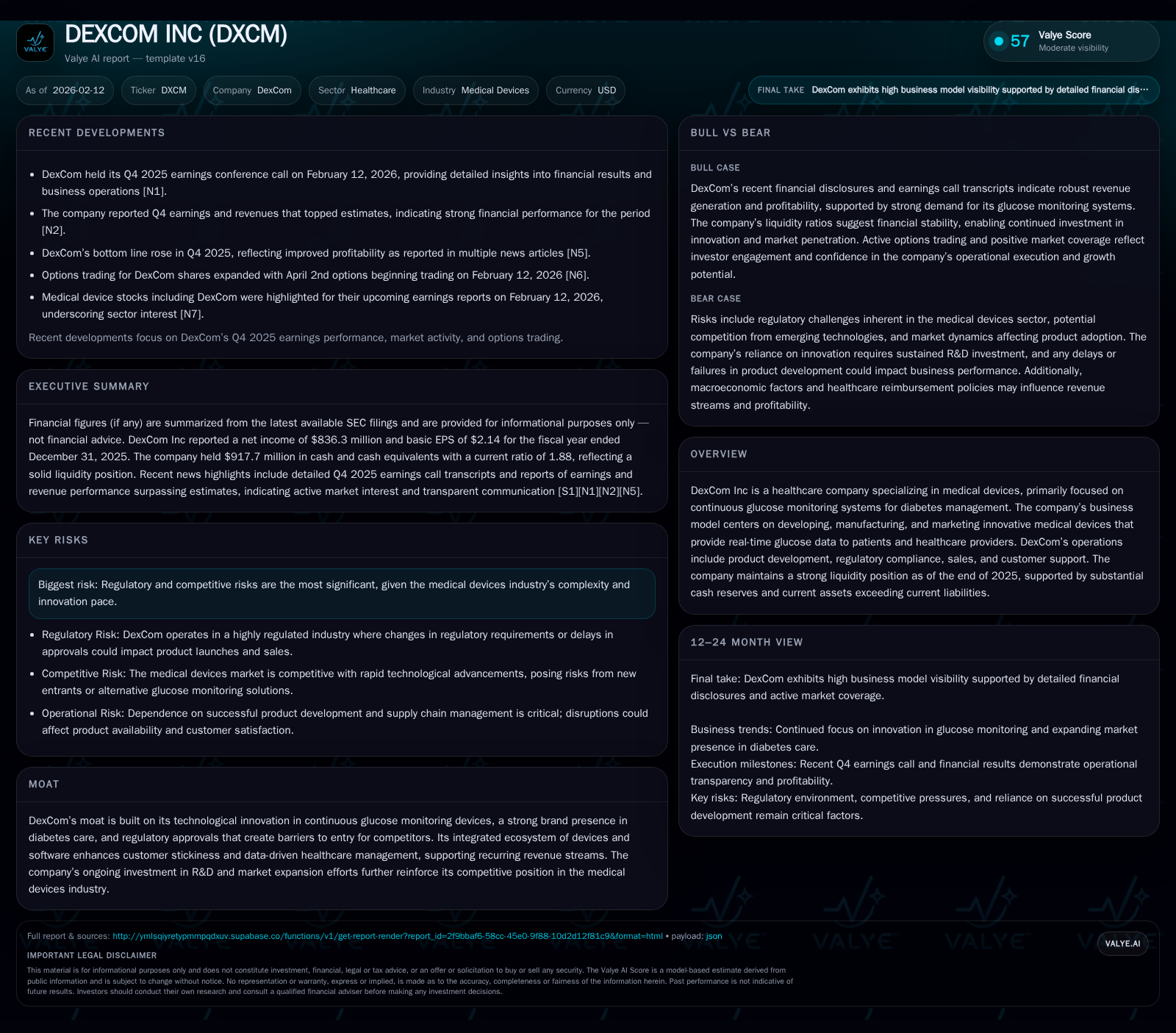
Dexcom Inc has firmly established itself as a leader in continuous glucose monitoring technology, offering diabetic patients and healthcare providers unprecedented data-driven tools. Its recent Q4 2025 earnings beat underscores operational momentum, driven by product innovation including AI-enhanced features and a well-fortified competitive moat. Despite regulatory and competitive pressures inherent to the medical devices industry, Dexcom’s robust financial position and strategic R&D investments position it well for sustained growth and market expansion.
Transforming Diabetes Care: Dexcom’s Core Mission and Market
Diabetes remains one of the most pervasive global health challenges—currently affecting hundreds of millions with projections pointing to continued growth over coming decades. For patients reliant on tight glucose control to avoid complications, real-time monitoring tools are essential. At the forefront of this effort is Dexcom Inc, whose continuous glucose monitoring (CGM) systems deliver real-time glucose data to both patients and healthcare providers. The company's mission centers not just on measurement but actionable insight — empowering users to proactively manage their condition through an integrated device-software ecosystem that fosters adherence and informed treatment decisions [valye_report_excerpt] [S1].
This integration creates a feedback loop where CGM data drives personalized care adjustments in near real time. Dexcom’s devices represent more than hardware—they are critical nodes in an evolving digital health paradigm emphasizing patient-centric data accessibility.
In the landscape of medical devices focused on diabetes care, Dexcom's specialization in CGM places it in a unique position to impact clinical outcomes positively through technology-enhanced disease management.
Sidebar: A Continuous Glucose Monitor (CGM) A CGM is a wearable medical sensor that continuously measures glucose levels in interstitial fluid under the skin, providing ongoing insights rather than periodic fingerstick tests.
Synthesizing this focus reveals why Dexcom is widely viewed as a catalyst in redefining diabetes treatment protocols.
Q4 2025 Earnings Beat: Signaling Strong Momentum
In its Q4 2025 earnings report, Dexcom demonstrated both top-line strength and margin improvements that outpaced analyst expectations [N1] [N2] [N13]. Revenue trends underscore not just steady volume growth in its installed base but also successful market penetration beyond core geographies. The quarter's bottom line benefitted notably from operational efficiencies alongside sustained investment in sales channels.
Financial filings confirm net income reaching $836.3 million in 2025 with cash equivalents totaling approximately $917.7 million at year-end — indicators of strong operational leverage and liquidity [F1] [S1]. The current ratio stands at around 1.88, signaling balanced working capital management versus short-term liabilities.
Detailed commentary during the earnings call highlighted positive uptake of new device iterations and expanding reimbursement landscapes as key catalysts. This momentum reflects effective execution across product development, regulatory navigation, and customer support realms.
The earnings performance suggests resilience amid macro uncertainties while positioning Dexcom for scalable growth opportunities ahead.
Innovative Technologies: From Continuous Monitoring to AI-Enabled Features
Innovation remains central to maintaining leadership in CGM technology. Most recently, Dexcom upgraded its Stelo platform by integrating AI-powered smart meal logging features [N12]. This enhancement enables improved contextual analysis of glucose data against dietary intake — a significant step toward personalized diabetes management.
Such AI-enabled functionalities increase patient engagement by simplifying meal tracking while providing actionable insights tailored to individuals’ metabolic responses [valye_report_excerpt]. This kind of sophistication enhances user stickiness by deepening value beyond raw glucose measurements.
Moreover, embedding AI capabilities within the existing ecosystem sharpens competitive differentiation relative to other CGM providers who may lack such advanced data integration or ease-of-use features.
The iterative technology development strategy thus reinforces Dexcom’s advantage through continuous feature enrichment aligned with evolving customer needs.
Building a Durable Moat: Brand, R&D, and Regulatory Barriers
Dexcom’s moat derives from multiple interlocking factors:
- Technological Innovation: Proprietary sensor designs combined with cloud-connected software applications persistent improve barrier-to-entry.
- Regulatory Approvals: FDA clearances and similar international authorizations take years to secure, effectively limiting viable competitors from rapid market penetration [valye_report_excerpt] [S1].
- Brand Strength: A recognized name among patients, providers, and insurers fosters trust crucial for medical device adoption.
- Recurring Revenues: Software platforms paired with disposable sensors encourage ongoing purchase cycles supporting stable cash flows.
Navigating regulatory landscapes for medical devices is inherently complex given patient safety priorities — a structural challenge that favors incumbents like Dexcom who have established compliance frameworks. The combination of R&D intensity funded by healthy margins further supports sustained innovation pipelines necessary to expand or defend market share.
The synergy between brand equity, technological depth, regulatory expertise, and recurring business models effectively fortifies Dexcom against emerging competition.
Financial Strength: Liquidity and Growth Trajectory
Reviewing financial metrics for fiscal year ending 2025 exposes robust balance sheet strength:
- Cash & Equivalents: Approximately $918 million provides substantial liquidity cushion [F1].
- Current Assets vs Liabilities: With current assets at ~$4.03 billion outweighing current liabilities near $2.14 billion yields a current ratio close to 1.88 [F1].
- Profitability: A net income figure surpassing $836 million reflects healthy margin profiles realized through economies of scale and cost management [F1].
This financial footing affords flexibility to fund R&D initiatives, international launches, potential M&A activities, or buffer cyclical headwinds. Moreover, recurring revenue streams underpin predictable cash flow generation that supports stable financial planning.
Collectively these factors position Dexcom well for disciplined capital allocation aligned with strategic long-term growth objectives.
Navigating Risks: Regulatory Hurdles and Industry Competition
Dexcom operates within an inherently challenging environment featuring key risks:
- Regulatory Complexity: Ongoing vigilance required to maintain certifications worldwide amid evolving standards can delay new product introductions or increase costs [valye_report_excerpt] [S1].
- Competitive Intensity: Entry by technologically adept firms with novel sensor tech or integrated platforms intensifies pressure on pricing and retention.
- Innovation Pace: Maintaining technological leadership demands continuous substantial investment in R&D which may affect near-term margins.
These risks necessitate agile regulatory strategy teams coupled with vigilant market intelligence efforts to anticipate shifts in reimbursement policies or competitor maneuvers.
While the company has mitigated many risk elements through proven capability so far, vigilance remains essential given fast-moving dynamics in digital health technologies relevant to diabetes care.
What’s Next? Market Expansion and Product Pipeline Insights
Looking forward, growth drivers appear tied to several themes:
- Geographic Expansion: Penetrating underserved regions with rising diabetes incidence offers sizable addressable markets yet often requires adapting products to local regulatory idiosyncrasies [S1].
- Pipeline Innovations: Enhancements like AI-assisted analytics within CGM platforms hint at broader digital therapeutics integration opportunities poised to complement core offerings [N12].
- Strategic Partnerships: Collaborations with pharma or device companies can accelerate ecosystem expansion creating synergies across chronic disease management arenas.
The interplay between technological sophistication (particularly AI augmentation) and strategic deployment plays a pivotal role shaping next-stage growth prospects amidst shifting healthcare paradigms emphasizing value-based care models.
Investor Takeaways: Valuation and Long-Term Prospects
Dexcom embodies many characteristics favored in medtech leaders — sustained innovation cycle fuelled by scalable business models backed by strong financial health. Its latest earnings results demonstrate operational excellence matched by timely technology upgrades incorporating AI capabilities that resonate well with patient needs.[N2] [F1]
Nonetheless investors should weigh inherent risks typical of medical device companies including stringent regulatory processes and intensifying competition that could impact future margins or growth trajectories.[valye_report_excerpt]
Overall the nuanced picture reveals a company strategically navigating complex industry terrain with steadfast commitment to innovation-led diabetes care transformation supported by strong balance sheet resources enabling continued R&D investments.
Disclaimer: This analysis is for informational purposes only; it is not investment advice nor a recommendation regarding any securities.

Comments