
Prudential Financial’s Strategic Resilience Amid Disruption, ESG Complexities, and Cybersecurity Vigilance
A detailed analysis of Prudential Financial’s adaptive strategies navigating earnings contrasts, competitive pressures, and evolving governance demands.
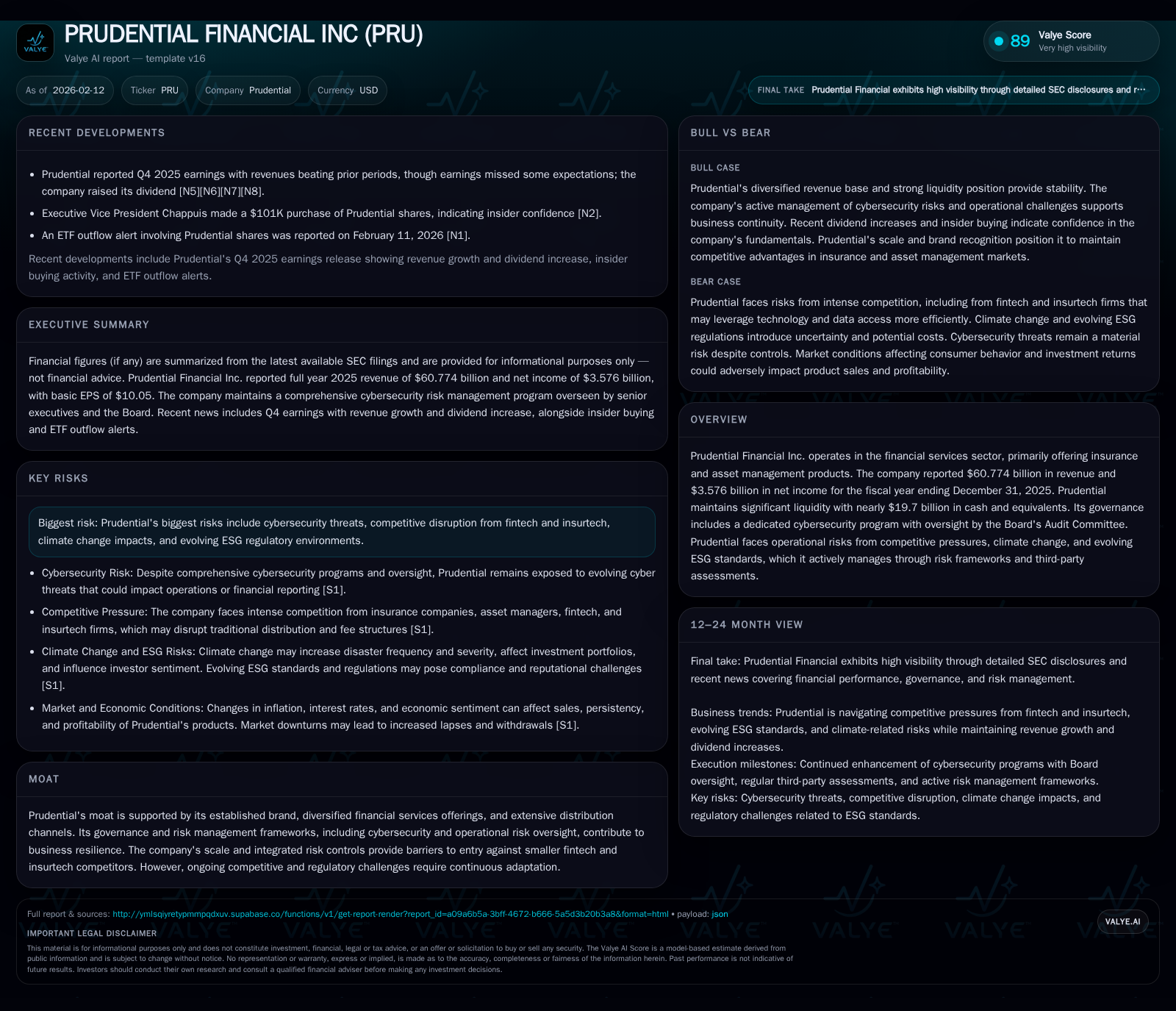
Prudential Financial posted full-year 2025 revenues of $60.774 billion with net income of $3.576 billion, showing solid top-line delivery but earnings pressure amid a changing financial ecosystem. Despite a Q4 earnings miss versus expectations, the company raised dividends—a confident signal to investors backed by insider buying. Prudential leverages scale, brand recognition, and diverse product lines to defend its moat against fintech and insurtech disruptions while maintaining rigorous cybersecurity oversight and navigating complex ESG mandates. Its substantial liquidity position supports prudent capital allocation in a volatile macro environment, though ongoing climate risks and reputation management remain critical focus areas.
Navigating a Quarter of Mixed Signals: Earnings Beat Revenues but Miss Expectations
Prudential Financial closed FY 2025 with revenues climbing to approximately $60.774 billion, affirming the company’s ability to maintain top-line growth in a challenging environment [F1]. Yet net income of $3.576 billion suggests margin pressure that manifested in Q4 results where earnings came in shy of analyst expectations despite a revenue beat [N2][N3][N4]. This juxtaposition underscores a nuanced earnings landscape framed by heightened claims costs in insurance operations and persistent macroeconomic headwinds. The market reaction was tempered; unlike peers such as Markel Corporation reporting both earnings and revenue beats to buoy investor sentiment notably on February 5th [N1], Prudential's mixed performance highlighted operational complexities.
Dividend Increases Amidst Earnings Headwinds: Significance and Market Reaction
Amid this backdrop, Prudential’s decision to raise its quarterly dividend stands out as an assertive signal of management’s confidence in the firm’s underlying financial health and future cash flow generation prospects [N2]. The move counters typical market jitters when earnings falter. Supporting this narrative, Executive Vice President Chappuis’s recent purchase of $101K in shares serves as an insider vote of confidence reflective of long-term value alignment with shareholders [N9]. Such actions may encourage investors to view Prudential’s capital return strategy as credible despite near-term profit pressures.
The Defensive Moat: Prudential’s Brand, Scale, and Distribution Channels
Central to Prudential's durability is its robust moat characterized by an entrenched brand with decades of trust in both insurance underwriting and asset management services [valye_report_excerpt.moat]. The company benefits from deep diversification across financial products which mitigates concentration risk while leveraging an extensive distribution infrastructure—including captive agents, broker relationships, and institutional partnerships—that provides competitive insulation against newer entrants lacking scale or established customer trust [S1][F1]. Integrated risk controls further raise barriers for nimble fintech competitors who may excel technologically but lack comprehensive risk management sophistication.
Cybersecurity: Boardroom Oversight Meets Operational Vigilance
In today’s digital-first financial landscape, Prudential has prioritized cybersecurity as a core pillar of operational resilience. This is manifested through its layered governance structure centered on the Chief Information Security Officer (currently interim) supported by the Information Security Office, with rigorous monitoring protocols designed to detect, mitigate, and remediate cyber threats before material impact occurs [S1]. Oversight extends up to the Board's Audit Committee receiving continuous updates alongside independent third-party program reviews evaluating preparedness. Such comprehensive vigilance reflects recognition that cyber incidents pose not only direct financial risks but also reputational damage that can have prolonged business consequences.
ESG in the Crosshairs: Managing Conflicting Mandates and Investor Expectations
Prudential navigates an increasingly complex ESG terrain marked by evolving regulatory frameworks globally alongside polarized public sentiments about environmental and social governance practices [S1]. While commitments are made toward sustainability and responsible investing objectives, the company must balance conflicting investor demands ranging from aggressively green mandates to growing anti-ESG political pressures which could reduce revenue streams or trigger regulatory scrutiny. Failure to meet shifting or inconsistent ESG standards risks reputational harm or loss of business with certain customer segments or institutional partners.
Climate Change as Both Risk and Investment Challenge
Emerging physical risks tied to climate change affect Prudential on multiple fronts: insurance exposures are subject to more frequent and severe natural disasters increasing claim costs; investment portfolios encounter valuation risks due to shifting regulatory landscapes or sector transitions away from carbon-intensive assets; additionally, climate-induced market sentiment shifts influence investor confidence broadly [S1]. These gray-area impacts require Prudential to embed adaptive risk frameworks capable of incorporating scenario analyses alongside proactive engagement with regulators and stakeholders.
Facing Competitive Pressure: Fintech and Insurtech Disruptors on the Horizon
The competitive landscape continues evolving rapidly as fintech and insurtech companies gain traction through technological agility such as artificial intelligence-driven underwriting models or user-friendly digital platforms providing streamlined customer experiences [S1]. These challengers often operate with leaner cost structures unencumbered by legacy systems that afflict incumbents like Prudential. Fee compression impacts key divisions such as PGIM where passive investment flows and robo-advisory growth exert downward pricing pressure. To remain relevant, Prudential must continuously innovate while leveraging its scale advantage.
Liquidity Strength and Capital Allocation in a Volatile Macro Environment
Prudential ended calendar 2025 holding nearly $19.7 billion in cash and equivalents—a testament to conservative liquidity management amidst global economic uncertainty characterized by inflationary pressures, fluctuating interest rates, and unpredictable rating agency behavior potentially leading to credit downgrades without warning [valye_report_excerpt][F1][S1]. Maintaining ample liquidity affords flexibility in sustaining dividend policies even during earnings softness while investing strategically for growth or addressing unforeseen claims volatility.
Reputation Risk: The Vanguard Asset in an Age of Rapid Public Scrutiny
Reputation remains an intangible yet paramount asset for Prudential whose business fundamentally relies on trust and promise-keeping with policyholders and counterparties alike [S1]. In an era where social media can amplify negative events instantaneously across global audiences, any misstep—be it operational failures or perceived ESG deficiencies—can rapidly erode brand equity. Effective cross-functional risk management integrated into governance frameworks is essential not just to prevent adverse incidents but also to maintain proactive public relations strategies reinforcing corporate values consistently.
Disclaimer: This report is for informational purposes only based on publicly available data as of February 12, 2026. It does not constitute investment advice or recommendations. Readers should conduct their own due diligence before making financial decisions.
Disclaimer: This is research-only, informational analysis and not investment advice. It may include AI-generated interpretation and general industry context. Always verify important details using primary sources.

Comments