
DHI Group, Inc. 2025 Year-End Review: Financial Strain Amid Growth Signals
DHI Group navigates revenue growth and profitability headwinds with liquidity pressures marking the fiscal landscape.
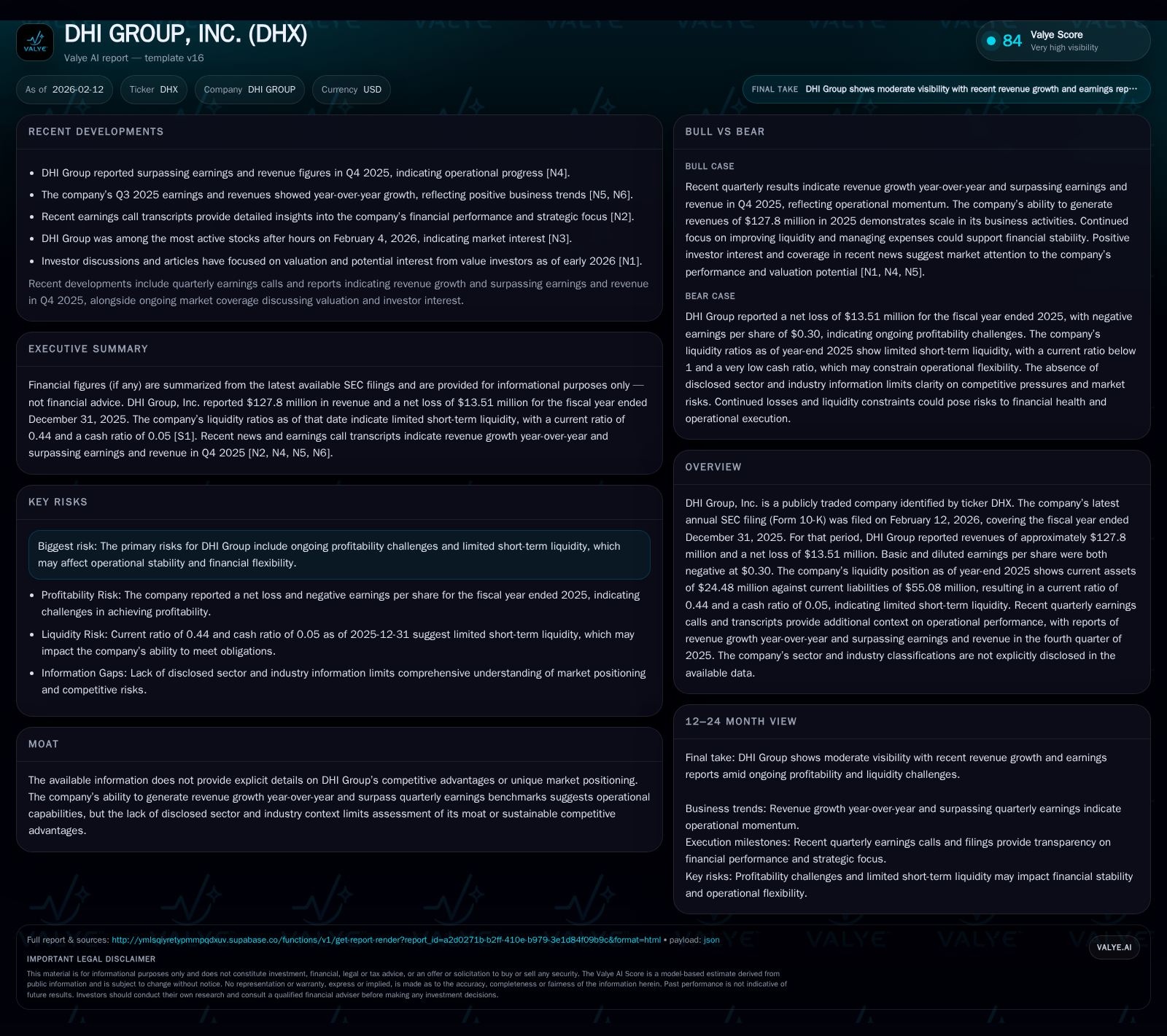
DHI Group, Inc. reported $127.8 million in revenues for fiscal 2025 but incurred a net loss of $13.51 million, highlighting ongoing profitability challenges. Despite surpassing earnings and revenue estimates in Q4 2025, the company's liquidity remains strained with a current ratio of 0.44 and cash ratio near 0.05 as of year-end. The absence of clear industry classification and limited disclosure on competitive positioning complicates evaluation of DHI’s sustainable moat. Operationally, revenue growth underscores potential, yet financial constraints present notable risks going forward.
Overview
DHI Group, Inc., trading under ticker DHX, closed fiscal year 2025 with total revenues of approximately $127.8 million while recording a net loss of $13.51 million [S1][F1]. Despite this bottom-line shortfall, the company demonstrated operational advances, notably surpassing consensus earnings and revenue estimates during the fourth quarter of 2025 [N2][N1]. Such performance points to pockets of growth and execution within its broader financial challenges.
Financial Performance Analysis
Revenue progression during 2025 reflects an encouraging trajectory; however, this has not translated into profitability as evidenced by the net income figure remaining negative at -$13.51 million [F1]. Earnings per share measurements reinforce this trend, with basic and diluted EPS both standing at a negative $0.30 [F1]. This disconnect implies elevated operating costs or other structural factors impacting margins.
Liquidity scrutiny reveals more acute concerns. The company's current assets amounted to $24.48 million against current liabilities totaling $55.08 million at year-end 2025, resulting in a current ratio of just 0.44 [F1]. This metric suggests that short-term liabilities substantially outweigh readily available assets capable of meeting immediate obligations.
Moreover, cash and cash equivalents were recorded at a meager $2.9 million, equating roughly to a cash ratio of 0.05 [F1]. This low liquidity cushion raises questions about financial flexibility should unexpected expenses arise or if operational cash flow deteriorates further.
Recent Operational Insights
Quarterly disclosures provide additional context around operational momentum despite headline losses. The Q4 2025 earnings call transcript highlights revenue growth trends and better-than-forecast outcomes that could signal inflection points in business performance [N1][N2]. These signals indicate that management may be successfully capitalizing on strategic initiatives or market opportunities even as structural profitability hurdles remain unresolved.
However, the absence of segment-level data or detailed industry classification in filings complicates deeper analysis into product lines or verticals driving these improvements [S1]. Similarly, lack of clarity around customer base or competitive advantages impedes precise assessment of DHI's positioning within any identifiable market context.
Competitive Landscape and Moat Assessment
The public disclosures provide limited insights regarding DHI Group’s sustainable competitive advantages. Without explicit sector or industry designations and without detailed discussion on proprietary products or barriers to entry, establishing a durable moat is challenging [S1].
While consistent revenue growth offers some operational validation, it alone does not confirm defensibility against peers or substitutes absent knowledge of market dynamics or intellectual property strength.
Risk Factors and Challenges
The primary risks highlighted revolve around financial stability — namely recurring net losses combined with tenuous liquidity ratios expose DHI to solvency and operational risk [S1]. If cash generation fails to improve in line with revenue gains, the company may face difficulty maintaining normal course investments or meeting debt covenants.
Furthermore, without clear visibility on sector-specific drivers or macroeconomic sensitivities tied to DHI’s operations due to absent industry classifications, it is difficult to gauge external risk exposures comprehensively.
Industry Context (Analysis)
In general terms, companies posting sub-50% current ratios with significant losses often contend with pressing balance sheet restructuring needs or require capital raises to sustain operations long term. Revenue growth in such cases reflects potential yet also raises scrutiny over expense management effectiveness.
In evolving technology-led sectors—if applicable—such profiles are common among firms investing ahead of monetization scalability.[N3] However, firms lacking clarity on differentiation have historically struggled to transition toward sustainable profit engines amidst competitive intensity.
Summary
DHI Group finished fiscal year 2025 reporting meaningful revenue growth but enduring losses that pressured its liquidity position significantly by year-end. While quarterly operational results hint at progress and market traction, constrained short-term financial resources and unclear competitive moats pose ongoing challenges for corporate stability.
Investors and stakeholders seeking comprehensive understanding must weigh positive top-line momentum against solvency risks accentuated by weak coverage ratios and negative EPS trends. The overall picture is one of a company striving for turnaround amid financial headwinds embedded in unresolved structural issues.
This analysis is based strictly on disclosed data from DHI Group’s SEC filings as well as publicly available transcripts and news sources cited herein. No speculative assumptions beyond the provided facts have been included.
Disclaimer: This is research-only, informational analysis and not investment advice. It may include AI-generated interpretation and general industry context. Always verify important details using primary sources.

Comments