CRISPR Therapeutics: Navigating Gene Editing Innovation Amidst Clinical and Regulatory Crosscurrents
A pioneering biotech with the first FDA-approved CRISPR-based therapy faces financial pressures and regulatory uncertainties while advancing diverse gene-editing modalities.
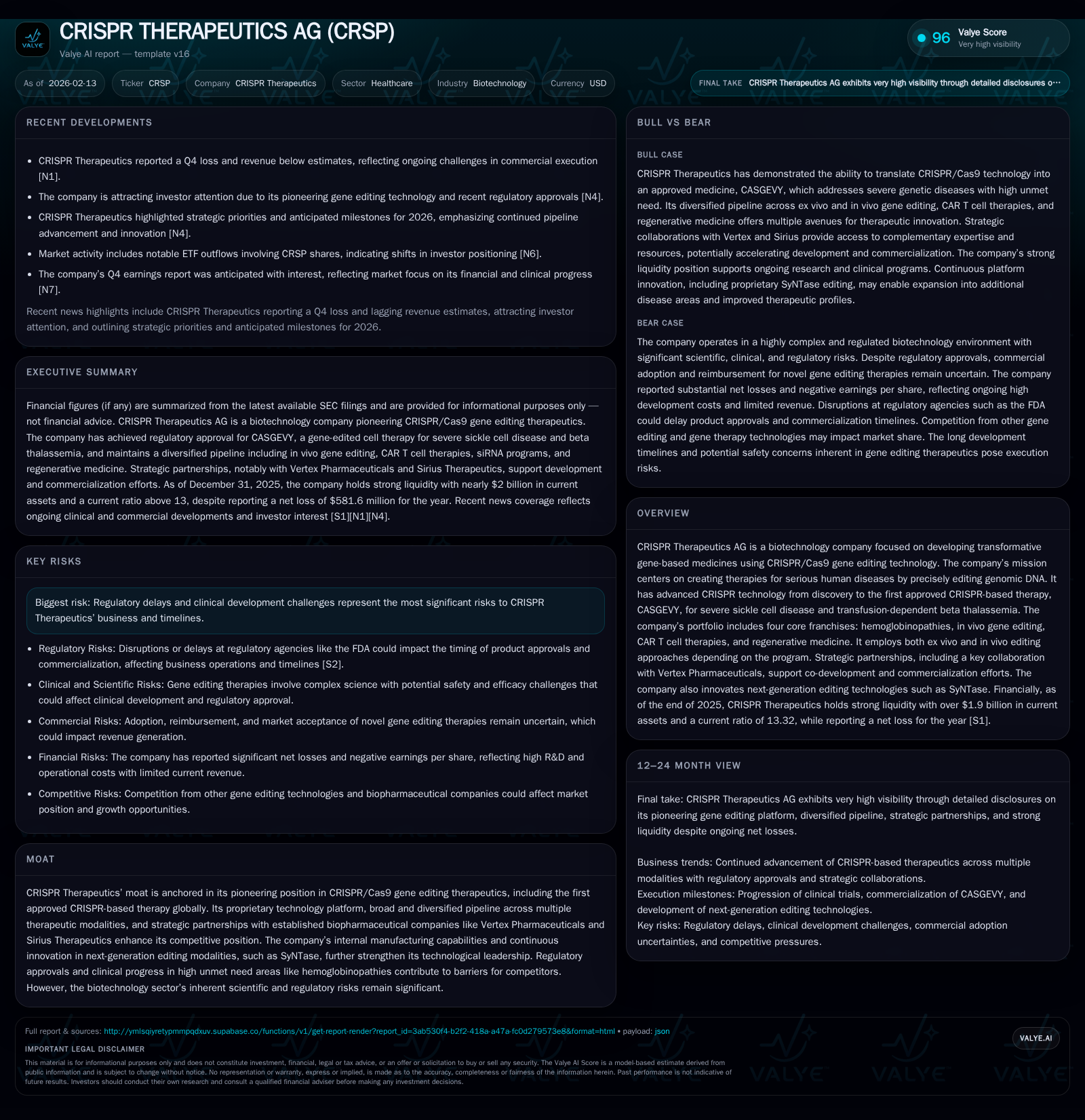
CRISPR Therapeutics AG stands at the forefront of gene editing due to its early approval of CASGEVY, a CRISPR/Cas9-based therapy addressing severe hemoglobin disorders. The company’s pipeline spans ex vivo and in vivo editing, CAR T cell therapies, and regenerative medicine, supported by strategic partnerships like Vertex Pharmaceuticals. Nevertheless, recent quarterly financial results reveal sustained losses, underscoring a heavy investment phase amid delayed revenues. Simultaneously, regulatory challenges including government shutdown-induced FDA delays cast shadows on development timelines. Balancing breakthrough science with pragmatic risks, CRISPR Therapeutics embodies both promise and the complexities of pioneering novel biotechnologies.
CRISPR Therapeutics: Gene Editing Trailblazers
CRISPR Therapeutics AG has carved out a distinctive leadership position in biotechnology through the pioneering development and commercialization of CRISPR/Cas9 gene editing therapeutics. As articulated in their latest 10-K filing, the company’s mission is resolute: to create transformative gene-based medicines that address serious human diseases by precisely modifying genomic DNA [S1]. This revolutionary technology—CRISPR/Cas9—provides an unprecedented mechanism for directly rewriting genetic instructions, potentially correcting disease-causing mutations at their source.
From discovery to regulatory approval, CRISPR Therapeutics has rapidly advanced this platform. Its landmark achievement was the FDA approval in 2023 of CASGEVY (exagamglogene autotemcel), marking the first-ever approved CRISPR-based therapy worldwide [S1]. This milestone not only validates the scientific foundation but also establishes a formidable moat underpinning their competitive positioning. Proprietary gene editing tools combined with internal manufacturing capacity have set a high barrier to entry for competitors attempting to replicate these successes.
Their portfolio spans four core franchises: hemoglobinopathies, in vivo gene editing programs, chimeric antigen receptor T (CAR T) therapies, and regenerative medicine [S1]. The company tailors its approach — either ex vivo or direct in vivo editing — depending on therapeutic goals. Such versatility exemplifies forward-looking innovation coupled with practical application.
CASGEVY and the Race to Transform Hemoglobinopathies
CASGEVY stands as the flagship therapeutic program within CRISPR Therapeutics' portfolio. It exemplifies an ex vivo gene-editing treatment where hematopoietic stem cells are harvested from patients suffering from severe sickle cell disease (SCD) or transfusion-dependent beta thalassemia (TDT). Using precision CRISPR/Cas9 technology to disrupt an erythroid enhancer region of the BCL11A gene, the therapy induces elevated fetal hemoglobin production in red blood cells—a biological workaround that mitigates symptoms driven by defective adult hemoglobin [S1].
This paradigm-shifting mechanism addresses pressing unmet medical needs in genetic blood disorders long plagued by limited treatment options. Underneath this clinical innovation lies a strategic partnership framework; the joint development and commercialization agreement with Vertex Pharmaceuticals has accelerated CASGEVY's path to market while sharing operational burdens [N9]. Ongoing research aims to expand the eligible patient population further by refining conditioning regimens and exploring in vivo editing approaches targeting hematopoietic stem cells [S1].
Pipeline Panorama: Diversification Through Innovation
Beyond CASGEVY, CRISPR Therapeutics pursues a broad array of R&D programs reflecting both scientific ambition and risk diversification [S1]. The company’s portfolio includes:
- In Vivo Gene Editing: Developing therapeutics delivered directly into patients to edit target tissues without cell extraction. This avenue broadens potential applications across rare genetic disorders as well as common diseases.
- Next-generation CAR T Therapies: Engineering allogeneic (“off-the-shelf”) CAR T cell candidates optimized through gene-editing techniques aimed at autoimmune diseases and certain cancers.
- Regenerative Medicine: Advancing device-free beta cell replacement products using precursor islet cells derived from induced pluripotent stem cells (iPSCs) targeting Type 1 diabetes—representing a leap towards restorative treatments rather than symptom management.
- Technological Innovation: Investing in proprietary next-gen platforms such as SyNTase which hold promise for more efficient or targeted editing modalities, potentially expanding therapeutic scope.
By balancing ex vivo methods exemplified by CASGEVY with cutting-edge in vivo approaches and cellular immunotherapies, CRISPR Therapeutics demonstrates strategic maturity essential for long-term competitiveness.
Strategic Partnerships Powering Growth
Recognizing the multifaceted challenges inherent in bringing complex gene therapies from lab bench to patient bedside, CRISPR Therapeutics leverages collaborations with established biopharma entities to pool expertise and resources [S1][N2][N9]. The partnership with Vertex Pharmaceuticals is particularly impactful—enabling shared costs for late-stage clinical trials, regulatory navigation, manufacturing scale-up, marketing infrastructure, and commercial distribution.
Additional alliances, such as those with Sirius Therapeutics (not detailed here but acknowledged historically), contribute further capabilities particularly around delivery technologies or complementary modalities. These collaborations do more than just hedge risk; they accelerate timelines and increase probability of successful launches amid challenging industry dynamics.
Moreover, partnering with players deeply embedded in therapeutic areas expands access pathways for patients while strengthening negotiating power with payers—a critical aspect given high reimbursement scrutiny surrounding advanced therapies.
Navigating Regulatory Labyrinths and Development Risks
No analysis would be complete without acknowledging that regulatory hurdles loom large over innovative biotech ventures especially one as groundbreaking as CRISPR Therapeutics [S2]. The ongoing U.S. federal government shutdown beginning October 2025 has severely hampered key regulatory agencies like the Food and Drug Administration (FDA) from fulfilling normal functions including reviewing new drug submissions or conducting inspections.
As detailed in recent 10-Q filings, these disruptions have resulted in furloughs of critical FDA personnel plus suspension of many activities crucial for timely approvals [S2]. Such bottlenecks introduce uncertainty into developmental timelines extending pipeline maturation periods well beyond original projections.
This risk is far from theoretical – delays affect potential revenue realization windows and can shift competitive balances if rival companies progress faster under less constrained review environments. Moreover, fluctuating FDA staffing levels combined with evolving political oversight intensify unpredictability regarding treatment approvals or guidance issuance frequency.
Biotechnology firms must therefore factor these systemic vulnerabilities into strategic risk management and investor communications given their material impact on business outlooks.
2026 Financial Review: Balancing Investment and Performance
Turning to financial performance illuminated by the recently filed 2025 full-year results provides concrete context on CRISPR Therapeutics’ operational realities [N1][F1]. Total revenue remains minimal at $157 thousand reported back in early 2020; reflecting that commercial sales contributions are nascent largely due to early stage product launches.
However, net loss escalated sharply reaching approximately $581.6 million for the twelve months ended December 31, 2025 [F1]. This deficit mirrors substantial R&D expenditure essential for advancing multiple costly clinical programs alongside general & administrative expenses required to operate at scale amid pathway development activities.
Yet liquidity metrics indicate solid financial health: cash & equivalents stood at around $347.6 million at year-end coupled with current assets vastly exceeding current liabilities yielding a very comfortable current ratio north of 13 [F1]. This balance sheet strength affords runway flexibility enabling continued investment during extended phases typically characterizing breakthrough biotech endeavors.
This financial snapshot underscores a classic biotech model where long lead times precede break-even points necessitating patience from stakeholders aligned with future transformative potential rather than near-term profitability.
Investor Sentiment and Market Dynamics in Early 2026
Market reception around CRISPR Therapeutics through early 2026 showcases nuanced investor reactions influenced by sector-wide themes alongside company-specific news flow [N11][N12][N14]. While enthusiasm buoyed by scientific milestones attracts prominent buyers such as ARK Invest founder Cathie Wood adding positions recently [N14], broader biotech ETF outflows signal caution prevailing amid macroeconomic pressures and volatile market cycles [N12].
Media narratives sometimes juxtapose gene-editing fundamentals against more hyped sectors like artificial intelligence—suggesting differentiated value propositions between areas driven by disruptive science versus tech speculation [N10]. Stock price fluctuations reflect this tension; surges linked tightly to clinical announcements or partnership updates often moderated by profit-taking or sector rotation phases.
Investor focus now increasingly pivots toward tangible commercial proof points such as growing uptake of CASGEVY combined with progress across newer modalities that might unlock additional revenue streams—the transition from theoretical promise toward sustained execution will shape sentiment trajectories.
Looking Ahead: Milestones, Technology, and Market Potential
Looking forward into 2026, CRISPR Therapeutics has outlined pivotal strategic priorities including expanding CASGEVY accessibility beyond initial patient subsets through enhanced trial designs plus advancing pipeline candidates employing novel delivery vehicles like SyNTase platforms poised to overcome existing limitations of gene editing efficiency or tissue targeting [N9][S1].
Success hinges not only on overcoming current regulatory headwinds but also on maintaining momentum amid competitive pressures from emerging genome editors utilizing alternative nuclease systems or base editors—a rapidly evolving landscape demanding continuous innovation alongside judicious clinical prioritization.
Commercially meaningful scaling up of manufacturing capabilities combined with reimbursement negotiations represent additional hurdles yet also gateways to fully unlocking market potential across hemoglobinopathies initially followed by other indications leveraging similar technology foundations.
In summation, CRISPR Therapeutics sits at an inflection point where extraordinary scientific breakthroughs meet complex industry realities requiring deft integration of research excellence, operational discipline, partner synergy, and adaptive risk management. Their journey encapsulates both the promise embedded within gene editing’s transformative power as well as the intricate challenges facing frontier biotechnologies striving toward widespread human impact.
This report summarizes publicly available information about CRISPR Therapeutics AG up to February 2026 based on SEC filings and recent news sources without forming any investment recommendation or forecast. It incorporates fact-based analysis contextualizing company disclosures within broader industry dynamics. Readers should supplement this overview with independent due diligence considering evolving clinical developments and market conditions.
Disclaimer: This is research-only, informational analysis and not investment advice. It may include AI-generated interpretation and general industry context. Always verify important details using primary sources.

Comments