
LXP Industrial Trust's Focused Sunbelt and Midwest Strategy Faces Tenant Risks Amid Plateauing Growth
LXP Industrial Trust maintains a disciplined approach to Class A industrial assets, balancing development-led growth with emerging tenant credit and lease rollover challenges.
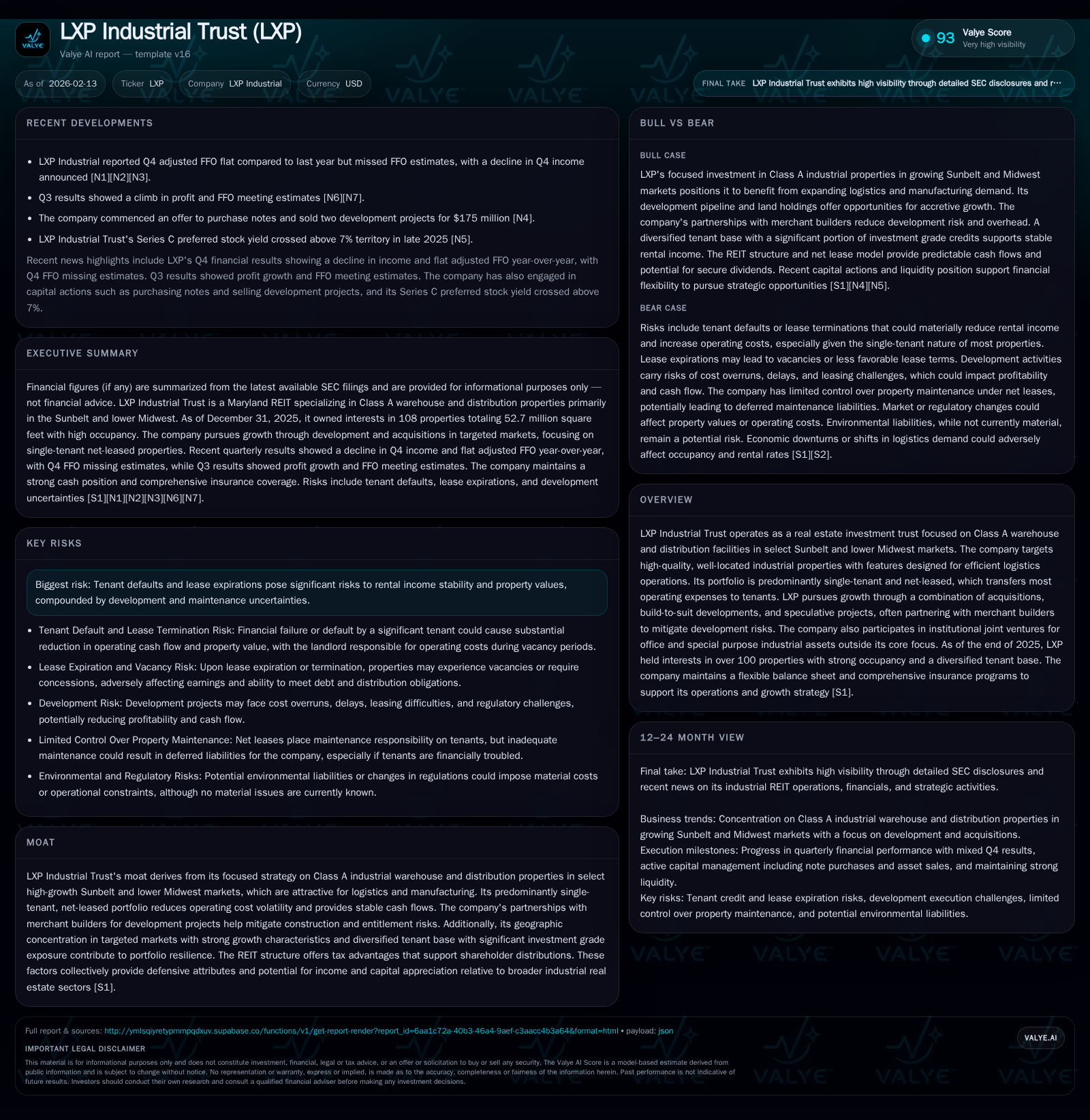
LXP Industrial Trust (LXP) strategically concentrates on high-quality single-tenant industrial warehouses predominantly across select Sunbelt and lower Midwest markets, leveraging net leases to deliver stable cash flow. However, recent Q4 results reflected flat adjusted FFO and missed estimates, intensifying concerns around tenant defaults and lease expirations that could impair income streams. Development partnerships with merchant builders underpin growth ambitions but expose LXP to execution risks in a softening industrial market. The company's robust balance sheet provides financial flexibility, yet the concentrated tenant profile mandates vigilant risk management to sustain its defensive moat.
Industrial Footprint Focus: Why Sunbelt and Lower Midwest Matter
LXP Industrial Trust's geographic concentration is one of its defining strategic pillars. The company invests in twelve key markets primarily within the Sunbelt and lower Midwest regions — areas benefiting from enduring demographic expansion, reshoring of manufacturing operations, and logistics network enhancements. These markets exhibit favorable combinations of employment growth, population migration trends, land availability, labor cost competitiveness, and infrastructure investments that support increased distribution demand. By focusing capital deployment here, LXP aims to harness these secular drivers for sustained property appreciation and income resilience [S1]. This regional discipline reduces competition with coastally saturated markets while aligning the portfolio with evolving supply chain geographies.
The approximately 52.7 million square feet under LXP's ownership as of end-2025 is spread over about 108 consolidated properties distributed across these target markets [F1][S1]. The strategy reflects a concentrated bet on class-A industrial warehouse assets designed for efficient logistics operations—critical as e-commerce penetration continues steady growth balanced by ongoing supply chain reevaluations.
Single-Tenant Net-Leases: Boon or Emerging Vulnerability?
LXP's reliance on predominantly single-tenant net leases is both a strength and a latent vulnerability. Net leases shift expenses like real estate taxes, utilities, insurance, and ordinary repairs onto tenants, significantly reducing landlord operating cost volatility—a boon for predictable cash flows given the generally long-term nature of such agreements [S1]. This structure underpins the trust’s defensive characteristics by limiting landlord responsibilities during stable occupancy.
Yet this business model concentrates risk: tenant financial distress can drastically reduce revenues since the trust is dependent on a limited number of tenants who may represent substantial parts of rental income. In cases of default or bankruptcy filings by tenants, LXP faces not only revenue loss but also responsibility for full operating expenses during vacancies plus potentially costly re-leasing efforts [S1]. Especially when tenants exercise termination options embedded in some leases—albeit often at penalties that are less than the economic value lost—value erosion can be material.
This dual-edged profile demands rigorous tenant credit oversight because single large failures could materially impact distributable funds or cause impairment charges reflecting depressed property valuations.
Decoding Q4: Earnings Flatline and Market Pulse
Recent fourth-quarter results delivered mixed signals that warrant close attention. Adjusted Funds From Operations (FFO)—a key cash flow metric for REITs—came in flat relative to prior year levels while missing consensus estimates [N1][N2]. Moreover, LXP announced a decline in overall income for the quarter [N3].
Despite persistent underlying demand for industrial space fueled by logistical modernization and reshoring trends broadly positive across many markets, investors reacted cautiously. The lack of growth contrasts with expectations set by many peers enjoying robust leasing velocity and rent escalations.
Particularly notable is how flat earnings reflect pressures from expiring leases being renewed at compressed terms or vacant periods post tenant turnover—manifestations linked tightly to the concentrated single-tenant portfolio complexities discussed earlier.
Strategic Growth Through Development: Build-to-Suit and Speculation
LXP pursues growth beyond acquisitions through an active development pipeline incorporating both bespoke build-to-suit projects tailored precisely for anchor tenants alongside carefully selected speculative builds designed partly in partnership with experienced merchant builders [S1]. These relationships help mitigate risks typically associated with entitlement issues or construction cost overruns because builders assume those burdens.
This approach allows LXP to fine-tune tenant specifications early—enhancing leasing certainty—and positions it to capture higher returns relative to simply acquiring stabilized assets. It also injects controlled incremental supply into tight target markets where demand remains healthy without excessive speculative risk concentration.
However, development inherently entails timing risks vis-à-vis lease-up success amid fluctuating market cycles. Effective execution will prove critical for sustaining growth trajectories amid evolving industrial real estate dynamics.
Partnerships That Mitigate Risk: Merchant Builders and Joint Ventures
In addition to direct developments, LXP extends its footprint via institutional joint ventures targeting office spaces or special purpose industrial properties outside its core warehouse focus [S1]. These partnerships are structured to allocate operational responsibilities more efficiently and share risk exposures across collaborators.
Merchant builder collaborations specifically relieve LXP of overhead tied to land entitlements and manage potential cost overruns during construction phases. These alliances represent critical levers enabling scale while preserving balance sheet strength.
Such diversified collaborations enhance portfolio breadth—both geographically within target regions and across complementary asset types—without diluting capital intensity or jeopardizing core industrial expertise.
Risk Underneath Stability: Tenant Defaults and Lease Expiration Exposure
While net leases grant operational predictability under occupancy, they also magnify disruption if tenancy falters. As detailed formally in risk disclosures, tenants undergoing financial distress can reject leases early through bankruptcy protections or exercise contractual termination rights leading to unexpected vacancies [S1]. This dynamic imposes several tangible consequences:
- Abrupt rent roll-offs sharply reduce operating income,
- Landlord assumes full property operating expenses including maintenance costs previously borne by tenants,
- Additional leasing commissions and incentives elevate costs upon re-leasing,
- Property values may decline triggering non-cash impairment charges impacting reported earnings,
- Difficulty enforcing maintenance responsibilities may lead to deferred repairs adversely affecting asset health.
These risks are heightened when significant lease expirations concentrate within short periods or tenant diversification is shallow—a scenario increasingly scrutinized following recent quarters’ results plateau [S1][N1]. Hence continuous proactive asset management coupled with careful tenant credit surveillance remains imperative for sustaining income stability.
Financial Flexibility: Balance Sheet Strength Amid Cash Flow Challenges
Amid challenging market headwinds affecting cash flows from leasing nuances, LXP demonstrates solid financial footing evidenced by its liquidity position exceeding $170 million in cash and equivalents as of December 2025 [F1]. This capital provides a buffer against short-term disruptions stemming from renewal delays or tenant transition costs [S1].
Moreover, maintaining access to varied financing avenues allows opportunistic acquisitions aligned with strategic targets during dislocations or pricing adjustments advantageous relative to replacement cost basis—thus enhancing total return potential over time.
This balance sheet robustness reflects management’s commitment not only to prudent leverage ratios but also flexibility essential to navigate cyclical reverberations inherent in real estate investing.
Portfolio Composition and Tenant Quality: Defensive Attributes Explored
Occupancy rates nearing 97.1% signal resilient demand for LXP’s Class A industrial spaces within selected growing markets [F1]. Further defense arises from a diversified tenant base featuring considerable investment-grade exposure that mitigates default likelihood at the portfolio level despite individual tenancy concentration [S1].
Class A property status connotes superior building quality characterized by modern building materials, design features optimizing logistics operations, efficient layouts accommodating large distribution footprints—all vital differentiators from legacy or lower-tier industrial assets facing secular obsolescence risks.
Together these factors articulate the moat supporting stable rent rolls historically delivered. Yet they concurrently necessitate vigilance given external macroeconomic inputs influencing occupier health such as trade policies impacting reshoring trends or inflation pressures driving operating cost escalations impacting tenant viability.
Market Positioning Versus Peer REITs: A Comparative Insight
Against the broader industrial REIT landscape where multi-tenant portfolios often dominate due to perceived diversification benefits via multiple leases per asset, LXP opts for a comparatively conservative but arguably purer net-leased single-tenant methodology [S1]. This choice trades reduced leasing churn volatility for amplified credit risk concentration.
Peers with more aggressive acquisition pipelines focused on multi-tenant warehouses cater more directly toward users requiring flexible space solutions often achieving faster rent reversion cycles but exposing themselves cyclically during downturns when smaller tenants vacate simultaneously.
LXP’s restrained growth profile privileges predictability over volatility yet depends heavily on management's stewardship managing those concentrated credits effectively while leveraging scale advantages within chosen geographic clusters.
Looking Ahead: Balancing Income Security and Growth Prospects
Navigating forward presents a nuanced balancing act. Stability offered by long-term net leases must confront pacing market anxieties about tenant creditworthiness amidst shifting economic conditions highlighted by flatlined FFO metrics recently reported [N2][N3]. Success likely hinges on focused efforts renewing leases proactively under favorable terms limiting vacancy duration coupled with precise execution of development initiatives mitigating traditional build risks through trusted builder partners.[S1]
In an environment where raw demand drivers underpinning Sunbelt and Midwest industrial real estate remain structurally strong—albeit moderated—the capacity for incremental capital appreciation alongside steady dividend generation depends critically on how well LXP manages its concentrated exposures amid evolving sector dynamics.
Management's ability to maintain financial flexibility while safeguarding high occupancies will be key factors influencing investor perceptions concerning valuation sustainability over medium-term horizons.
This analysis is based on publicly available information as of February 13, 2026. It does not constitute investment advice or recommendations. Readers should consider multiple sources before forming conclusions regarding any security.
Disclaimer: This is research-only, informational analysis and not investment advice. It may include AI-generated interpretation and general industry context. Always verify important details using primary sources.

Comments