
Richtech Robotics: Navigating AI Advances and Operational Challenges at a Crucial Juncture
Richtech Robotics leverages cutting-edge AI partnerships and strong liquidity while confronting scaling demands and governance hurdles.
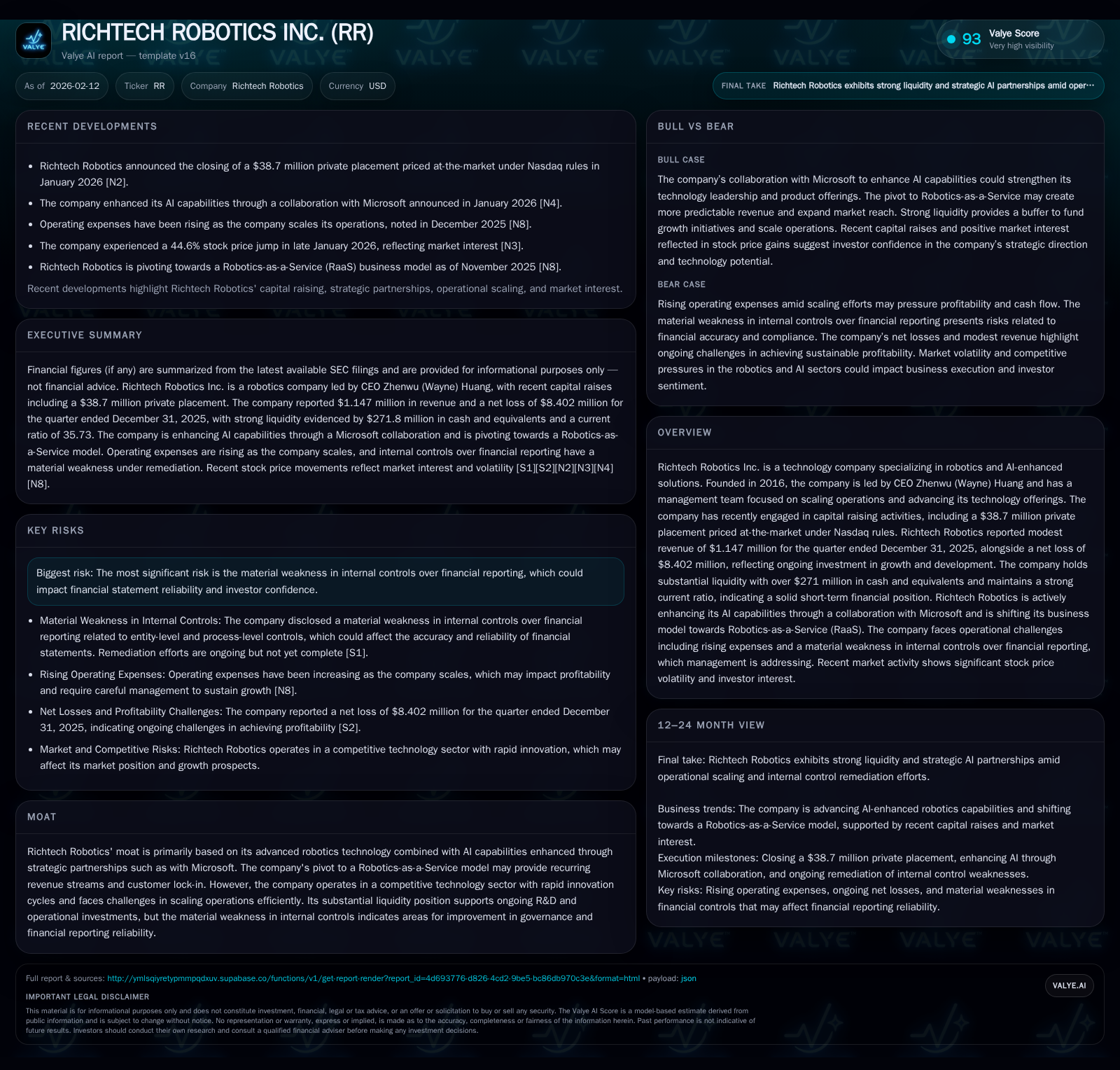
Richtech Robotics Inc. has strategically positioned itself at the forefront of AI-enhanced robotics through an impactful collaboration with Microsoft, signaling its ambition to redefine commercial robotics technology. Despite posting modest revenues juxtaposed with significant net losses, the company’s robust liquidity—bolstered by a recent $38.7 million private placement—provides a powerful financial runway for expansion and innovation. The pivot toward a Robotics-as-a-Service (RaaS) model aims to stabilize revenue streams amid fierce competition and rapid technological shifts. Nevertheless, material weaknesses in internal controls present notable risks that could undermine investor confidence and operational integrity as Richtech scales.
Harnessing Innovation: The Microsoft Collaboration and AI Leap
Richtech Robotics’ recent partnership with Microsoft represents a formidable stride toward embedding advanced AI into its robotics platforms. This collaboration is not merely additive but transformative, enabling Richtech to augment its robots’ autonomous capabilities and data processing finesse while leveraging Microsoft's vast cloud infrastructure and AI toolkits [N1]. Rather than competing solely on hardware specifications, the company is playing to the strengths of intelligently integrated software solutions — a critical differentiator in the fast-evolving robotics landscape.
This strategic alliance reflects Richtech’s acknowledgement that future leadership depends on marrying physical robotics with robust artificial intelligence systems that can adapt in dynamic environments like restaurants, hotels, and healthcare facilities — sectors it targets for deployment [valye_report_excerpt]. The partnership thereby enhances Richtech's moat by creating a technology stack that rivals may find difficult to replicate swiftly.
Scaling Ambitions Amid Financial Realities
Despite these promising technological advances, the financial data paints a picture of a company still navigating growth pains. For the quarter ended December 31, 2025, revenue was reported at $1.147 million, modest by industry standards, whereas net loss ran substantially higher at $8.402 million [F1]. This sizable gap underscores ongoing investments into product development, expanding corporate infrastructure, and efforts to scale operations internationally as projected in the company’s disclosures [S1].
The discrepancy reveals Richtech's current operating model is weighted toward upfront capital deployment before revenue ramp-up—a typical pattern among emerging robotics enterprises but one requiring careful cash flow management over the medium term. Strong balance sheet metrics offer assurance here: notably, a robust current ratio of 35.7 indicates ample short-term liquidity relative to obligations [F1]. However, these numbers also reflect limited revenue diversification as Richtech transitions its model.
The Strategic Pivot: Embracing Robotics-as-a-Service
Central to this evolution is Richtech’s embrace of a Robotics-as-a-Service (RaaS) business model. Moving away from one-time hardware sales towards subscription-based robotics solutions promises recurring revenues and deeper customer engagement [valye_report_excerpt]. This shift aligns with broader industry trends where automation providers are seeking predictable cash flows while enhancing client lock-in via service agreements.
The RaaS model addresses commercial clients’ apprehensions around upfront capital commitments for new technologies by offering scalability and flexibility with managed robotic fleets. While promising improved revenue quality over time, this transition comes fraught with challenges including increased operational complexity, customer support demands, and pressure on margins as service costs mount. Success will depend on Richtech’s ability to deliver reliable autonomous solutions supported by AI-driven updates—a capability boosted by their Microsoft collaboration.
Moat Strengths vs. Fierce Industry Competition
Richtech operates within an intensely competitive arena marked by legacy industrial robot manufacturers and innovative startups vying for leadership in commercial service robotics [S1]. Its moat resides chiefly in its hybrid proposition: sophisticated AI-infused robotics platforms developed alongside strong technology alliances.
However, pace-of-innovation challenges remain formidable as competitors could leapfrog in feature sets or cost-efficiency given superior resources or faster commercialization cycles. Furthermore, incumbent players hold entrenched client relationships which present barriers to market entry for newer entrants like Richtech [valye_report_excerpt]. Maintaining technological relevance demands relentless R&D investment and agile adaptation to user feedback under rapid innovation timelines.
Capital Fortitude: Strong Liquidity Cushion Supporting Growth
One of Richtech’s standout strengths lies in its substantial liquidity position—$271.8 million in cash and equivalents at Q4-end—reflecting both capital raising successes and careful treasury management [F1]. Recently closed was a sizeable $38.7 million private placement at-the-market under Nasdaq rules conducted just weeks prior to Q4 reporting [N3].
This war chest grants Richtech operational flexibility pivotal for ongoing R&D funding, geographic expansion plans beyond U.S. markets outlined in filings, and the patient absorption of near-term operating losses while scaling up sales pipelines [S1]. It also permits strategic optionality whether through organic growth or potential acquisitions should opportunities arise.
Governance Under the Lens: Material Weaknesses in Internal Controls
Amidst these positives lie material concerns surrounding corporate governance highlighted by documented material weaknesses in internal controls over financial reporting [valye_report_excerpt], specifically addressed in their latest annual disclosure [S1].
Such deficiencies compromise financial statement reliability which can erode investor trust—particularly important for publicly-listed small-cap technology firms dependent on external capital access for growth financing. While no immediate corrective measures were detailed recently, remediation will be essential for credible long-term stewardship.
Evaluating Market Risks in an Emerging Field
The nascent domain of commercial service robotics naturally entails high uncertainty. Challenges include slower-than-expected market adoption rates driven by user skepticism or resistance towards co-working autonomous machines alongside humans [S1]. Safety issues—given robots operate autonomously amidst moving obstacles or people—pose significant liability risks if inadvertent incidents occur despite advanced sensors and programming.
Furthermore, unanticipated technological barriers or evolving regulatory landscapes can delay product deployment horizons or raise costs—intensifying funding needs even further in early commercialization phases.
Reading the Financial Pulse: Revenue, Losses, and Cash Flow
A granular review shows Richtech grappling with typical early-stage tech firm dynamics: operating losses ($8.4 million quarterly) significantly outpacing currently thin top-line revenue ($1.15 million). Cash burn aligns with intensive R&D outlays coupled with expenses associated with public company compliance efforts detailed within filings [F1], [S2].
Yet balance sheet strength remains intact as evidenced by strong current assets exceeding current liabilities nearly 36-fold revealing sound short-term solvency supported notably by cash reserves rather than accounts receivable build-up or inventory accumulation [F1]. Financing activities continue to be the primary source of cash inflows emphasizing dependence on equity injections alongside warrant exercises seen historically [S1].
Looking Forward: Opportunities and Headwinds in Commercial Robotics
In sum, Richtech Robotics finds itself at a crucial crossroads — its pioneering AI enhancements backed by global tech partnerships set it apart amidst crowded innovation corridors; meanwhile robust finances underpin ambitions for scaling through subscription models promising steadier income streams.
Yet scaling operationally without sacrificing governance rigor remains paramount especially given risks embedded within an evolving market with unpredictable adoption timelines and regulatory uncertainties [S1]. The coming months will test management’s dexterity implementing quality controls while expanding commercially—a dual imperative shaping whether Richtech fulfills its disruptive potential or struggles against structural challenges framing emerging tech ventures.
Disclaimer: This analysis is based on publicly available information as of February 2026 and does not constitute investment advice or recommendations.
Disclaimer: This is research-only, informational analysis and not investment advice. It may include AI-generated interpretation and general industry context. Always verify important details using primary sources.

Comments