
AIG's Regulatory Mastery and Underwriting Excellence Drive Capital Returns Amid Global Insurance Complexities
American International Group’s robust Q4 earnings underscore its adept navigation of intricate regulations and underwriting prowess driving strategic growth and shareholder value.
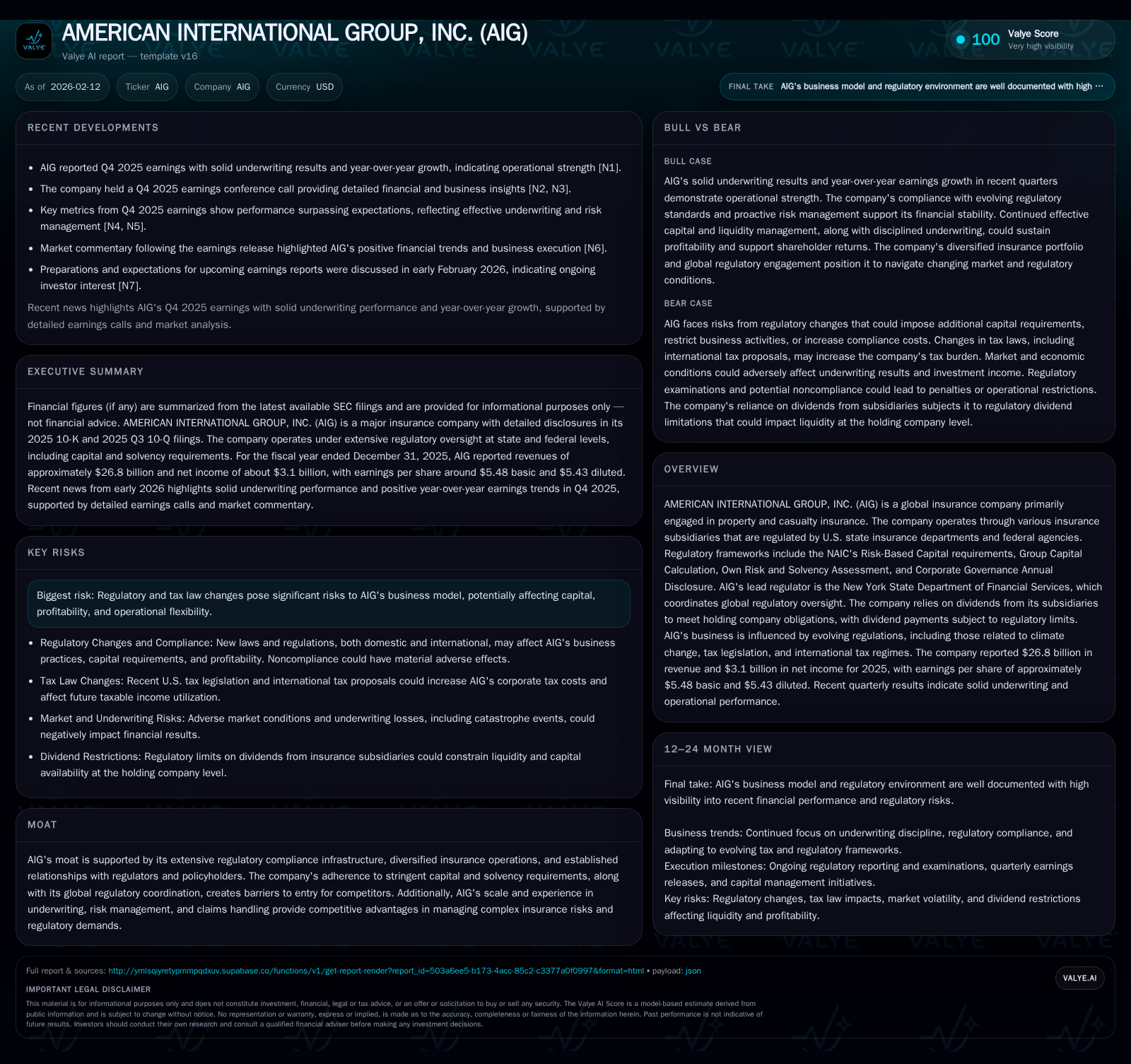
In its latest financial disclosure, AIG demonstrated a strong earnings beat in Q4 2025 driven by solid underwriting results reflected in a combined ratio of 90.1 and a 22% increase in underwriting income year-over-year. This operational strength unfolds within a challenging regulatory environment characterized by multilayered state, federal, and international oversight, which AIG leverages as a competitive moat. The company’s capital return discipline, strategic multi-billion-dollar investments in specialty insurers and asset managers, and prudent risk management frameworks collectively support its standing in the global insurance landscape.
Strategic Underwriting Strength: Dissecting Q4 Earnings Outperformance
American International Group (AIG) closed 2025 on a high note with fourth-quarter earnings exceeding Wall Street expectations. The company produced $2.3 billion in underwriting income—a notable 22% lift from the previous year—and maintained an enviably low combined ratio of 90.1 [N1][N4][F1]. These metrics spotlight AIG's operational excellence where disciplined underwriting selection and cost controls translated directly into profitability gains despite a competitive insurance environment. The underlying improvement in accident year combined ratios illustrates better-than-anticipated loss experience outside catastrophe events—a primary driver of these results [N4]. The earnings narrative underscores how underwriting expertise remains an essential lever translating premium volumes into shareholder value.
Navigating the Web: AIG’s Regulatory Infrastructure as a Competitive Edge
AIG’s business model intricately integrates with an extensive regulatory mosaic shaped primarily by U.S. state insurance departments coordinated through the National Association of Insurance Commissioners (NAIC). The company's lead regulator—the New York State Department of Financial Services—acts as a global nucleus for regulatory oversight [S1][valye_report_excerpt.overview]. Compliance spans Risk-Based Capital requirements ensuring minimum solvency buffers to Own Risk and Solvency Assessments that demand proactive enterprise risk governance. Dividend payments from subsidiaries to the holding company are tightly regulated with prior approvals mandated to prevent destabilizing capital drains [S1]. This labyrinthine oversight creates formidable barriers for new entrants while reinforcing AIG's moat through longstanding engagement with regulators and sophisticated internal governance systems.
Capital Dynamics: Shareholder Returns Amid Regulatory Constraints
Despite stringent dividend approvals embedded in insurance regulation, AIG exhibited considerable financial discipline returning approximately $6.8 billion to shareholders in 2025—split between nearly $1 billion in dividends and $5.8 billion stock repurchases resulting in an 11% reduction in shares outstanding [S1][N13][F1]. These capital deployment actions reflect confidence in balance sheet strength while navigating U.S. state-imposed dividend limitations designed to maintain insurer solvency [S1]. This prudence simultaneously supports valuation metrics such as return on equity (7.5%) and core operating return on equity (11.1%), underscoring efficient use of capital under regulated constraints.
Investment Ventures: Multi-Billion-Dollar Strategic Commitments Explained
AIG's strategic posture extends into diversified investment ventures signaling ambitions beyond traditional lines. Noteworthy is the $2.1 billion investment into Convex Group Limited—a niche global specialty insurer—alongside a near-10% stake acquisition in asset management firm Onex Corporation valued at approximately $646 million [S1]. Further collaboration agreements with CVC Capital Partners, involving separately managed accounts totaling up to $2 billion alongside private equity secondaries evergreen funds commitment of up to $1.5 billion from existing portfolios, illustrate a multifaceted approach integrating asset management expertise with insurance-related investments [S1]. This strategy broadens revenue streams while leveraging market niches requiring specialized underwriting skill sets.
Risk Management Innovations and Accounting Judgments Underpinning Stability
Central to AIG’s resilience is its rigorous approach to critical accounting estimates—most notably loss reserves—which necessitate actuarial modeling infused with judgment amid uncertainty over claim development patterns [S1][S2]. The company regularly refines these estimates yet acknowledges inherent volatility owing to changing loss trends or emerging claim types. Concurrently, enterprise risk management frameworks comprehensively address credit exposure from investments, market fluctuations influencing securities valuations, operational risks including technological threats, and liquidity risks ensuring timely obligations fulfillment [S1]. Technological advancements coupled with corporate governance enhancements support this integrative risk mitigation architecture that buttresses financial stability under dynamic conditions.
Global Footprint and Regulatory Interactions: Beyond U.S. Borders
While U.S. states form the cornerstone of AIG’s regulatory oversight ecosystem, the company must synchronize divergent international regulations impacting subsidiary operations abroad [S1][valye_report_excerpt.overview]. This includes adapting to local capital adequacy regimes, investment restrictions enforcing geographic asset localization mandates, and regulatory dividend controls constraining cross-border capital flows back to the holding company [S1]. Coordination challenges multiply given different supervisory philosophies but also heighten complexity around compliance costs and reporting timelines. Yet this multifaceted jurisdictional presence adds scale benefits enhancing underwriting diversification—integral to spreading risk globally.
Climate Change and Tax Legislation: Emerging Challenges in AIG’s Horizon
Looking forward, evolving regulatory schemata on climate change cast new dimensions onto reserving practices where environmental risks increasingly influence actuarial assumptions around future loss frequency and severity [S1][valye_report_excerpt.risks]. Simultaneously, pending tax legislation changes threaten operational flexibility; notably "ownership change" provisions under Section 382 may constrain future utilization of net operating loss carryforwards vital to tax efficiency [S1]. Such uncertainties require adaptive strategies blending conservative reserving buffers with tax planning agility to maintain profitability amidst shifting policy landscapes.
The Moat in Insurance: Scale, Expertise, and Complex Risk Handling
AIG’s structural advantages extend beyond compliance — its sheer scale allows enhanced bargaining power with reinsurers and distribution networks while facilitating access to diversified data pools refining underwriting analytics [valye_report_excerpt.moat]. Sophisticated claims handling coupled with seasoned risk assessment underpin competitive pricing sophistication necessary in addressing complex commercial lines exposures spanning contingencies difficult for less-experienced peers. These entrenched capabilities create durable market positioning stabilized further by entrenched regulatory relationships difficult for newcomers lacking infrastructure or capital depth.
Financial Ratings Trajectory: How Market Assessments Shape AIG’s Future
Credit rating agencies have recently affirmed or upgraded several of AIG's key insurance subsidiaries’ ratings—Fitch, S&P Global Ratings, Moody’s Investor Service accords plus an affirmation from A.M. Best—that fortify market perceptions around financial strength [S1]. These endorsements reduce borrowing costs improving liquidity access while bolstering counterparty confidence essential for reinsurance transactions and large scale client engagements amid cyclical pressures facing the sector.
Synthesizing Prospects and Risks: Balancing Growth with Regulatory Uncertainties
AIG stands at a crossroads balancing recognized growth trajectories against intensifying regulatory scrutiny which inherently injects volatility implications into earnings profiles as reflected by recent reports noting decreased bottom-line results despite underlying operational strength [N14][S1][valye_report_excerpt.risks]. Success hinges on agile navigation through legal reforms—spanning climate-related disclosures to tax code shifts—while leveraging core underwriting competencies synergized with strategic investment expansions diversifying future profit streams. Maintaining this equilibrium will define sustainable value creation amid evolving global insurance ecosystems.
This report synthesizes information publicly available as of February 12th, 2026 including SEC filings and market intelligence without offering investment advice or recommendations.
Disclaimer: This is research-only, informational analysis and not investment advice. It may include AI-generated interpretation and general industry context. Always verify important details using primary sources.

Comments