SITIME Corp: MEMS Timing Innovation Tackles Semiconductor Cyclicality Amid Concentration and Supply Chain Risks
SITIME's MEMS-based precision timing solutions disrupt legacy quartz technology, powering AI and communications with challenges from industry volatility and customer dependency.
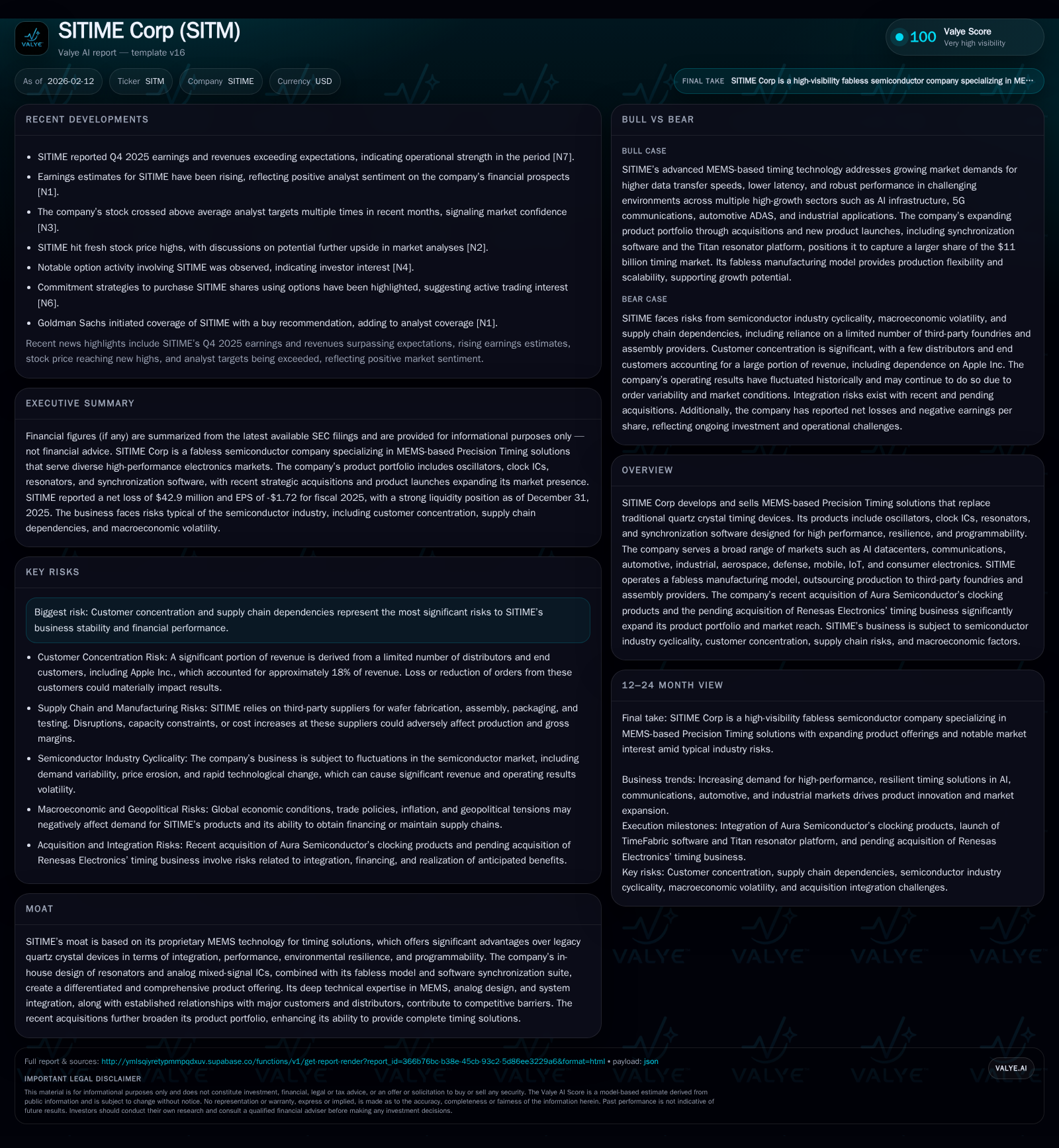
SITIME Corp has pioneered MEMS precision timing devices that markedly outperform traditional quartz crystal oscillators by offering superior integration, resilience, and programmability—a technological leap critical to cutting-edge markets such as AI datacenters and aerospace. Recent acquisitions significantly expand its portfolio, complementing strong Q4 2025 financial results that ignited investor enthusiasm. However, the company remains exposed to the semiconductor sector’s inherent cycles, concentrated customer revenue—dominantly from Apple and top distributors—and supply chain fragilities tied to its fabless manufacturing model. SITIME’s substantial liquidity buffers near-term risks, but navigating macroeconomic headwinds and sustaining innovation execution will be pivotal to balancing growth ambitions with prevailing market uncertainties.
From Quartz to MEMS: SITIME’s Technological Breakthrough
Timing components underpin virtually every modern digital system — from microprocessors in smartphones to radar arrays in satellites. Traditional quartz crystal oscillators have served as the cornerstone of electronic timing for decades due to their frequency stability and low cost. Yet quartz technology is inherently limited by its size, fragility under harsh conditions, fixed frequency offerings, and complexity integrating with semiconductor processes.
SITIME Corp has upended this paradigm by developing a proprietary MEMS (micro-electro-mechanical systems) based approach to Precision Timing. Unlike competitors who rely on quartz resonators or outsource analog circuit design, SITIME designs both its resonators and analog mixed-signal clock ICs in-house. Their MEMS devices are fabricated using advanced semiconductor processes that yield oscillators far smaller than quartz counterparts with superior resistance to shock, vibration, temperature extremes, and electromagnetic interference [S1][valye_report_excerpt].
Moreover, SITIME's timing products are programmable with integrated digital control allowing dynamic frequency adjustments — a capability quartz crystals cannot match without external circuitry. This programmability enhances system flexibility in rapidly evolving applications such as AI hardware requiring precise synchronization or automotive systems needing rugged reliability under environmental stress.
Combined with proprietary software synchronization suites that optimize timing accuracy across distributed systems, SITIME offers an integrated solution from silicon resonator through clock IC to system-level management — a holistic stack inaccessible to most traditional quartz oscillator manufacturers [valye_report_excerpt]. This fusion of MEMS mechanical engineering with advanced analog design establishes SITIME's moat backed by complex cross-domain expertise not easily replicated.
Precision Timing in the AI Datacenter and Beyond
The explosion in AI workloads has reinvigorated demand for high-precision timing components. Datacenters running AI models depend on tightly synchronized clock signals for processor coordination and data integrity at massive scale. SITIME has capitalized on this secular trend; it reports robust revenue growth from AI-focused deployments as of 2025 [valye_report_excerpt].
Beyond datacenters, diverse markets from telecommunications infrastructure upgrading to 5G/6G standards to increasingly autonomous automotive safety electronics rely critically on precise timing signals resilient against interference — a core strength of SITIME's MEMS solutions. Aerospace and defense customers prioritize ruggedness and reliability where quartz devices often fall short. In IoT and mobile consumer devices where power efficiency and miniaturization matter immensely, SITIME’s low-power small-form-factor offerings gain traction.
The company estimates the total global timing market at around $11 billion with strong growth driven by next-generation computing platforms [valye_report_excerpt]. Its positioning across over 400 end applications reflects both scale and diversified industry exposure albeit within a focused high-end precision niche.
Acquisitions Accelerate Portfolio Expansion
In late 2025 and early 2026, SITIME strategically bolstered its product breadth through the acquisition of Aura Semiconductor’s clocking product line alongside a pending transaction for Renesas Electronics’ timing business [valye_report_excerpt]. These moves expand beyond oscillators into complementary clock ICs and synchronization technologies potentially widening addressable markets.
Such inorganic growth efforts provide multiple benefits: supplementing internal R&D pipelines; accelerating time-to-market through established product lines; expanding customer relationships particularly with Tier-1 OEMs; and potentially easing reliance on any single product category or customer channel.
This broadened offering could better position SITIME against diversified competitors including quartz incumbents trying to modernize offerings while also reinforcing its status as a comprehensive Precision Timing supplier capable of addressing complex system demands end-to-end.
Decoding the Latest Earnings Beat and Investor Response
Q4 2025 results marked a notable inflection point for investor sentiment. Revenue exceeded analyst expectations coupled with improvements in gross margins according to transcripts from the earnings call [N2][N3]. Post-earnings stock action saw a breakout past average analyst price targets reflecting confidence in operational execution [N4][N5][N10].
Additionally, increased bullish options activity signaled growing speculative interest aligned with anticipated momentum continuation [N6][N8]. Barclays’ recent upgrade further underscored institutional recognition of SITIME’s improving fundamentals amid semiconductor market optimism [N9].
These finance metrics mirror underlying technical leadership in MEMS timing integrated with strategic acquisitions setting a foundation for scaling revenue while managing costs. Investor enthusiasm appears tethered both to near-term performance beats as well as longer-term vision of Silicon Valley-style disruption within a traditionally staid segment.
Navigating Semiconductor Cycles: Growth Meets Volatility
Despite technological advances fueling demand surges, SITIME remains vulnerable to the semiconductor sector’s classic boom-bust rhythms [S1][S2]. Rapid innovation cycles cause frequent product obsolescence paired with aggressive pricing that compresses margins over time.
Moreover, broad macroeconomic factors like inflationary pressures or geopolitical tensions frequently ripple down causing inventory corrections across customer bases — disrupting demand visibility for suppliers like SITIME. Historical experience includes inventory adjustments by customers leading to revenue volatility especially pronounced in prior years like 2023 [S1][S2].
While new product introductions around AI infrastructure somewhat soften this cyclicality impact presently by feeding stronger order books, there is no escaping underlying structural volatility inherent to semiconductors which color medium-term outlooks.
Supply Chain Spotlight: The Fragility Beneath Fabless Model
Operating a fabless manufacturing model enables SITIME flexibility and cost advantages but engenders dependencies on external foundry partners for wafer production plus assembly/test suppliers [S1][S2].
Global supply constraints over recent years exacerbated by political hostilities (notably U.S.-China trade frictions), logistics bottlenecks post-COVID lockdowns, raw material shortages, energy price spikes—all shape capacity availability risks critical for timely delivery.
The company warns that insufficient foundry/assembly capacity could hinder ramp-up plans or inhibit fulfillment during peak demand cycles. Given ultra-fine-tolerance MEMS fabrication sensitive to process variations coupled with intricate packaging requirements enveloping both resonator die plus analog ICs internally designed—outsourcing complexity always carries potential delays or quality risks [S1][S2].
This delicate upstream supply situation underlines an often overlooked operational vulnerability contrasting favorably controlled internal design intellectual property.
Customer Concentration: A Double-Edged Sword
Revenue concentration presents another material challenge affecting financial stability [S1]. The top three distributors accounted for approximately 59% of total revenue in 2025—a slight increase from prior years—accentuating dependency on key distribution channels funneling products into major OEM customers.
Even more strikingly Apple alone represented about 17% of revenues last year representing sizeable single-customer risk should orders diminish due to shifting tech cycles or supplier switching strategies [S1]. While Apple’s scale provides valuable steady demand support aligned with premium device rollouts leveraging advanced timing chips, such concentration can lead quickly to revenue swings if contracts are not renewed or volumes plateau.
Efforts at portfolio expansion via M&A likely aim in part at diversifying customer exposure while deepening penetration across other verticals, but the reliance remains significant mandating ongoing risk vigilance.
Financial Health Check: Strong Liquidity Amid Recent Losses
Though SITIME reported a net loss of approximately $42.9 million for fiscal year 2025 [F1], liquidity metrics tell a more reassuring story about short-term financial resilience. The year-end balance sheet showed current assets well exceeding current liabilities—a ratio near 11.3—indicating ample working capital buffer to sustain operations even as investment spend continues [F1].
Such cushion provides necessary runway not only for absorbing cyclical downturn effects but also funding M&A initiatives aimed at extending the product suite organically supplemented by acquisitions noted earlier.
Still profitability challenges reflect transitional phases embracing growth-oriented commercialization expenses versus legacy volume maturity dynamics common across capital-intensive semiconductor innovators.
Looking Ahead: Balancing Innovation with Macroeconomic Drag
Looking forward, SITIME stands at a crossroads emblematic of many semiconductor innovators bridging past legacy tech replaced by disruptive platforms integrated into emerging end markets.
Success will require disciplined execution integrating acquired product lines smoothly alongside continuing R&D advancing proprietary MEMS innovations enhancing programmability and robustness vital to future demands [S1][valye_report_excerpt].
Concurrently navigating slowing macroeconomic environments clouded by inflation concerns, geopolitical uncertainties impacting supply chains plus capital access will test strategic agility severely [S2][N1]. Sustained focus on broadening customer base beyond dominant accounts while managing exposure prudently remains imperative.
In sum,SITIME exemplifies Silicon Valley ingenuity reimagining critical timing components through MEMS technology uniquely suited for an increasingly connected intelligent world — yet encumbered by typical semiconductor cycle volatility plus concentrated customer dependencies necessitating balanced perspective between opportunity upside versus operational risk realities.
This analysis is based on publicly available information as of February 12, 2026. It does not constitute investment advice or recommendations but aims to provide an informed overview grounded in SEC filings and recent industry context.
Disclaimer: This is research-only, informational analysis and not investment advice. It may include AI-generated interpretation and general industry context. Always verify important details using primary sources.

Comments