
Inflection Point Acquisition Corp. IV Advances Autonomous Fixed-Wing Flight Amid Heavy R&D and Regulatory Hurdles
Merlin Labs integration propels development of Merlin Pilot platform, with key US Air Force contract underway but continued losses and certification challenges loom.
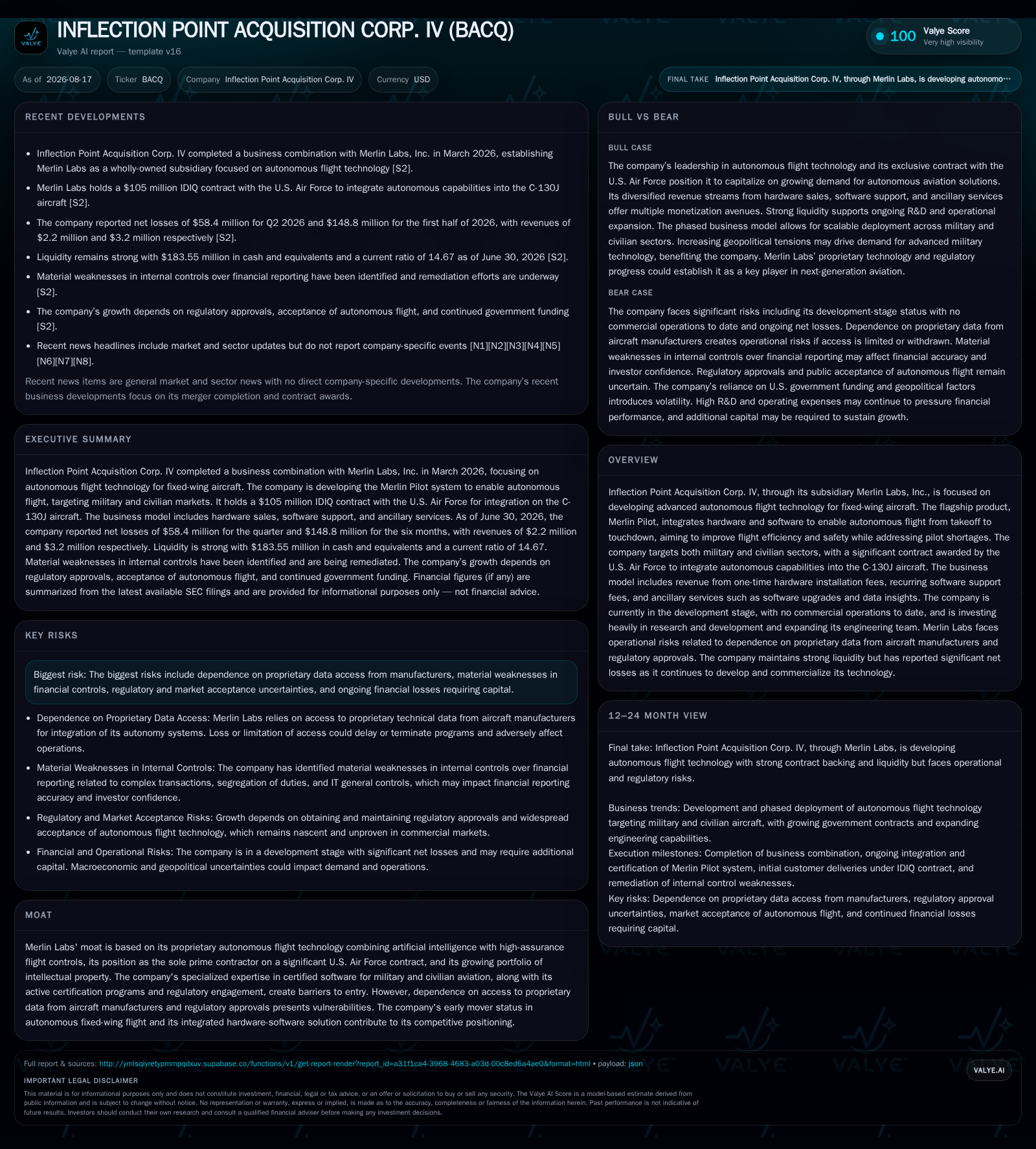
Inflection Point Acquisition Corp. IV (ticker BACQ) operates through its subsidiary Merlin Labs to develop autonomous flight technology for fixed-wing aircraft, combining hardware and AI-powered software to enable fully autonomous operations from takeoff to landing. The company is in a critical development phase supported by a $105 million ceiling U.S. Air Force IDIQ contract, highlighting strategic positioning in military autonomy amid pilot shortages. However, it continues to incur substantial net losses driven by increased R&D and administrative costs as regulatory certification efforts progress. Access to proprietary aircraft data and evolving regulatory acceptance remain key risks that will shape the path to commercialization.
Recent Operating Update
Inflection Point Acquisition Corp. IV's latest quarterly filing dated August 14, 2026 ([S2]) reveals critical developments as the combined company, now operating post-merger as Merlin, Inc., advances its flagship autonomous flight product, Merlin Pilot. For Q2 2026, the firm reported a net loss of $58.4 million, a material increase from $16.3 million in Q2 2025. The loss growth primarily reflects significant expansions in research and development (R&D) spending, alongside elevated general & administrative (G&A) expenses related to operational scaling post-Business Combination with Merlin Labs ([S2],[S20]).
Importantly, Merlin functions as prime contractor under an Indefinite Delivery Indefinite Quantity (IDIQ) contract with U.S. Air Force Special Operations Command (USSOCOM), providing an institutional revenue anchor valued up to $105 million ([S2]). This contract validates Merlin's technology relevance in military autonomous fixed-wing applications but revenue recognition remains nascent given ongoing delivery phases. The company projects deploying the first Merlin Pilot on either commercial or military fixed-wing aircraft within three years ([S2]), situating it well into the industry's long lead times for certification and market entry.
Business Model
The company's business model revolves around delivering integrated hardware installations coupled with proprietary AI-flight control software that automates full flight cycles for fixed-wing aircraft—from takeoff through landing ([S1],[S2]). Revenue generation relies on upfront fees from hardware installs augmented by recurring software support subscriptions which provide higher-margin stability typical of aerospace autonomy startups ().
Contracts principally serve government military customers initially, leveraging the IDIQ contract platform while prepping pathways into commercial aviation—where pilot shortages are driving demand for autonomous augmentations (,). Revenue scales with aircraft equipped, software licenses renewed, and ancillary services such as ongoing system upgrades or data analytics. The extensive R&D investments partly relate to complex certification programs addressing stringent safety and compliance requirements governing both military and civilian aviation sectors ([S1],[S2]).
Industry Structure and Competitive Position
Inflection Point competes within a nascent yet rapidly evolving autonomous flight ecosystem characterized by slow-moving regulatory frameworks, heavy R&D burdens, reliance on partnerships with original equipment manufacturers (OEMs), and dominance of aerospace primes. The company benefits from its role as sole prime contractor on a major U.S. Air Force autonomous fixed-wing contract—a position few peers hold outside large defense entities like Lockheed Martin or specialized players such as Aurora Flight Sciences (,).
Its competitive moat stems from specialized intellectual property combining advanced artificial intelligence algorithms integrated tightly with high-assurance certified flight control systems—technology that requires deep regulatory engagement and lengthy testing cycles (). Proprietary data access from airframe manufacturers underpins successful platform integration; restricted or revoked access could materially disrupt product delivery or industry trust ([S1]). Strategic collaborations such as the earlier partnership with GE Aerospace reinforce technology validation but also illustrate OEM collaboration dependencies.
Growth Drivers
The primary structural growth lever is an acute global pilot shortage intensified across commercial airlines and military fleets alike—prompting operators to seek autonomy solutions mitigating crew constraints while boosting utilization (). Parallel trends include persistent military modernization drives favoring unmanned or minimally crewed platforms enhancing operational flexibility.
Technological advancement in AI-enabled flight controls and sensor suites improves solution safety margins over time, facilitating regulatory agencies’ acceptance of autonomous operations—an essential precondition for broad adoption (). Long-term government contracts provide steady funding for continued development plus validation benchmarks.
Commercial aviation cost pressures accelerate fleet operators' interest in efficiency gains achievable via autonomy-driven route optimization or higher cycles per day—potentially translating into millions saved per aircraft annually (). Additionally, expanding certifications across new categories of fixed-wing aircraft create incremental addressable markets.
Risks and Constraints
Foremost risk lies in reliance on proprietary technical data controlled exclusively by aircraft OEMs necessary for system integration—this data governs avionics interfaces crucial for safe operation ([S1]). Any inability to maintain access due to competing OEM strategies or contractual impediments poses engineering challenges that may delay certification or force redesigns.
Certification remains an arduous pathway involving iterative testing against rigorous aerospace safety standards for both military and civilian markets; any slipups can postpone commercialization timelines materially (,).
Financially, persistent net operating losses fueled by aggressive R&D scaling stretch cash reserves despite a robust June 30 cash balance ($183.6 million) devoid of debt ([F1]).
Additional risks include potential material weaknesses in internal financial controls reported previously impacting reporting reliability ([S1]) alongside geopolitical uncertainties affecting defense budgets or commercial airline operations globally ( [S15],). Market acceptance of autonomous flight solutions outside distinctly measured safety improvements remains unproven at scale.
What To Watch Next
Key near-term execution metrics include progress toward critical certification milestones tied to regulatory approvals which will shape commercial readiness timelines (,).
Monitoring contract backlog evolution beyond the existing USSOCOM ceiling will provide insight into pipeline strength alongside implementation cadence across multiple aircraft platforms targeting commercial entry.
R&D expenditure trends versus achieved integration cycle-time efficiencies will indicate whether technical challenges are being addressed effectively or escalating with complexity. Sales & marketing spend trajectories should be watched for evidence of ramping commercialization efforts beyond government contracting niches.
Financially, updates on cash burn rates relative to capital-raising activities —including potential PIPEs or debt issuance—will clarify balance sheet runway amid ongoing investment intensive business model economics ([F1],[S15]).
Finally, any disclosures around OEM partnerships or data-sharing agreements bear significance due to their pivotal role in sustaining technical moat and platform viability.
Financial Profile Discussion
As of June 30, 2026, Inflection Point Acquisition Corp. IV reported a cash and equivalents balance totaling approximately $183.6 million with zero outstanding debt obligations following repayment of prior term loans earlier in the year ([F1]). The absence of leverage provides flexibility but does not preclude future financing needs given ongoing negative EBITDA results reflecting development-stage expenditures—EBITDA stood at negative $58.7 million in Q2 2026 compared to negative $14.5 million a year earlier ([S2]).
Research & Development expenses rose sharply by about 139% year-over-year during Q2 2026 driven by hiring specialist engineers and outsourcing technical consultants vital for resolving complex airborne integration challenges ([S20]). Concurrent increases in selling/marketing (+274%) reflect accelerated go-to-market preparation while general/admin leapt over 300% attributable mainly to legal, accounting fees related to public listing compliance costs after business combination completion ([S20]).
Interest income grew substantially tied to larger cash holdings held in interest-bearing instruments post-PIPE funding rounds offsetting minimal interest expenses now recognized due to accounting changes regarding prior loan instruments ([S20]). This stabilized financing cost profile aids financial health but sustainable profitability remains contingent on transitioning swiftly from R&D burn toward recurring software revenue streams.
In sum, while well-capitalized presently, the company faces a classic early-stage technology commercialization profile: high cash consumption accompanying heavy investment in platform maturation coupled with uncertain timing on achieving profitable scale amid regulatory approval pipelines.
This analysis is based solely on publicly available filings up through August 2026 combined with industry context commentary; it does not constitute investment advice nor reflect investor research views. Investors should conduct additional due diligence where necessary before making decisions.
Disclaimer: This is research-only, informational analysis and not investment advice. It may include AI-generated interpretation and general industry context. Always verify important details using primary sources.

Comments