
Yesway Q2 2026: Strong Net Income Growth and Solid Liquidity Support Expansion Strategy
Yesway, Inc. reported a tripling of net income for the first half of 2026 alongside stable liquidity and leverage, underpinning its acquisition-driven growth.
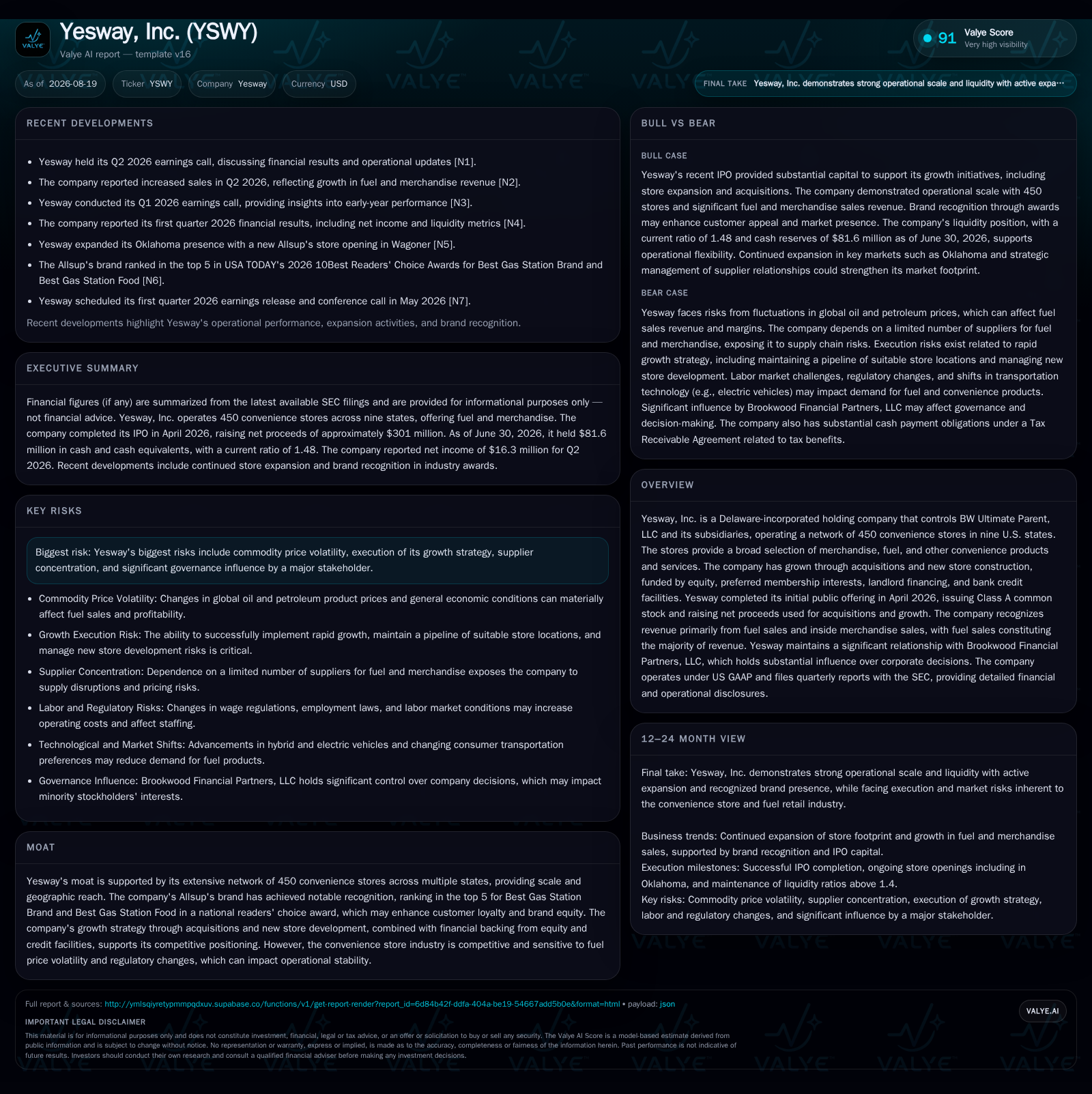
Yesway, Inc. achieved net income of $59.9 million for the six months ended June 30, 2026, more than tripling from $18.5 million in the prior year period. The company’s liquidity position remains solid with $81.6 million in cash and a current ratio of 1.48, supporting ongoing operations and acquisitions. Despite significant total debt of $399.5 million, Yesway’s net debt of approximately $317.9 million reflects moderate leverage. Operating a network of 450 convenience stores across nine states, the company’s profitability gains and balance-sheet stability are critical for sustaining its expansion strategy amid fuel price volatility and competitive pressures.
Latest Quarterly Financial Performance
Yesway, Inc. reported a significant increase in net income for the six months ended June 30, 2026, achieving $59.9 million compared to $18.5 million in the same period of 2025 [S2]. This tripling of net income reflects improved operational profitability and suggests potential margin expansion or gains in operating leverage. Notably, depreciation and amortization expenses remained relatively stable, with $32.6 million in the first half of 2026 versus $31.2 million in the prior year period, indicating that the profitability improvement is driven more by enhanced revenue generation or cost efficiencies rather than reduced non-cash charges [S2].
The increase in net income also supported higher net cash provided by operating activities, reinforcing the company’s capacity to generate cash internally and fund growth initiatives without excessive reliance on external financing [S2]. This positive cash flow dynamic is critical for Yesway as it pursues an acquisition-driven expansion strategy and invests in new store development.
Balance Sheet and Liquidity Position
As of June 30, 2026, Yesway held $81.6 million in cash and cash equivalents, contributing to a current ratio of 1.48, with current assets totaling $232.9 million against current liabilities of $156.9 million [F1]. This liquidity position indicates positive working capital coverage, which is essential for meeting short-term obligations and supporting ongoing operational needs.
Despite this liquidity, the company carries significant leverage, with total debt of $399.5 million and net debt of approximately $317.9 million after subtracting cash balances [F1]. This level of leverage influences Yesway’s financial flexibility and risk profile, particularly given the cyclical nature of the fuel retail industry and exposure to commodity price volatility. The net debt to EBITDA ratio, while not explicitly disclosed, is an important metric to monitor in future filings to assess leverage sustainability.
Yesway's liquidity and net leverage metrics as of June 30, 2026, include a current ratio of 1.48 and net debt of approximately $317.9 million [F1]. These figures may provide some capacity to support acquisitions and new store developments, which are part of its reported growth activities. However, the company's debt level warrants continued observation to assess refinancing risks and covenant compliance, particularly given potential volatility in fuel prices.
Business Model and Competitive Positioning
Yesway operates approximately 450 convenience stores across nine U.S. states, primarily generating revenue through fuel sales supplemented by inside merchandise such as food and other convenience items [S2]. Fuel sales constitute the majority of revenues, a common characteristic in the fuel retail and convenience store sector where gross margins are sensitive to fuel price fluctuations.
The company’s geographic footprint and brand recognition, including operations under the Allsup's brand, provide scale benefits and competitive positioning within its markets [S2]. This network supports revenue stability by diversifying regional exposure and customer bases. The multi-state presence allows Yesway to leverage operational efficiencies and negotiate favorable supply agreements, which can contribute to margin improvement.
Profitability in this sector depends on balancing fuel volume sold and merchandise sales mix, with merchandise typically offering higher margins. Operational efficiencies and cost management also play critical roles in driving margin expansion and cash flow generation. Yesway’s recent net income growth suggests it may be successfully enhancing these aspects, although fuel price volatility remains a key margin risk.
Risks and Industry Context
The convenience store and fuel retail industry is structurally competitive but subject to cyclical pressures, notably fuel price volatility and regulatory changes that can impact operating costs and consumer demand. Yesway’s significant exposure to fuel sales means that fluctuations in commodity prices can materially affect gross margins and profitability.
The company’s leverage reflects a total debt of $399.5 million with $81.6 million in cash as of June 30, 2026, resulting in net debt of approximately $317.9 million [F1]. This level of leverage requires monitoring, as it could increase financial risk if operating performance deteriorates due to adverse market conditions or regulatory constraints. This scenario assumes sustained fuel and merchandise demand, effective integration of acquisitions, and a stable or favorable fuel pricing environment. This scenario assumes moderate fuel price fluctuations, a stable competitive environment, and continued access to capital markets. This scenario assumes sustained fuel price declines or volatility, regulatory cost increases, and deterioration in credit markets limiting refinancing. This conclusion is supported by the stable depreciation and amortization expenses, indicating improved profitability rather than cost reductions alone [S2].
Monitoring changes in total and net debt levels could provide insight into Yesway's leverage management over time. Additionally, fuel price trends and regulatory developments are important external factors that may influence margins. Announcements of acquisitions or new store openings could serve as indicators of progress related to the company’s growth activities.
However, its significant leverage and exposure to fuel price volatility warrant careful ongoing scrutiny to ensure financial flexibility and operational resilience.

Comments