
Blue Biofuels Advances Cellulosic Biofuels with Patented CTS Technology Amid Early Commercialization Challenges
Blue Biofuels is developing its patented Cellulose-to-Sugar (CTS) technology to produce sustainable biofuels but faces significant financial and regulatory hurdles in scaling production.
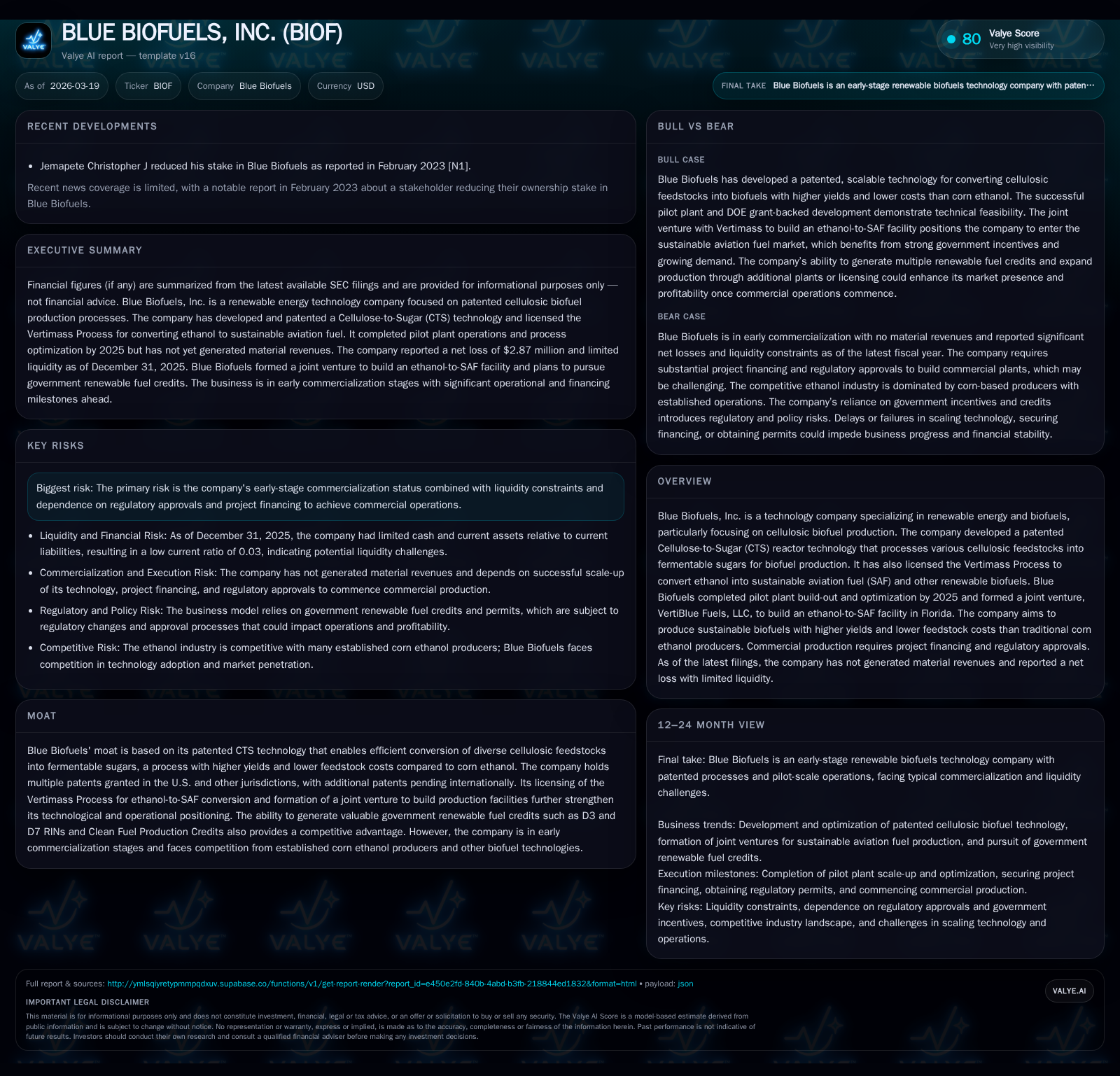
Blue Biofuels, Inc. has pioneered a patented CTS reactor technology targeting higher-yield, lower-cost cellulosic biofuel production using diverse feedstocks beyond traditional corn ethanol. The company completed pilot plant build-out and optimization by 2025 and formed a joint venture to produce sustainable aviation fuel (SAF) from ethanol. Despite promising technological advances and valuable renewable fuel credits under federal programs, Blue Biofuels remains in an early commercial stage with no material revenues, operating losses persisting mostly due to R&D and pilot activities, and a fragile liquidity position requiring successful project financing and regulatory approvals. The firm’s future growth hinges on scaling commercial plants, securing permits, and capitalizing on government incentives amid intense competition.
Company Overview
Blue Biofuels, Inc., incorporated in Nevada in 2012 initially as Alliance Media Group Holdings, has emerged as an innovator in renewable fuels through its patented Cellulose-to-Sugar (CTS) reactor technology. Since pivoting fully toward biofuels and lignin technologies in late 2013, the company has focused on breaking down cellulosic biomass into fermentable sugars—a platform enabling the production of sustainable biofuels such as ethanol, bio-gasoline, and sustainable aviation fuel (SAF).
The genesis of the core technology traces back to early 2018 when CEO Ben Slager developed a novel continuous mechanical/chemical CTS process with higher yield efficiency relative to conventional approaches. This technology converts a wide array of non-food cellulosic feedstocks—including grasses like king grass and agricultural residues—into sugars suitable for fermentation.
Historical Performance and Financials
Blue Biofuels remains virtually pre-revenue as it continues pilot scale development. The company reported nominal revenue only in 2017 ($134k) but has generated no meaningful top-line figures since [F1]. Operating losses have persisted due mainly to research & development spend on pilot projects, testing, engineering optimization, intellectual property filings, and early-stage commercialization efforts.
Historical performance (annual)
| FY | Net ($mm) | CFO ($mm) | OpInc ($mm) | Capex ($) | Net YoY |
|---|---|---|---|---|---|
| 2025 | -3 | -1 | -4 | 68898 | -102.6% |
| 2024 | -1 | -1 | -4 | 71138 | +53.6% |
| 2023 | -3 | -2 | -3 | 287828 | +22.9% |
| 2022 | -4 | -2 | -4 | 138170 |
Source: SEC companyfacts cache [F1].
Capital returns and efficiency (annual)
| FY | FCF ($mm) | ROE% |
|---|---|---|
| 2025 | -1 | 77.6 |
| 2024 | -1 | 49.9 |
| 2023 | -2 | 85.8 |
| 2022 | -2 | 168.0 |
Source: SEC companyfacts cache [F1].
All figures in USD [F1]
Operating income improved slightly between 2024 (-$4.06 million) and 2025 (-$3.72 million), while net income showed a larger loss in 2025 versus prior year due mainly to factors not detailed explicitly. Operating cash flows remain negative but show gradual improvement consistent with scaling efficiencies. Capital expenditures reflect investments primarily related to pilot plant infrastructure rather than commercial capacity.
Equity stood at negative $3.71 million at end-2025 reflecting accumulated losses outweighing contributed capital [F1]. The current ratio of approximately 0.03 indicates severe short-term liquidity constraints with current liabilities vastly exceeding current assets ($2.98 million liabilities vs $76.8 thousand assets).
No dividends or share repurchases have been recorded; the firm is instead focused on conserving resources until commercial revenue streams materialize.
Patented Technology as Competitive Moat
Blue Biofuels' competitive edge centers on its patented CTS reactor technology granted U.S. Patent No. 10,994,255 in 2021 plus additional patents domestically and abroad across key markets including Japan, Australia, Russia, El Salvador—with pending applications covering Europe, Brazil, China and Africa [S1].
The CTS process uniquely allows continuous throughput processing ensuring tight control over reaction parameters which enhances sugar yield optimization compared to batch or lower-throughput systems common in the industry. This mechanical/chemical method processes entire plant materials instead of just kernels or select portions as seen in corn-based ethanol production.
Feedstock versatility is pivotal: Blue Biofuels can utilize grasses like king grass yielding roughly up to 3,500 gallons per acre compared to approximately 600 gallons per acre from traditional corn feedstock [S11]. This broadens raw material availability while potentially lowering costs significantly since these feedstocks are abundant agricultural waste or non-food crops.
Beyond producing cellulosic ethanol from sugars extracted by CTS reactors, Blue Biofuels licenses Vertimass’s one-step catalytic process converting ethanol into value-added sustainable aviation fuels (SAF) and bio-gasoline derivatives that qualify for premium government credits [S13].
Industry Context & Regulatory Incentives
Cellulosic biofuel development benefits from rising mandates under the U.S. Renewable Fuel Standard (RFS). Advanced biofuels including cellulosic types attract significantly higher Renewable Identification Number (RIN) credit values—approximately $2.44/D3 gallon for cellulosic ethanol versus $1.40/D6 gallon for corn ethanol as of filing date [S12]. SAF qualifies for D7 RINs linked to sustainable advanced fuels thus enhancing economic viability.
Further support comes from federal clean energy legislation such as the Inflation Reduction Act’s Section 45Z Clean Fuel Production Credits offering up to $1 per gallon depending on carbon intensity metrics [S12]. Additionally, states like California incentivize reduced carbon lifecycle fuels through Low Carbon Fuel Standard credits (~$71 per metric ton CO2 reduction).
These layered incentive mechanisms aim to de-risk capital formation for new production plants but require robust verification of fuel lifecycle emissions reductions and regulatory approval from EPA’s Office of Transportation and Air Quality before commercial sales commence.
Future Growth Prospects & Commercialization Milestones
After successfully completing its pilot plant by end-2023 and optimizing upscaling phases through 2025 [S11], Blue Biofuels has set milestones toward commercial scale:
- Formation of VertiBlue Fuels LLC joint venture (50% ownership each with Vertimass) established January 2024 focusing on building an ethanol-to-SAF facility in Florida targeting initial output of roughly 10–25 million gallons SAF annually with potential expansion toward approximately 70 million gallons per annum [S13].
- Plans include initially using sugarcane ethanol feedstock transitioning toward own cellulosic ethanol from upcoming CTS plants once scaled.
- Commercial builds hinge upon securing project financing alongside obtaining various permits including renewable fuel registrations and environmental approvals subject to rigorous EPA evaluation mechanisms required under transportation fuels regulation [S12][S13].
- Pursuit of long-term contracts locking-in feedstock supply agreements is intended to mitigate input cost volatility contrasting the corn ethanol market’s price-sensitive dynamics [S5].
Management intends to replicate growth by constructing multiple modular CTS reactors within plants leveraging modularity inherent in their mechanical system design facilitating scalable expansion potentially supplemented by international licensing or local partnerships [S6][S13].
Risks & Challenges
While Blue Biofuels possesses advanced technology aimed at disruptive gains over incumbent corn ethanol producers—especially via superior feedstock economics and enhanced government credit profiles—it confronts several significant risks:
- Financial fragility persists with negative equity position exceeding $3 million by end-2025 coupled with extremely low liquidity raising uncertainty about ability to finance large-scale plant construction without dilutive capital raises or debt facilities [F1][S4][S11].
- Regulatory approvals impose long lead times plus compliance complexity which could delay commercialization timelines or inflate costs beyond current projections [S12][S13].
- Intense competition exists from well-capitalized conventional corn ethanol producers controlling majority U.S. market share alongside emerging alternative cellulosic technologies competing for project finance allocations.
- Operational risks remain around upscaling CTS processing from pilot scale efficiencies into consistent full commercial throughput while achieving targeted yields on varied biomass materials.
- Impact of government policy changes regarding RIN values or subsidy programs could materially alter profitability prospects given reliance on these credits for margin enhancement.
Returns & Capital Allocation Summary
Due to its nascent status still engaged heavily in R&D and pilot demonstration stages without commercial revenue generation or dividends declared since inception [F1], evaluating traditional financial returns such as Return on Equity is limited:
- Approximate ROE calculated using latest net loss over negative equity yields an accounting distortion figure (~77%), reflecting ongoing losses rather than effective capital return [F1].
- Operating cash flows remain persistently negative though showing gradual improvement consistent with smaller operational scale costs being incurred relative to previous years.
- Capital expenditures at roughly $69k during recent years represent relatively minor investments mainly targeted at finalizing pilot plant process definitions rather than full-scale buildouts reinforcing current experimental posture.
- Absence of buybacks or dividends aligns with typical early-stage tech development companies prioritizing reinvestment toward commercialization milestones over shareholder distributions.
Monitoring Points & Conclusion Analysis
Stakeholders should watch closely:
- Progress securing substantial project financing enabling construction of first full-scale CTS plant linked with downstream SAF units under VertiBlue Fuels partnership.
- Timelines addressing regulatory clearances from EPA and state bodies essential before commencing commercial operations.
- Updates regarding feedstock agreements locking supply volumes at stable prices critical for predictable operating expenses.
- Evolutions in federal/state incentive programs’ structure impacting RIN values or CFPC eligibility will significantly influence projected profit margins.
- Expansion plans beyond initial facility including international licensing deals warrant attention as they could transform Blue Biofuels’ footprint globally.
In sum, Blue Biofuels offers an innovative technology platform converting abundant low-cost cellulose sources efficiently into fermentable sugars via its patented CTS process coupled with licensed catalytic conversion technologies producing SAF positioned well within growing sustainable aviation fuel markets incentivized heavily by U.S. policy frameworks.
Nonetheless considerable execution risk remains linked primarily to early commercialization phase typical pitfalls: funding challenges amidst persistent losses; regulatory hurdles delaying market entry; competition from corn ethanol incumbents defending established supply chains; operational risks scaling novel reactors; unpredictable commodity markets affecting downstream economics; and dependency on maintaining favorable government subsidies crucial for competitive positioning.
Stakeholders must factor that while technical innovation is evident along with articulated growth pathways via modular scalable reactors plus strategic JV collaborations—the journey toward stable financial performance will be protracted necessitating patient support until proof-of-concept transitions fully into recurring commercial revenues driven by scale economies across multi-facility operations.
This report is based solely on public disclosures dated through March 19, 2026 [F1][S1–S13] without providing investment advice or recommendations related to securities ownership decisions.
Disclaimer: This is research-only, informational analysis and not investment advice. It may include AI-generated interpretation and general industry context. Always verify important details using primary sources.

Comments