
BioVie’s Clinical Pipeline: Navigating Inflection Points Amid Capital and Data Integrity Strains
BioVie Inc. advances bezisterim for neurodegenerative and post-viral conditions, and BIV201 for liver disease, but faces acute trial execution and funding risks. Recent protocol deviations, an underpowered Alzheimer’s readout, and a dilutive capital raise sharpen questions about the company’s ability to translate early clinical signals into regulatory and commercial momentum.
BioVie’s lead asset, bezisterim, has shown promising Phase 2b results in Parkinson’s and initial signals in Long COVID, but its pivotal Alzheimer’s trial suffered from major protocol violations, leaving efficacy unresolved. While BIV201 for cirrhotic ascites has regulatory designations and Phase 2 evidence, both programs require further validation and substantial funding. A recent $4.74 million direct offering underscores ongoing dilution risk as BioVie balances clinical progress with financial constraints.
BioVie Inc. stands at a crossroads as it attempts to convert early clinical promise into sustainable value. Its lead candidate bezisterim has yielded encouraging Phase 2b signals in Parkinson’s disease and initial readouts in Long COVID, but the company’s pivotal Alzheimer’s trial was undermined by widespread protocol violations that forced patient exclusions and left efficacy in question. Meanwhile, BIV201 for liver cirrhosis ascites advances toward Phase 3, backed by regulatory incentives. Yet, with limited cash, ongoing net losses, and a recent dilutive capital raise, BioVie’s next chapters hinge on clinical validation and the ability to secure further funding without eroding shareholder value.
Recent Clinical and Financial Developments Shape BioVie’s Near-Term Outlook
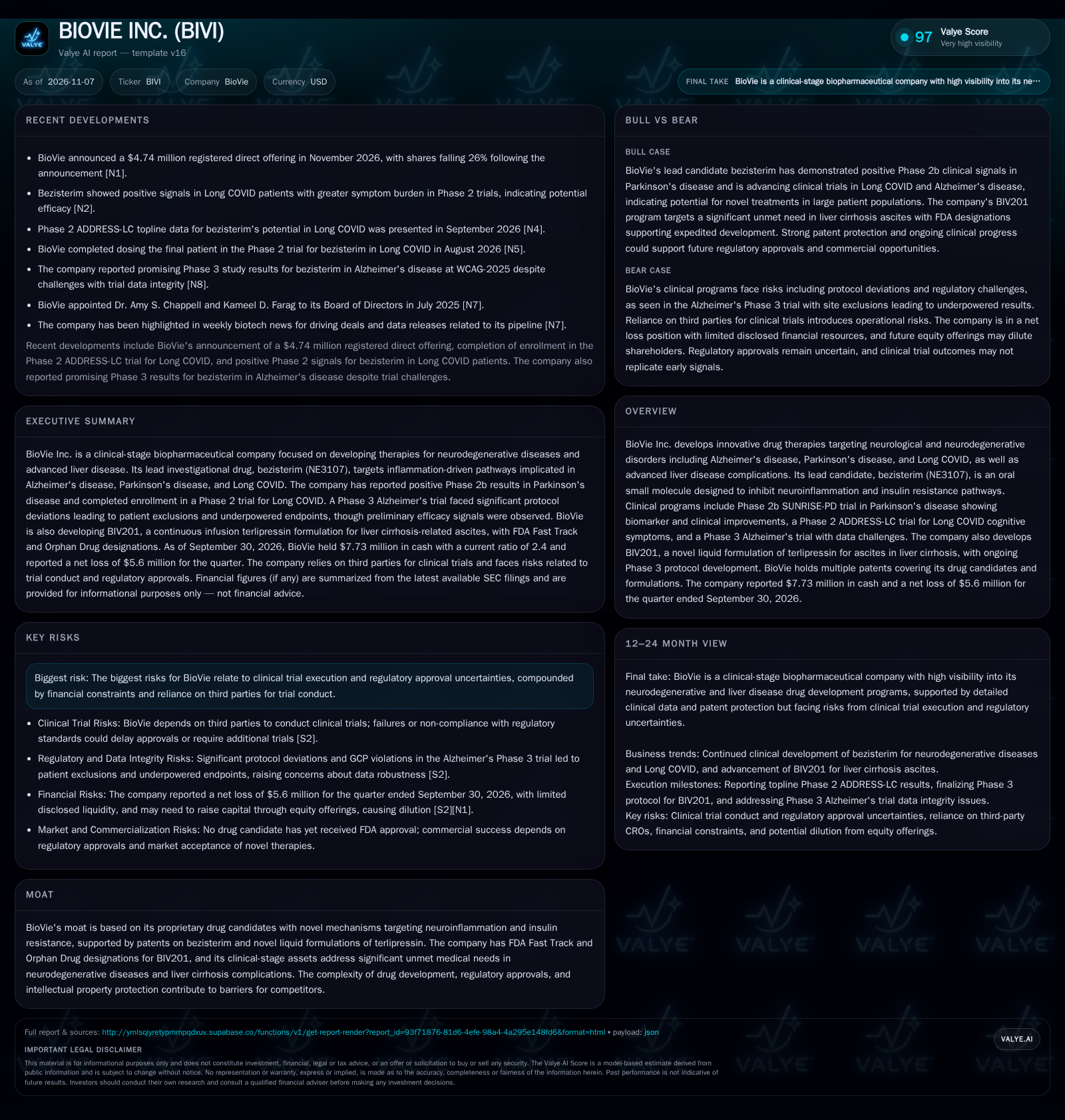
BioVie’s clinical pipeline has reached several pivotal junctures: bezisterim’s Phase 2b trial in Parkinson’s delivered statistically significant biomarker and symptomatic improvements, and the Phase 2 ADDRESS-LC trial in Long COVID completed enrollment with topline data expected imminently [S1] [N4] [N5]. However, the company’s Phase 3 Alzheimer’s trial suffered substantial protocol deviations and GCP violations at 15 sites, leading to patient exclusions and underpowered efficacy endpoints—casting doubt on the strength of the dataset [S1]. On the financial front, BioVie reported $7.73 million in cash as of September 30, 2026, and subsequently raised $4.74 million via a registered direct offering in November, triggering a 26% stock decline [S2] [N1]. These facts frame a company with high clinical ambition but acute execution and funding pressures.
The Economics of Experimental Therapies: High Stakes, High Burn, and the Search for Leverage
BioVie’s business model hinges on the successful clinical development and eventual commercialization or out-licensing of its investigational drugs. Until regulatory approval, revenue generation is deferred and the company operates at a net loss, as evidenced by its $5.6 million quarterly loss [S2]. The economics of small-molecule neurodegenerative and hepatic therapies are characterized by high fixed R&D and regulatory costs, with variable costs rising sharply upon commercialization due to manufacturing scale-up, marketing, and post-market surveillance requirements.
Pricing for novel therapies in Alzheimer’s, Parkinson’s, and cirrhosis-related ascites could be substantial given the high unmet need and the potential for disease-modifying effects. However, payers and health systems are increasingly scrutinizing real-world efficacy and cost-effectiveness, especially for CNS drugs. If bezisterim or BIV201 reach approval, BioVie could pursue premium pricing, but the value proposition will require robust, unambiguous clinical data. Given the company’s limited cash and ongoing losses, further capital raises are likely unless a partnership or licensing deal materializes. This dynamic places a premium on trial execution and clear milestones to unlock non-dilutive funding or partnering leverage.
Barriers and Battlegrounds: Intellectual Property, Trial Complexity, and Therapeutic Crowding
BioVie’s competitive position relies on three pillars: the novelty of its drug mechanisms, patent protection, and regulatory designations. Bezisterim’s dual targeting of ERK and NFκB pathways addresses neuroinflammation and insulin resistance, a differentiated—if still unproven—approach in Alzheimer’s and Parkinson’s, where many large and emerging biopharma players compete [S1]. The company holds patents for bezisterim and its terlipressin formulation in multiple jurisdictions, potentially delaying generic entry if approvals are won.
However, the neurodegenerative and liver disease landscapes are crowded, with established firms and innovative biotechs pursuing diverse modalities (e.g., monoclonal antibodies, gene therapies, other small molecules) and targeting varied pathophysiological axes. In Alzheimer’s, recent regulatory approvals for anti-amyloid antibodies have set a high bar for both efficacy and safety. For cirrhotic ascites, off-label therapies and interventional procedures compete for patient share. BioVie’s FDA Fast Track and Orphan Drug designations for BIV201 confer some development and exclusivity advantages, but ultimate differentiation will depend on clinical outcomes and real-world impact.
A Path to Value: If Clinical Validation Unlocks Partnerships and Payer Acceptance
The most favorable scenario for BioVie is that upcoming clinical readouts—particularly from the compliant subset of the Alzheimer’s Phase 3 trial and the forthcoming Long COVID topline data—demonstrate unambiguous efficacy and safety for bezisterim. Such results could catalyze interest from larger pharmaceutical partners, enabling licensing deals or co-development agreements that bring non-dilutive capital and commercial infrastructure.
Similarly, if BIV201’s Phase 3 design (now being finalized) is accepted by the FDA and subsequent trials reproduce Phase 2 efficacy in reducing ascites, BioVie could leverage Fast Track and Orphan Drug status for expedited review and market exclusivity. Confirmation of robust efficacy would also strengthen the company’s hand in payer negotiations, supporting premium pricing. Evidence confirming this scenario would include positive, statistically significant clinical endpoints in upcoming trials, partnership announcements, and the avoidance of further protocol deviations.
Clinical Progress Tempered by Execution Risks and Ongoing Dilution
The most plausible trajectory is incremental progress in BioVie’s pipeline with intermittent data readouts, but continued operational and financial headwinds. Bezisterim may generate additional supportive data in Parkinson’s and Long COVID, but the impact of the compromised Alzheimer’s Phase 3 trial will likely limit near-term regulatory momentum and partnership appeal. BIV201’s advancement depends on timely Phase 3 initiation and clean execution.
In this scenario, BioVie will need to fund ongoing operations through additional equity offerings, resulting in further dilution. The company’s reliance on third-party CROs and the recent history of trial protocol deviations suggest that execution risk will remain a persistent overhang. Confirmation would come from modest clinical progress, ongoing net losses, periodic capital raises, and lack of transformative partnerships or approvals.
Adverse Outcomes: Trial Setbacks, Regulatory Delays, and Capital Exhaustion
The bear case materializes if upcoming clinical data fail to meet efficacy or safety thresholds, or if additional protocol deviations erode confidence in BioVie’s trial management. Regulatory authorities could require new or expanded studies, delaying any path to approval and escalating costs. If cash burn continues at current rates and capital markets become less receptive—especially after a 26% share price drop post-offering—BioVie could face severe dilution or even going-concern risk.
Further, if competitors launch more effective or safer therapies in BioVie’s target indications, the commercial opportunity could shrink before the company’s assets reach the market. Evidence confirming this scenario would include negative or inconclusive trial results, regulatory setbacks, further protocol violations, and difficulty raising funds on acceptable terms.
Milestones That Will Define BioVie’s Value Creation or Erosion
Topline efficacy and safety data from the Phase 2 ADDRESS-LC trial in Long COVID—especially cognitive and fatigue endpoints.
FDA feedback and initiation of the Phase 3 trial for BIV201 in cirrhotic ascites, including protocol acceptance and enrollment pace.
Clarity on the regulatory fate of bezisterim in Alzheimer’s following the compromised Phase 3 dataset—especially any guidance on additional study requirements.
Evidence of partnerships, licensing deals, or non-dilutive funding that reduce reliance on equity issuance.
Operational metrics on trial conduct: protocol adherence, patient retention, and adverse event rates (if disclosed).
Cash burn rate and quarterly net loss trends, especially in relation to the timing of new capital raises.
Competitive landscape developments: new therapies approved or launched in Alzheimer’s, Parkinson’s, or ascites.
Patent status and freedom to operate in key geographies for bezisterim and BIV201.
Disclaimer: This is research-only, informational analysis and not investment advice. It may include AI-generated interpretation and general industry context. Always verify important details using primary sources.

Comments