
Heartland Express: Fleet Modernization, Regulatory Pressures, and the Economics of Capital-Intensive Trucking
Heartland Express balances the costs and risks of a newer fleet, regulatory compliance, and market volatility against operational efficiency and customer retention. Indebtedness from acquisitions, tightening environmental rules, and used equipment market swings shape the outlook for profitability and capital allocation.
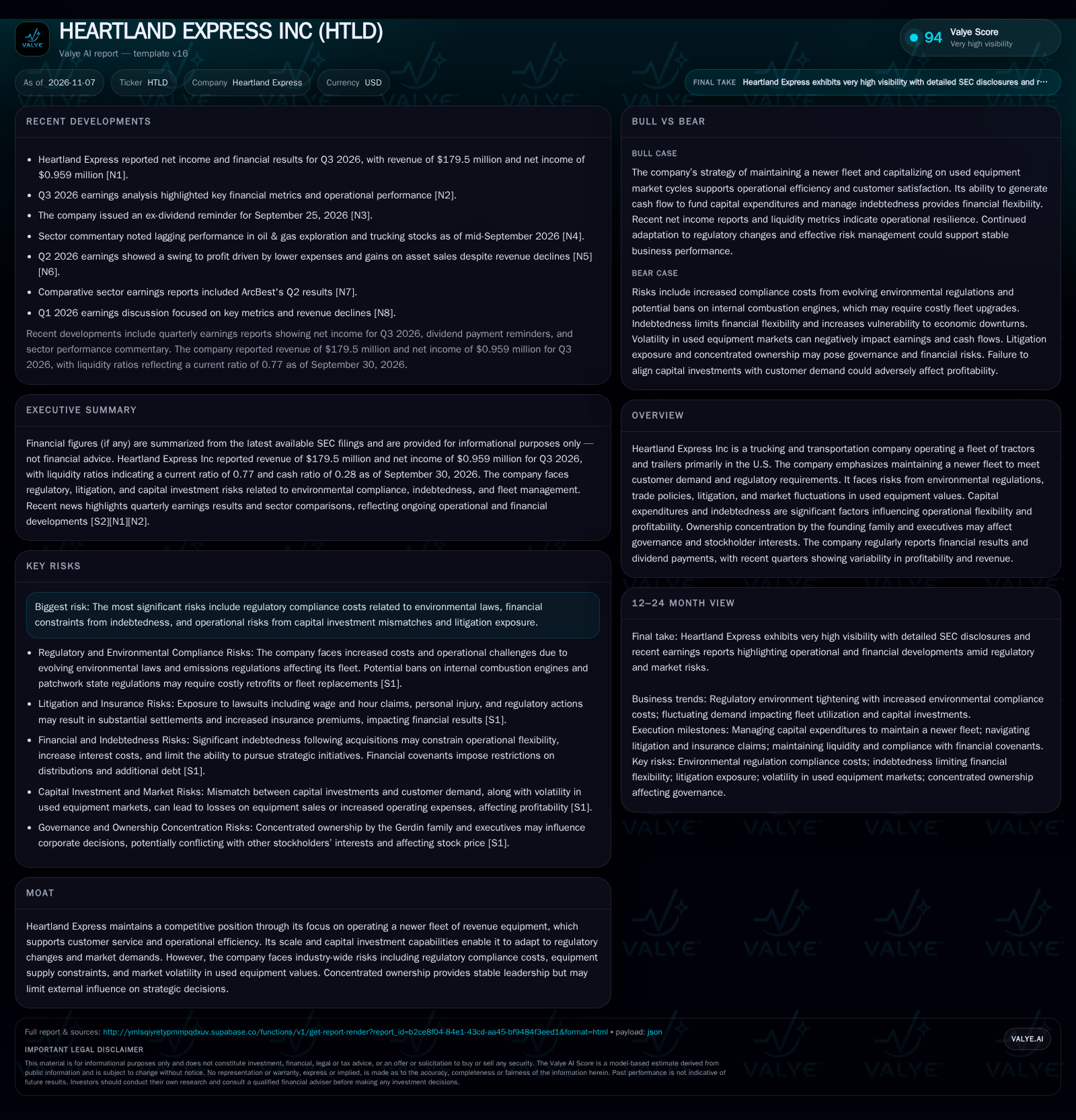
Heartland Express is navigating a capital-intensive, regulation-driven trucking landscape by prioritizing a newer fleet and operational efficiency. The company’s recent profitability rebound was aided by asset sales and cost control, but high debt and tightening environmental standards create ongoing financial and strategic pressures. Ownership concentration and litigation risk add further complexity for investors evaluating the path forward. [S2] [N6]
Heartland Express stands at a crossroads common to asset-intensive trucking firms: the need to maintain a young, efficient fleet for regulatory and customer reasons while managing the financial drag of debt, capital expenditures, and volatile used equipment markets. Recent profits were buoyed by asset sales and expense discipline, but underlying challenges remain. Investors must weigh whether the company’s operational strengths can offset the risks from regulatory change, litigation, market cycles, and the constraints of concentrated ownership. The next phase will test Heartland’s ability to align capital allocation with shifting industry economics and external pressures. [S2] [N6]
Recent Profit Drivers, Capital Structure, and Regulatory Exposure
The most material current developments for Heartland Express include its swing to profitability in Q2 2026, primarily on the back of reduced expenses and gains from asset sales, even as revenues declined [N6]. This underscores the company’s ability to manage costs and extract value from its fleet in a challenging demand environment. However, the company operates with substantial indebtedness following acquisitions, which increases interest costs and restricts operational flexibility [S1].
Maintaining a newer fleet remains a central pillar of Heartland’s strategy, but this demands continuous capital outlays and exposes the business to volatility in the used equipment market, which can directly impact earnings and cash flows [S1]. Meanwhile, tightening environmental regulations and the looming risk of internal combustion engine bans threaten to raise compliance costs and accelerate the need for costly fleet upgrades or retrofits [S1].
Fleet Investment, Asset Sales, and the Cost Structure of Trucking
Heartland Express’s business model is built around high fixed costs for fleet acquisition and maintenance, offset by variable operating expenses such as labor, fuel, and insurance. The company’s emphasis on a younger fleet can deliver operational efficiency—reduced breakdowns, higher fuel efficiency, and compliance with evolving emissions standards. However, this approach also creates a recurring need for capital investment, funded through a mix of operating cash flow, equipment sales, and borrowings.
Revenue is typically generated on a per-mile or per-load basis, with pricing heavily influenced by freight demand, contract terms, and competition. When demand is soft, as recent revenue declines suggest, pressure mounts on both pricing and fleet utilization. Gains on asset sales—when used equipment fetches favorable prices—can temporarily bolster profits, but these are inherently cyclical and volatile. Conversely, downturns in the used equipment market can lead to impairment charges or losses on sales, directly hitting the bottom line.
Indebtedness from prior acquisitions increases financial leverage and interest expense, reducing the cushion for error during weak freight cycles. Regulatory compliance and litigation costs are largely out of management’s control, acting as unpredictable drains on profitability. The company’s dividend payments remain discretionary and may be revisited as capital needs evolve [S1] [N3].
Fleet Age as a Differentiator—But Not a Moat
Heartland Express’s competitive position is built on operating a newer fleet, which can be leveraged for reliable service, regulatory compliance, and cost efficiency. In markets where shippers increasingly value reliability and environmental performance, a modern fleet can provide a modest edge in winning contracts and managing downtime.
However, this advantage is not unassailable. Larger trucking peers with greater scale can also invest in new equipment, and the capital intensity of fleet turnover is a shared industry challenge. Barriers to entry are meaningful due to capital requirements and regulatory hurdles, but within the established cohort, pricing remains highly competitive and cyclical.
Potential substitutes include intermodal rail and, in certain corridors, autonomous freight technologies (though these remain in early stages of commercial deployment as of 2024). The risk of regulatory-driven fleet obsolescence is rising, especially as states and federal agencies tighten emissions standards and discuss future bans on diesel engines. This dynamic could compress margins industry-wide and erode any cost advantage from prior investments.
How Efficient Capital Allocation Could Create Shareholder Value
A favorable scenario for Heartland Express would require continued discipline in capital allocation—timing fleet purchases to market cycles, maximizing the value of used equipment sales, and controlling operating costs even as regulatory burdens rise. If the company can maintain high fleet utilization and secure premium contract pricing by leveraging its newer fleet, it could offset the drag from higher compliance and interest costs.
Confirmation of this scenario would come from sustained profitability even as revenue growth lags, stable or improving operating margins, and evidence that gains on equipment sales are not masking underlying weakness. Additional positive signals would include the ability to reduce leverage over time and maintain or grow dividends without sacrificing fleet quality. Falsification would be visible if profits become increasingly dependent on asset sales, debt rises, or if compliance costs sharply erode margins.
Balancing Fleet Renewal with Debt and Regulatory Pressures
The most plausible outcome is that Heartland Express continues to manage a delicate balance: maintaining a competitive, compliant fleet while absorbing the costs of debt service, regulatory adaptation, and variable freight demand. Earnings may remain volatile—boosted in some quarters by asset sales, but pressured when used equipment markets or freight pricing weaken.
Evidence for this middle path would be periodic swings in quarterly profitability tied to external market cycles, modest revenue growth or stagnation, and a steady (but not rapidly rising) capital expenditure pattern. If the company can avoid major litigation or regulatory shocks, it may continue to return some capital to shareholders while preserving operational flexibility. This scenario would be undermined by sustained revenue declines, large impairment charges, or a sudden spike in compliance costs that outpaces the company’s ability to adapt.
Rising Compliance Costs and Used Equipment Market Weakness Drive Earnings Erosion
The adverse scenario for Heartland Express centers on a confluence of regulatory, market, and financial headwinds. If environmental standards tighten more rapidly than anticipated, the company could face sharply higher capex to retrofit or replace non-compliant equipment, straining liquidity and potentially forcing asset sales at unfavorable prices. A downturn in the used equipment market could magnify these losses, leading to impairment charges and negative cash flow.
Compounding these risks, high debt service obligations would limit the company’s ability to absorb shocks or invest in operational improvements. Litigation or insurance costs could further erode margins, while soft freight demand would pressure pricing and fleet utilization. Confirmation of this scenario would be a pattern of quarterly losses, rising leverage, dividend cuts, and adverse legal or regulatory developments.
Developments That Could Shift Heartland Express’s Trajectory
Quarterly trends in operating margins and the proportion of earnings derived from asset sales versus core trucking operations.
Fleet age profile and capital expenditure levels—if disclosed—to assess the sustainability of the newer fleet strategy.
Used equipment market prices and realized gains/losses on equipment sales, as these can materially impact profitability.
Updates on regulatory changes affecting emissions standards or potential internal combustion engine bans at the federal or key state levels.
Debt and interest expense trends, including any covenant disclosures or refinancing activity.
Litigation outcomes, insurance claims, and any disclosed settlements that could affect operating costs or balance sheet strength.
Customer contract wins, renewals, or losses—if disclosed—that would indicate the competitive impact of fleet modernization and service levels.
Disclaimer: This is research-only, informational analysis and not investment advice. It may include AI-generated interpretation and general industry context. Always verify important details using primary sources.

Comments