
Lincoln International: Cash-Rich, Data-Savvy, but Operational Transparency Remains the Missing Link
Lincoln International’s reported cash position and visible market presence via its Private Market Index anchor its credibility in financial services. Yet with limited operational disclosure, investors are left to speculate about business model mechanics, margin structure, and strategic levers for growth.
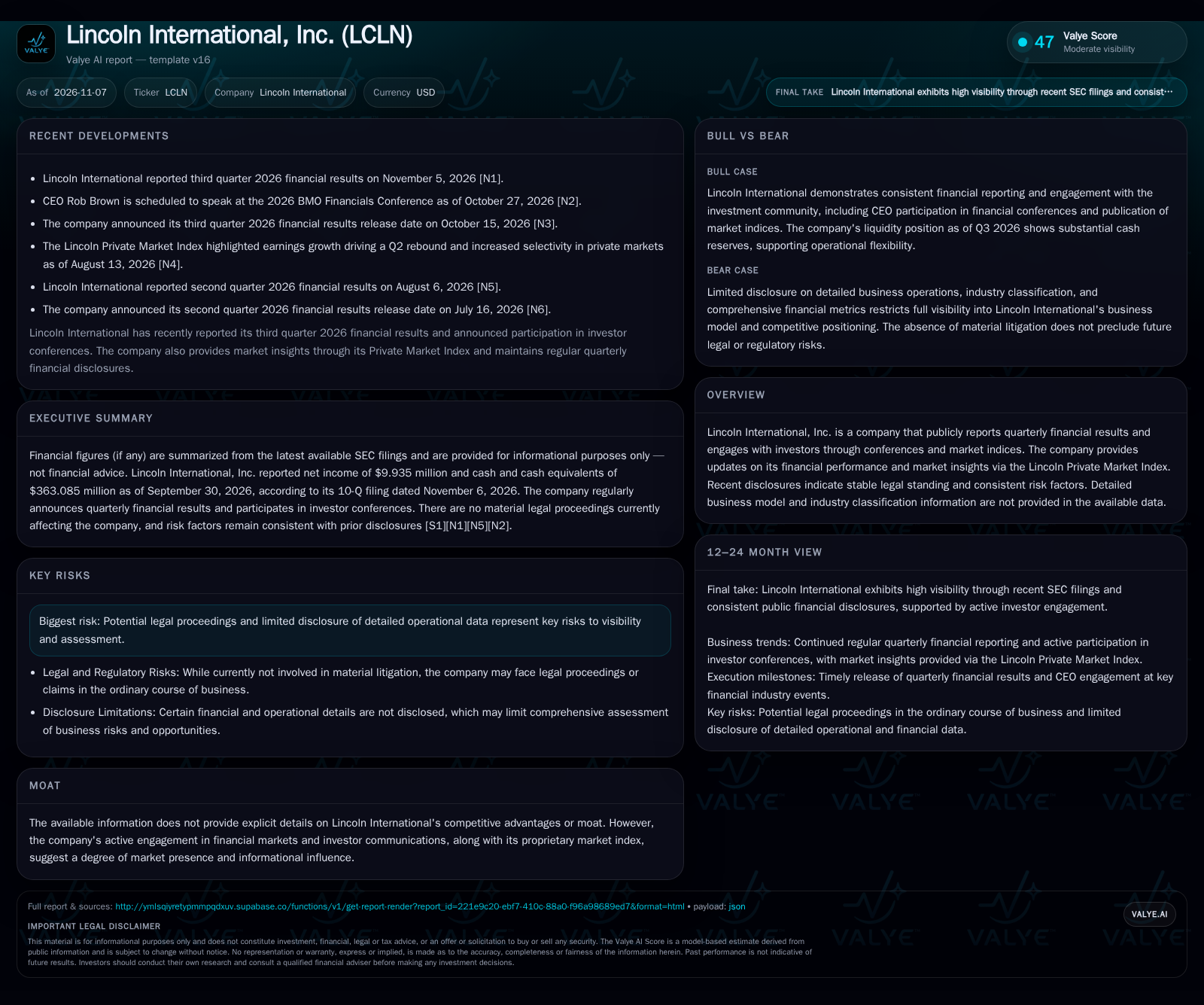
Lincoln International reported $9.935 million in net income and $363.085 million in cash as of September 30, 2026, while maintaining active investor engagement and producing private market insights. The firm’s financial disclosures and informational influence suggest stability, but the lack of detail on underlying business activities and industry structure limits thesis clarity and complicates competitive assessment. Key questions persist regarding the economics, scalability, and resilience of Lincoln’s core operations amid evolving private market dynamics. [S1] [N1] [N4]
Lincoln International stands out for its reported cash position, consistent profitability, and proactive investor relations, underpinned by its proprietary Private Market Index. The firm’s visible presence in the financial community and regular, transparent financial reporting offer a veneer of stability and credibility. However, with little public information about its industry focus, service offerings, or commercial structure, the investment case hinges as much on what is unknown as on what is reported. This opacity leaves investors with open questions about Lincoln’s true economic engine, scalability, and how its informational edge in the private markets translates into durable returns.
Snapshot: Profitability, Liquidity, and Market Engagement Define the Present
Lincoln International reported net income of $9.935 million and held $363.085 million in cash and equivalents as of September 30, 2026, per its latest 10-Q. These figures indicate ongoing profitability and a substantial liquidity buffer. The company continues to issue quarterly financial results and participates in high-profile investor conferences, with CEO Rob Brown recently scheduled as a speaker. It also maintains the Lincoln Private Market Index, which tracks trends in private market earnings and selectivity, signaling an active role in market thought leadership. Notably, there are no material legal proceedings or changes to risk factors disclosed in the most recent filings, further suggesting operational stability. [S1] [N1] [N2] [N4]
Unpacking Revenue Streams and Cost Structure: What’s Beneath the Surface?
The company’s public disclosures do not specify its primary business activities, but the recurring publication of the Lincoln Private Market Index and active participation in financial conferences suggest an orientation toward financial advisory, investment banking, or private capital markets services. In such models, revenue is typically generated via advisory fees, transaction-based commissions, or asset management charges. Fee-based businesses in financial services can deliver high operating leverage, as incremental revenue from additional deals or assets often outpaces the associated variable costs once a critical mass of clients or transactions is achieved.
Lincoln’s reported net income indicates that it is operating profitably, but without expense line breakdowns or revenue segmentation, the relative weight of fixed versus variable costs—and thus the sensitivity of margins to deal flow or market cycles—remains speculative. The company reported cash and liquidity metrics for the period; these figures do not by themselves establish operating runway, investment capacity, financial flexibility, or financing capacity. However, absent disclosure, it is unclear whether Lincoln’s capital is used primarily for working capital, as a strategic reserve, or to fund proprietary activities.
In financial advisory and private capital markets, the mix between recurring fee income and transaction-based revenue critically shapes earnings stability and growth potential. If Lincoln’s revenue is heavily weighted toward advisory fees tied to completed deals, then periods of market inactivity could disproportionately compress margins due to fixed cost absorption. Conversely, a larger share of retainer or subscription-style fees linked to ongoing client advisory would provide a steadier revenue base. Furthermore, the extent to which Lincoln outsources or automates certain operational functions would influence its cost structure and scalability. For instance, investment in proprietary technology platforms or data analytics could reduce incremental costs per transaction, enhancing operating leverage as deal volume grows.
Capital allocation decisions also warrant deeper consideration. Alternatively, if a meaningful portion of cash is earmarked for selective acquisitions, technology development, or expansion into adjacent service lines, this could signal a proactive growth strategy with potential margin implications. The balance between reinvesting cash flow to build capabilities versus returning capital to shareholders or maintaining liquidity reflects management’s risk appetite and long-term vision, which in turn affects the firm’s ability to adapt to evolving private market dynamics.
Is Informational Edge Enough? Competitive Dynamics in Private Markets
Lincoln’s informational footprint, exemplified by its Private Market Index, could confer a competitive edge in originations, client advisory, or deal matchmaking by establishing the firm as a trusted source of market intelligence. In the fragmented world of middle-market investment banking and advisory, such proprietary data can attract institutional clients seeking nuanced insights and differentiated execution.
However, the absence of explicit detail on Lincoln’s service lines, target client segments, or geographic reach makes it difficult to benchmark against specialist boutiques, global advisory firms, or large universal banks. Key differentiators in this space often include sector expertise, relationship networks, deal execution track record, and the ability to leverage proprietary data for actionable insights. The question is whether Lincoln’s informational brand translates into pricing power, repeat business, or client retention at a level that outpaces peers.
The competitive landscape in private market advisory is shaped not only by informational assets but also by relationship depth and sector specialization. Lincoln’s ability to translate proprietary data into actionable client insights depends on the integration of quantitative analysis with qualitative expertise. Firms that combine strong sector knowledge with robust data analytics tend to command higher client loyalty and pricing power. Additionally, geographic footprint and regulatory familiarity can materially influence competitive positioning, especially as private capital markets become increasingly globalized. Without clarity on Lincoln’s geographic reach or sector focus, it is challenging to assess whether its informational edge can overcome entrenched client relationships and specialized competitors in targeted niches.
Moreover, the durability of Lincoln’s informational advantage hinges on the continuous refinement and exclusivity of its data offerings. In a market where data commoditization and third-party analytics proliferate, sustaining a differentiated insight platform requires ongoing investment in data quality, proprietary methodologies, and client engagement. If Lincoln’s Private Market Index serves as a gateway to deeper advisory relationships, the firm must demonstrate that it can convert data-driven insights into tangible deal flow and revenue growth. Conversely, if competitors replicate or surpass Lincoln’s data products, the firm risks losing its informational premium, which could erode client acquisition and retention metrics over time.
Market Leadership Through Data-Driven Advisory: What Would Prove Scalable Advantage?
The most favorable scenario for Lincoln International would be if its Private Market Index and informational assets drive a virtuous cycle of client acquisition and retention, enabling the firm to win a disproportionate share of high-value advisory mandates. If the company leverages its data-driven reputation to command premium pricing, cross-sell services, and attract recurring institutional business, operating margins could expand meaningfully over time.
Evidence that would confirm this dynamic includes disclosure of rising advisory fee rates, an increasing proportion of repeat clients, or a growing backlog of mandates. Additional proof points would be public wins in competitive deal processes or explicit references to the Index as a differentiator in client decisions. Conversely, if future disclosures show stagnant or declining advisory revenue per client, or if competitors begin to replicate Lincoln’s informational products, the thesis of sustainable data-driven leadership would weaken.
Incremental Growth Amid Market Cyclicality and Selectivity
Given current facts, the most plausible scenario is that Lincoln International continues to operate profitably, leveraging its market insights and established relationships to compete for advisory or investment banking mandates in a cyclical and increasingly selective private capital environment. The firm’s financial discipline and informational brand may enable steady, if unspectacular, growth—contingent on deal activity and private market sentiment.
Confirmation of this trajectory would come from continued net income stability, cash preservation, and regular client engagement via conferences and published indices. Falsifying evidence would include a sudden drop in net income, cash outflows unrelated to growth investments, or negative shifts in the Private Market Index signaling a sharp contraction in addressable deal flow.
Opaque Operations and Market Disruption: Where Risks Could Erode Value
Without greater transparency into business mechanics, Lincoln’s fortunes could be more vulnerable to adverse private market cycles, competitive encroachment, or regulatory change than the headline numbers suggest. If deal volume in the private markets contracts sharply, or if larger, more diversified competitors leverage superior technology or distribution to win share, Lincoln’s revenue base could erode quickly given the likely operating leverage in its model.
If the Private Market Index loses relevance or credibility, Lincoln’s informational edge—and, by extension, its client pipeline—could diminish, amplifying downside risk.
Testing the Lincoln Thesis: What Would Clarify or Challenge the Investment Case?
Quarterly revenue and segment-level disclosure, if provided, to illuminate core business drivers and margin structure.
Trends in cash flow from operations versus investing and financing activities, to distinguish organic profitability from capital redeployment or reserve drawdown.
Client concentration metrics or disclosure of repeat versus new client mix, which would help gauge the stability and durability of revenue streams.
Explicit references to how the Lincoln Private Market Index influences client decision-making or deal origination success.
Any announced expansion into new service lines, geographies, or technology-enabled offerings, which could signal growth levers or risk.
Updates on regulatory environment and any emerging legal proceedings, since these could rapidly alter risk profile.
Market share or competitive win/loss disclosures relative to peer boutique and bulge-bracket financial advisory firms, if available.
Changes in leadership or notable departures, which might affect client relationships and strategic direction.
Disclaimer: This is research-only, informational analysis and not investment advice. It may include AI-generated interpretation and general industry context. Always verify important details using primary sources.

Comments