
TEN Holdings: Platform Event Tech Faces Margin Compression and Scale Dilemma
TEN Holdings grew quarterly revenue by nearly 18% year-on-year, but surging operating costs and persistent net losses underscore the challenge of scaling a hybrid event platform in a competitive and evolving broadcasting landscape.
Despite revenue growth and a diversified event platform offering, TEN Holdings continues to post substantial losses due to rapidly rising operating expenses.
TEN Holdings Inc (Nasdaq: XHLD) is attempting to carve out a niche in the broadcasting and event technology space, offering a mix of virtual, hybrid, and managed event solutions through proprietary platforms. While the company posted a near 18% increase in quarterly revenue year-on-year, it faces intensifying margin pressure: gross profit slipped and operating losses nearly doubled, primarily due to surging costs in both service delivery and overhead.
Recent Results Reveal Revenue Growth and Escalating Losses
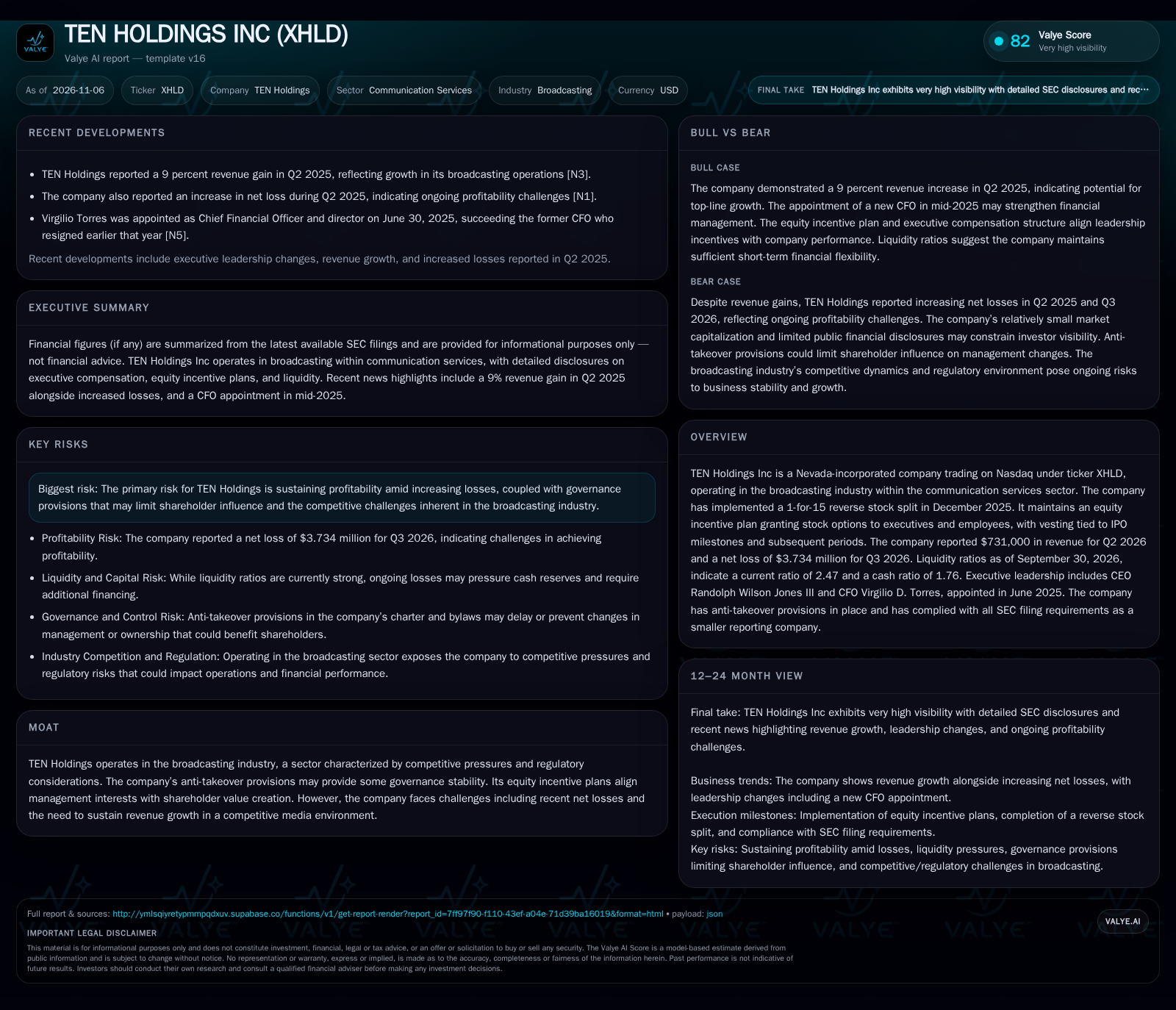
For the quarter ended September 30, 2026, TEN Holdings reported revenue of $640,000, a 17.9% year-on-year increase, driven by a dramatic 308% growth in professional and managed services revenue. However, cost of revenue rose 89.1%, and gross profit declined by 6.4%. Operating expenses surged 76.8% to $4.1 million, resulting in a loss from operations of $3.74 million—nearly double the loss in the prior-year quarter. As of September 30, 2026, the company reported $3.505 million in cash and cash equivalents and reported liquidity-ratio trends of 2.47, suggesting reported liquidity position [S2].
Event Platform Economics: Scale, Pricing, and Margin Compression
TEN Holdings generates revenue from two main activities: platform usage (through its Xyvid Pro and TEN Pro platforms) and professional/managed services for event execution. The mix between recurring platform fees and more labor-intensive service contracts will materially affect margin structure. The sharp rise in cost of revenue—outpacing revenue growth—suggests that incremental business is currently coming at lower incremental margin, possibly due to discounting, higher labor content, or sub-scale operations.
Operating expenses, especially selling, general, and administrative (SG&A), nearly doubled year-on-year, indicating significant investment in sales, marketing, and corporate infrastructure. This heavy fixed-cost base could yield operating leverage if revenue growth accelerates, but as of Q3 2026, the company is not yet seeing this effect. If the business can shift more revenue to higher-margin platform usage and automate elements of service delivery, gross margins could improve. However, continued reliance on labor-intensive services may keep margins thin.
The company’s liquidity metrics are currently solid, but persistent operating losses will ultimately require either a swing to cash flow breakeven or access to new capital.
The dynamics between platform and service revenue streams are crucial in understanding TEN Holdings’ margin trajectory. Platform revenue, typically characterized by subscription or usage-based fees, tends to offer higher gross margins due to its scalable nature and lower incremental costs. In contrast, managed services involve significant labor input, customization, and on-site support, which are inherently less scalable and more cost-intensive. If TEN Holdings cannot effectively increase the proportion of platform-based revenue relative to services, the company may face persistent margin compression. Additionally, pricing strategies such as discounting to win contracts or bundling services could further erode average revenue per user, complicating efforts to improve profitability.
Market Positioning in a Crowded Event Tech and Broadcasting Field
TEN Holdings operates at the intersection of broadcasting and event technology, competing with SaaS event platforms, traditional broadcasters, and managed event service providers. The market is characterized by rapid technology change, low switching costs for digital tools, and significant pressure to differentiate through features, integrations, and service quality.
Potential advantages may include proprietary platforms, integrated service offerings, and the ability to deliver both virtual and in-person events. However, the company faces counterforces from larger, better-capitalized competitors, as well as downward pricing pressure as virtual event technology commoditizes. Regulatory and content licensing risks are also present in the broadcasting sector.
The company’s anti-takeover provisions provide management stability but could limit shareholder-driven change if performance does not improve. The equity incentive plan may help retain key talent, an important factor in a sector where technical and sales expertise are crucial.
If Scale Delivers Operating Leverage: A Path to Profitability
In a favorable scenario, TEN Holdings successfully shifts revenue mix toward higher-margin platform usage while automating or streamlining service delivery. Accelerated customer acquisition—potentially from enterprise clients seeking integrated hybrid event solutions—could drive revenue growth that outpaces fixed-cost increases, yielding operating leverage and EBITDA improvement.
Evidence supporting this scenario would include consecutive quarters of gross margin expansion, a declining ratio of SG&A to revenue, and recurring revenue contracts with large enterprise customers. Confirmation would also come from customer case studies or disclosures of multi-year platform deals, as well as a stabilization or reversal of net losses.
Incremental Growth, Margin Pressure, and the Need for Funding
The most plausible near-term path is one of moderate revenue growth accompanied by ongoing—possibly widening—operating losses. With cost of revenue and SG&A rising nearly in lockstep with revenue, the company may struggle to generate meaningful operating leverage unless it can fundamentally alter its cost structure or pricing power.
In this scenario, reported liquidity position for several quarters, but the company would need to seek external funding if losses persist. Evidence supporting this outcome would be continued sequential revenue growth but flat or declining gross margins, coupled with regular equity raises or debt issuance. Falsification of this scenario would require a clear, sustained improvement in both gross and operating margins.
Continued Cash Burn Forces Strategic or Structural Change
If cost growth continues to outpace revenue and gross margin erosion persists, TEN Holdings could exhaust its cash reserves, forcing a dilutive capital raise, asset sales, or restructuring. Failure to secure new customers or retain existing ones—amid intensifying competition—could accelerate this timeline.
Evidence for this scenario would include consecutive quarters of declining cash balances, disclosures of going concern risk, or emergency financing activity. Deterioration in customer renewal rates or loss of major contracts (if disclosed) would further support the downside case.
Factors That Will Determine Whether TEN Holdings Can Turn Growth into Value
Quarterly gross margin trends, especially the mix between platform usage and managed services revenue, will be critical to gauge the path toward profitability.
The ratio of SG&A to revenue: sustained declines would indicate improving operating leverage.
Customer concentration risk—if disclosed—including reliance on a few large clients versus a diversified base.
Cash burn rate and changes in cash reserves relative to operating losses.
Evidence of long-term, recurring platform contracts or multi-year customer commitments.
Churn or renewal rates for enterprise clients (if disclosed), as a proxy for product stickiness.
Any announced or completed external capital raises, debt issuances, or strategic partnerships.
Management commentary or disclosures regarding cost containment, automation initiatives, or pricing strategy.
Disclaimer: This is research-only, informational analysis and not investment advice. It may include AI-generated interpretation and general industry context. Always verify important details using primary sources.

Comments