
Telomir Pharmaceuticals: Preclinical Momentum, Licensing Constraints, and the Long Road to Value Realization
Telomir Pharmaceuticals’ progress in preclinical research for Telomir-1 is promising, but the company’s future hinges on navigating licensing dependencies, financing needs, and the risks inherent to early-stage drug development. The next 18 months will test whether scientific advances can translate into regulatory and commercial milestones.
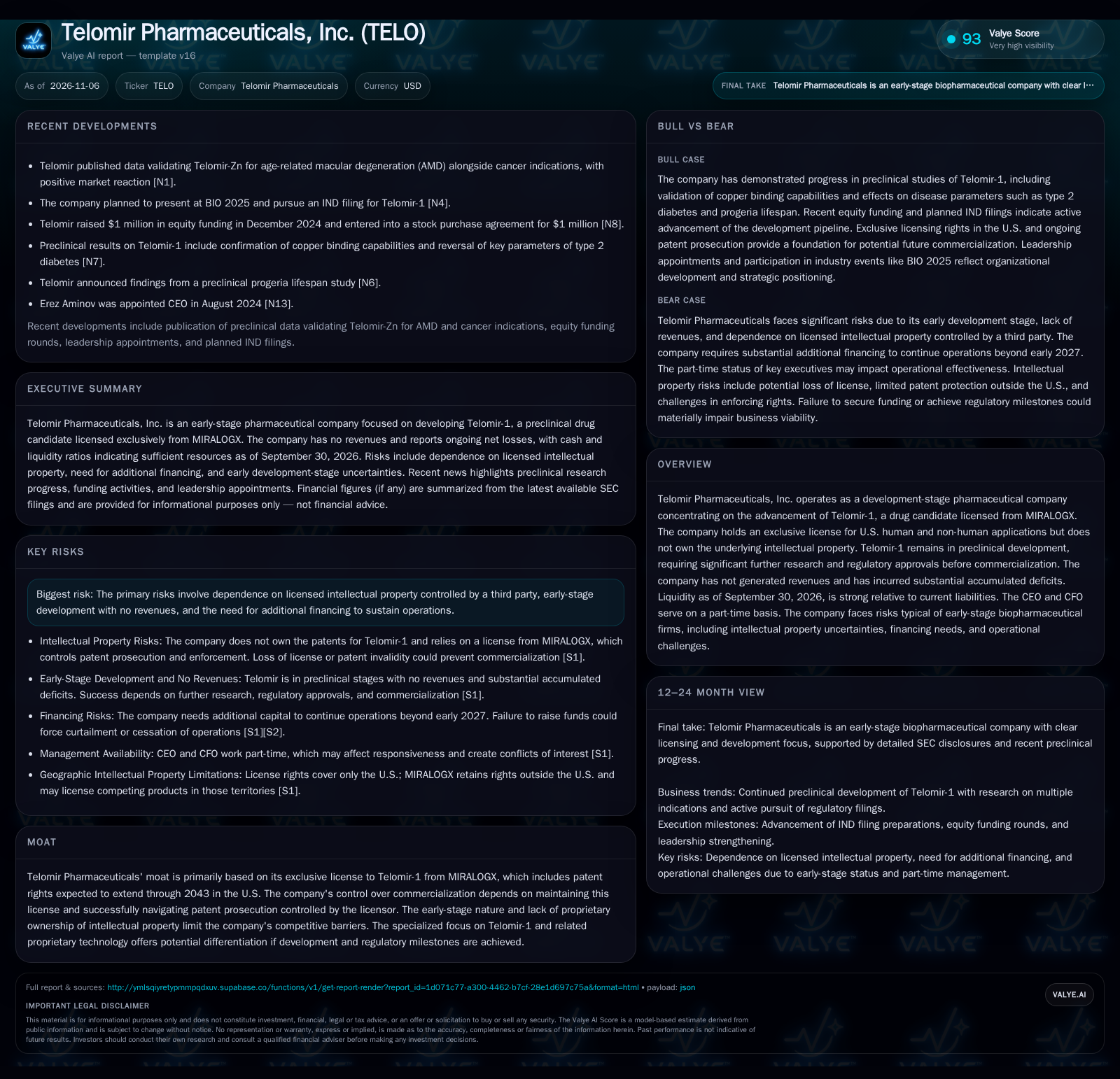
Telomir Pharmaceuticals remains a preclinical-stage biotech with no revenue, marked by recent positive preclinical data and strong near-term liquidity. However, its dependency on an exclusive U.S. license—without owning the intellectual property—and the need for substantial new funding create a high-risk, high-reward profile as it targets IND filing for Telomir-1.
Telomir Pharmaceuticals, Inc. stands at a familiar but pivotal crossroads for early-stage biotechs: promising signals from preclinical research, a reported cash balance, and a business model entirely dependent on advancing a single licensed asset toward clinical trials. While recent data releases on Telomir-1’s potential in multiple indications have buoyed market sentiment, Telomir’s lack of revenue, reliance on a third-party-controlled license, and the need for substantial new capital underscore the steep challenges ahead. The company’s ability to convert scientific findings into pipeline momentum, regulatory progress, and eventual commercial value will determine whether its story is one of breakthrough or attrition.
Recent Advances and Persistent Business Constraints
Telomir Pharmaceuticals’ main asset, Telomir-1, remains in preclinical development and is licensed exclusively from MIRALOGX for U.S. applications; Telomir does not own the underlying intellectual property and pays an 8% royalty on net sales or revenue under this arrangement [S1].
The company recently published positive preclinical data on Telomir-1, including findings related to copper binding, type 2 diabetes markers, progeria lifespan, and validation for age-related macular degeneration (AMD) and cancer indications [N1] [N6] [N7].
As of September 30, 2026, Telomir reported $4.52 million in cash and equivalents, a current ratio of 19.6, and a net loss of $705,225 for the latest quarter, with no revenue and an accumulated deficit of $41 million [S2].
Leadership structure remains lean, with both the CEO and CFO serving on a part-time basis, which may affect operational continuity and strategic execution [S1].
How Telomir Might Make Money—And the Economic Frictions
Telomir’s potential revenue model is entirely predicated on the successful development, regulatory approval, and commercialization of Telomir-1. If advanced, revenues would be generated from product sales, but the company would owe an 8% royalty on net sales or revenue to MIRALOGX [S1].
R&D costs dominate the expense structure in the preclinical and early clinical phases. The business is highly capital-intensive, requiring ongoing financing to fund research, regulatory filings, and, eventually, clinical trials. Fixed costs are relatively low outside of R&D, but variable costs could increase substantially in later-stage development and commercialization (manufacturing, sales, pharmacovigilance).
Operating leverage is currently negative: each dollar spent increases the deficit without generating revenue. If Telomir-1 advances into clinical trials and achieves proof of concept, the company could see significant operating leverage as fixed R&D costs are spread over a pipeline or as scale is achieved. However, the royalty burden, lack of global rights, and absence of proprietary IP ownership could structurally limit long-term margins—even with successful commercialization.
The need for repeated capital raises is a core risk, as dilutive equity funding or licensing/out-licensing deals may become necessary to sustain operations until self-funding is plausible.
Licensing, IP Constraints, and the Competitive Map
Telomir’s main point of differentiation is its exclusive U.S. license to Telomir-1, with potential for first-mover advantage in indications where preclinical results are promising. However, the company does not own the underlying patents and MIRALOGX controls patent prosecution and enforcement, creating a structural vulnerability [S1].
Intellectual property risk is compounded by the fact that Telomir’s license does not extend outside the U.S.; MIRALOGX retains global rights and could license to, or compete with, other entities in international markets [S1]. This limits Telomir’s addressable market and negotiating leverage.
Telomir also faces competition from larger, better-funded pharmaceutical and biotech companies pursuing therapies for aging, metabolic diseases, and degenerative conditions. Many of these competitors have deeper pipelines, greater clinical development experience, and integrated commercialization capabilities.
Switching costs and customer lock-in are irrelevant at this stage, as the company has no commercialized products or recurring revenue base. A future moat would depend on the strength and duration of patent protection, clinical differentiation, and payer/provider adoption if the drug advances.
Breakthroughs in Preclinical and Regulatory Progress Drive Value Creation
A favorable scenario for Telomir would see the company’s ongoing preclinical momentum translating into successful Investigational New Drug (IND) filings and acceptance by the FDA, followed by rapid progression into clinical trials. Positive clinical data in any of the target indications—particularly in high-value areas like AMD, cancer, or metabolic diseases—could dramatically increase Telomir’s valuation and attract licensing or partnership interest.
Evidence supporting this scenario would include the announcement of an accepted IND filing, successful transition to Phase 1 trials, and the securing of non-dilutive or partnership funding. Additional validation would come from peer-reviewed publication of robust preclinical or early clinical data, as well as early-stage dealmaking (e.g., option agreements, milestone-based partnerships) with established pharmaceutical companies.
Falsification would occur if IND filing is delayed, regulatory feedback is negative, or if preclinical results fail to replicate or translate into meaningful clinical signals.
Incremental Progress, Funding Hurdles, and Continued Uncertainty
The most plausible near-term outcome is that Telomir continues to advance Telomir-1 through preclinical studies and prepares for IND submission, while engaging in modest capital raises to sustain operations. The company may present additional preclinical data and participate in industry partnering events to raise its profile.
In this scenario, progress is steady but slow: Telomir faces the inherent delays and uncertainties of drug development, and its financial runway could become constrained by late 2027 if no significant funding or partnership is secured. The risk of dilution through further equity raises remains high.
Key confirming evidence would be updates on IND filing status, new equity or grant funding, and continued publication of positive preclinical results. Falsifying evidence would include failed financing rounds, negative preclinical findings, or a breakdown in the MIRALOGX license relationship.
Funding Shortfall or IP Disruption Derails the Pipeline
The adverse scenario is characterized by Telomir’s inability to secure additional financing, resulting in the curtailment or cessation of operations before clinical milestones are reached. Alternatively, loss or disruption of the MIRALOGX license, adverse patent outcomes, or negative preclinical data could undermine the entire business case.
Evidence confirming this scenario would include public disclosures of failed fundraising efforts, going concern warnings, or the announcement of layoffs and program discontinuations. License disputes or patent litigation involving MIRALOGX, or failure to advance Telomir-1 into clinical trials due to regulatory or scientific setbacks, would further validate the downside case.
The company’s part-time leadership structure could also exacerbate execution risk, particularly if operational issues or external shocks require rapid decision-making.
What Will Determine Telomir’s Trajectory Over the Next 18 Months?
Updates on IND filing status, FDA feedback, and specific timelines for clinical trial initiation.
The pace and outcome of additional preclinical studies for Telomir-1, especially in high-value indications such as AMD, cancer, and metabolic diseases.
Disclosure of new financing—whether through equity, grants, partnerships, or non-dilutive sources—and associated dilution or terms.
Any changes to the MIRALOGX license agreement, including duration, exclusivity, or royalty structure.
Announcements of partnerships, option deals, or out-licensing agreements with larger pharmaceutical companies.
Turnover or changes in the executive team, particularly regarding the time commitment or appointment of full-time C-suite leaders.
Evidence of progress (or lack thereof) in securing global development or commercialization rights beyond the U.S., if disclosed.
Disclaimer: This is research-only, informational analysis and not investment advice. It may include AI-generated interpretation and general industry context. Always verify important details using primary sources.

Comments