
Empery Digital: Investment Returns, Legal Headwinds, and the Challenge of Sustainable Value Creation
With a digital asset treasury focus and minority stakes in data center projects, Empery Digital reports robust net income despite minimal operating revenue. However, ongoing governance litigation and heavy legal costs pose structural risks to future value realization.
The company’s minority positions in data centers expose it to regulatory delays, while costly stockholder litigation clouds governance and strategic flexibility. Sustainable value hinges on investment performance, legal resolution, and navigating project permitting hurdles. [S2] [N1]
Empery Digital’s latest financials paint a complex picture: a company flush with cash and reporting significant net income, yet generating minimal operating revenue and facing mounting legal costs from persistent governance disputes. Its strategy blends digital asset treasury management with minority investments in data center infrastructure—a model offering upside exposure to digital infrastructure demand, but also embedding regulatory and structural risks. The path forward depends on investment performance, litigation outcomes, and the company’s ability to translate potential financial flexibility into durable shareholder value.
Liquidity, Litigation, and Investment-Driven Profits Define Near-Term Reality
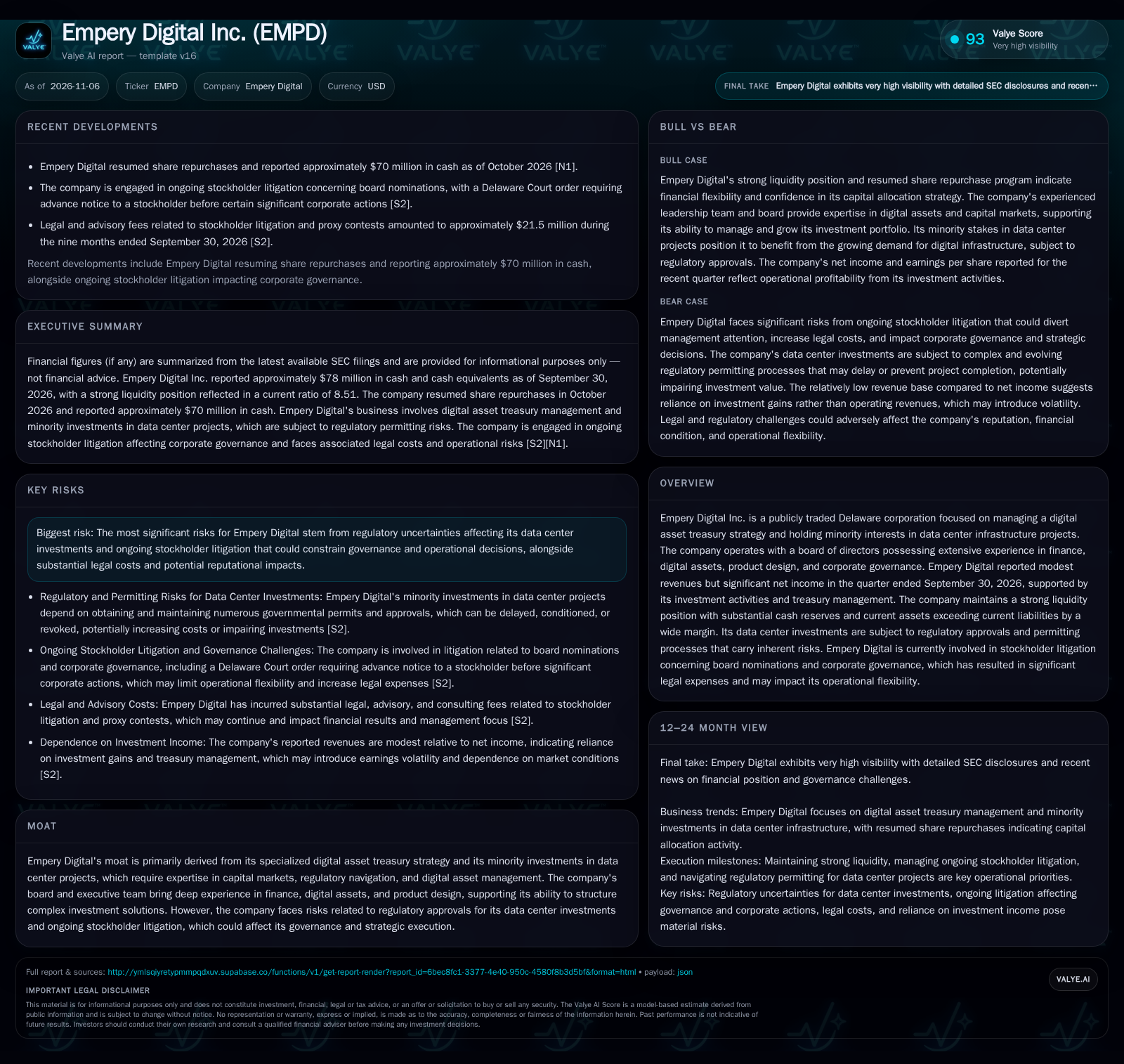
As of September 30, 2026, Empery Digital reported $78.05 million in cash and cash equivalents, with current assets of $80.2 million and current liabilities of $9.4 million. This resulted in a current ratio of 8.51 and a cash ratio of 8.28, underscoring a liquidity position that is unusually strong for a company of its reported scale. [S2] In the same quarter, net income reached $23.99 million on revenues of just $99,606, revealing that earnings are almost entirely driven by investment activities, not operating businesses. [S2] The company resumed share repurchases in October 2026, suggesting a willingness to return capital to shareholders. [N1] However, $21.5 million in legal and advisory expenses linked to ongoing stockholder litigation and proxy contests signal a significant drain on resources and management focus. [S2] Regulatory risks around its data center investments remain unresolved, as permitting delays or revocations could undermine asset value. [S2]
How Empery Digital’s Model Converts Assets Into Earnings—And Where It Could Falter
Empery Digital’s economics hinge on capital allocation, investment returns, and risk management rather than traditional revenue-generation. The company’s modest reported revenues reflect limited operational activity, with the bulk of profitability sourced from gains on digital assets and minority holdings in data center projects. This structure can deliver high returns in favorable markets, as seen in the recent net income spike, but earnings are inherently volatile and highly sensitive to asset price fluctuations.
Fixed costs include legal and advisory fees, which have become material due to ongoing litigation. Variable costs are low absent operational scale, but compliance and regulatory costs may rise as data center projects progress. The capital-light nature of minority investments means Empery Digital is not directly funding or operating large infrastructure, but this also limits its influence over project outcomes. The company reported cash and liquidity metrics for the period; these figures do not by themselves establish operating runway, investment capacity, financial flexibility, or financing capacity.
Specialization in Digital Assets and Data Centers: Advantage or Vulnerability?
Empery Digital’s edge, if any, is rooted in its board’s expertise in digital asset management, financial structuring, and regulatory navigation. This positions the company to identify and participate in high-upside, complex opportunities—especially in digital infrastructure, where expertise and capital access can be barriers to entry. However, as a minority investor in data centers, Empery Digital lacks operational control, making it dependent on partners’ execution and regulatory outcomes.
The competitive landscape for digital asset management and data center investment includes specialized investment funds, infrastructure REITs, and venture-backed digital infrastructure platforms. Many of these competitors have greater scale, deeper operational capabilities, or more diversified portfolios. Empery Digital’s focus on minority stakes may limit its ability to influence outcomes or secure preferential economics, especially in a sector where permitting and regulatory hurdles can derail projects entirely. Litigation-driven governance instability could further undermine its attractiveness as a partner or co-investor in future deals.
If Litigation Subsides and Data Center Bets Pay Off, Value Could Compound Rapidly
A favorable scenario for Empery Digital would see the resolution of stockholder litigation, freeing management to focus on capital deployment and strategic growth. With legal distractions minimized and regulatory approvals secured for its data center projects, the company could benefit from rising demand for digital infrastructure, translating minority stakes into outsized investment returns. Continued strong performance in its digital asset treasury could further amplify net income, while share repurchases would enhance per-share value.
Confirmation of this scenario would come from a sharp decline in legal and advisory spending, successful permitting and development progress at underlying data center projects, and sustained or growing net income from investment activities. If Empery Digital demonstrates an ability to originate or access new high-return opportunities—possibly evidenced by further accretive investments or strategic partnerships—the case for durable value creation would strengthen.
Earnings Volatility Persists Amid Legal Distraction and Regulatory Hurdles
In the most plausible middle path, Empery Digital continues to post lumpy profits driven by investment performance, while periodic legal costs and regulatory delays remain a drag on resources and management bandwidth. The data center portfolio may see some projects progress, but others could be delayed or impaired by permitting challenges. Share repurchases might continue opportunistically, but without a clear path to scalable operating revenues, the company’s valuation remains tied to external market conditions and the outcome of ongoing litigation.
Evidence supporting this scenario would be continued high legal expenses, intermittent project updates without transformative wins, and a net income profile that swings with asset valuations. If the company maintains reported liquidity position but does not achieve operating leverage or resolve governance issues, the market may continue to assign a discount to its shares.
Prolonged Litigation, Regulatory Setbacks, and Investment Losses Could Erode Value
A negative outcome could emerge if stockholder litigation escalates or persists, leading to further legal costs, management distraction, and governance gridlock. Regulatory delays or failures in obtaining permits for data center projects could impair the value of Empery Digital’s minority interests, making it difficult to realize investment returns or exit positions profitably. If digital asset markets turn unfavorable, the company’s treasury gains could reverse, resulting in negative earnings and cash burn.
This scenario would be confirmed by rising or sustained high legal and advisory expenses, project write-downs or impairments, and declining cash balances. An increase in shareholder turnover, negative court rulings, or the inability to deploy capital into new opportunities would further signal structural challenges to value preservation.
Milestones and Developments That Will Shape Empery Digital’s Long-Term Trajectory
Quarterly trends in legal and advisory expenses, which will indicate whether litigation is subsiding or intensifying.
Progress updates on regulatory permitting and development milestones for data center investments, if disclosed.
Net income volatility relative to underlying digital asset and data center market conditions.
Cash and cash equivalents balance over time, especially in relation to ongoing legal and operational expenditures.
Board composition and governance disclosures, including any changes resulting from litigation outcomes or stockholder actions.
Announcements of new investments, exits, or strategic partnerships, which would clarify the company’s ability to originate value-accretive deals.
Share repurchase volumes and timing, which may reflect management’s capital allocation confidence and market valuation views.
Any public disclosure of contract terms, revenue recognition, or investment exit proceeds from data center holdings, which would help test the underlying asset performance thesis.
Disclaimer: This is research-only, informational analysis and not investment advice. It may include AI-generated interpretation and general industry context. Always verify important details using primary sources.

Comments