
YUM Brands After the Pizza Hut Divestiture: Franchise Economics, Digital Ambitions, and the Next Phase of Global QSR Competition
With the $1.7 billion Pizza Hut divestiture gain, accelerating digital sales, and a near-total franchise model, YUM Brands enters a new strategic era. The company’s ability to leverage proprietary technology, maintain franchisee alignment, and adapt to shifting consumer and competitive dynamics will shape its future value creation.
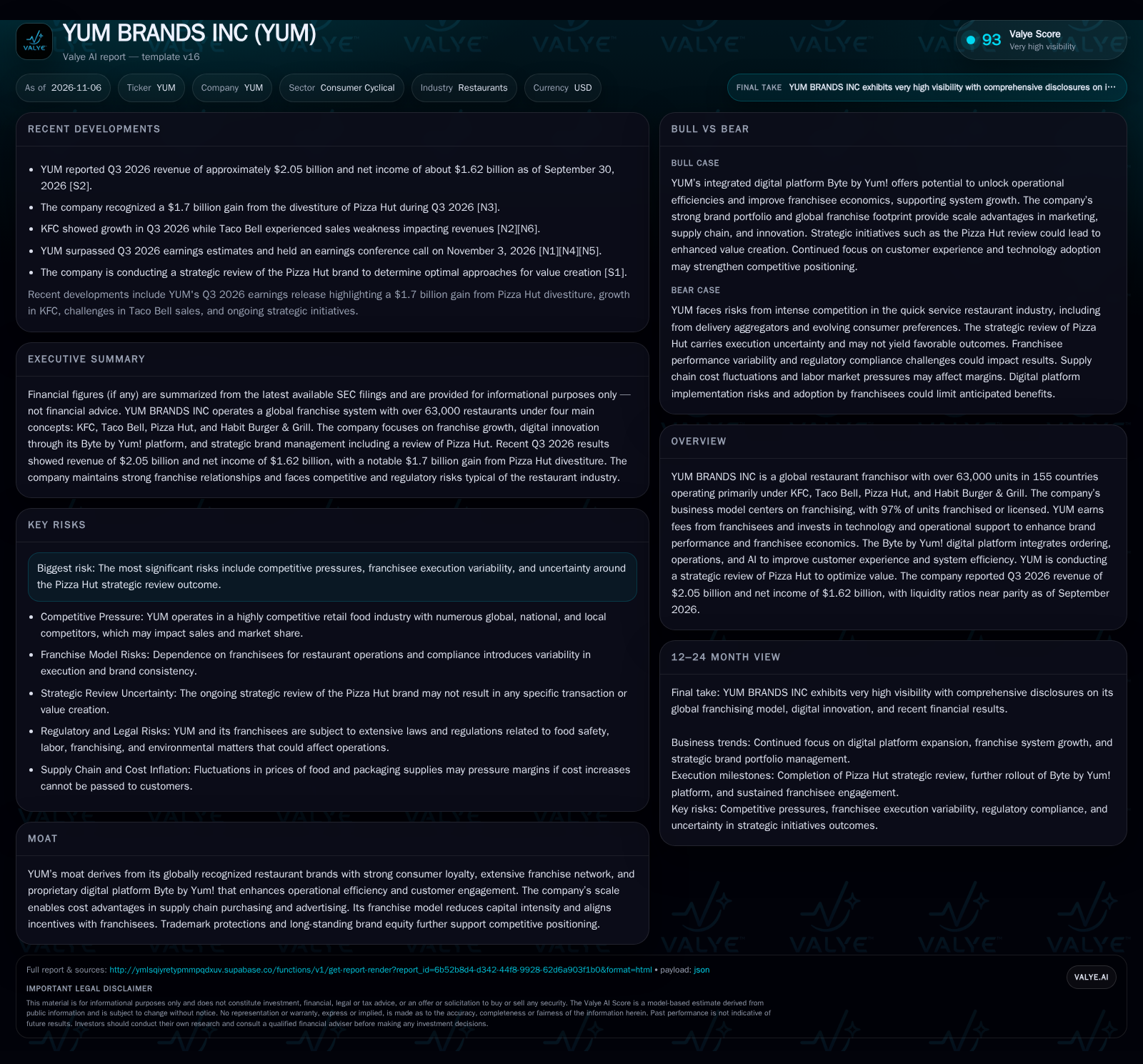
YUM Brands reported a $1.7 billion gain from the Pizza Hut divestiture in Q3 2026, while KFC’s momentum offset Taco Bell’s recent softness. The company’s digital push—now driving 60% of system sales—relies on Byte by Yum!, a proprietary platform integrating operations and customer engagement. YUM’s nearly fully franchised model provides capital efficiency but raises questions about franchisee economics, execution variability, and adaptation to evolving QSR competition.
YUM Brands stands at an inflection point following the $1.7 billion gain from its Pizza Hut divestiture, a move that both simplifies the company’s brand portfolio and places its strategic review of Pizza Hut center stage. With over 63,000 restaurants—97% franchised—the company’s capital-light model and increasing reliance on digital platforms like Byte by Yum! have the potential to enhance system-wide economics and operational efficiency. However, diverging brand performance, especially Taco Bell’s recent softness, and the ever-intensifying quick service restaurant (QSR) landscape pose ongoing challenges. The next phase will test whether YUM can translate its digital and operational initiatives into durable, system-wide value, while managing franchisee alignment and competitive threats.
Divestiture, Digital Penetration, and Mixed Brand Momentum: What’s Shaping YUM Right Now
Three developments define YUM Brands’ current context. First, the company’s Q3 2026 results include a $1.7 billion gain from the Pizza Hut divestiture, marking a pivotal shift in brand portfolio management and triggering an ongoing strategic review of the Pizza Hut brand’s future role. This move could reshape the company’s revenue mix and capital allocation priorities. [N3] [S1]
Second, YUM’s digital transformation is material: digital sales accounted for approximately 60% of system sales and nearly $40 billion in 2025, propelled by the rollout of Byte by Yum!, a proprietary platform integrating operations, ordering, and AI-powered optimization across the franchise base. [S1]
Finally, the Q3 2026 period revealed disparate brand trajectories—KFC showed growth and resilience, while Taco Bell faced sales headwinds that impacted consolidated revenue. This divergence highlights the importance of brand-specific execution within YUM’s multi-concept structure. [N2] [N6]
How YUM’s Franchise Model and Digital Investments Drive Earnings Power
YUM Brands’ economics are fundamentally shaped by its asset-light, high-margin franchise model. With 97% of over 63,000 global units franchised or licensed, the company primarily earns revenue through initial fees, continuing royalties (typically 4-6% of sales), and advertising contributions—rather than direct restaurant operations. This model limits YUM’s exposure to labor and food cost volatility but concentrates its risk in franchisee sales performance and system health. [S1]
The economics of franchising offer substantial operating leverage: incremental system sales (especially digital) generate high-margin royalty streams with minimal capital outlay, as franchisees bear most operating and investment costs. However, this structure also means YUM’s top-line growth is tied to systemwide sales and the ability of franchisees to grow volumes, maintain standards, and adapt to changing consumer habits.
The Byte by Yum! digital platform is designed to drive franchisee productivity and customer satisfaction, potentially unlocking further system sales growth and margin expansion. If widely adopted and effective, it could reduce franchisee labor costs, improve order accuracy, and optimize delivery—benefiting both franchisees and YUM’s royalty base. However, the actual uplift depends on franchisee engagement, ongoing tech investment, and competitive digital offerings.
Capital needs at the corporate level remain modest given the franchise structure. [S2]
Scale, Brand Equity, and Digital Integration: Assessing YUM’s Defenses and Vulnerabilities
YUM’s competitive position is anchored by four globally recognized brands—KFC, Taco Bell, Pizza Hut (in flux), and The Habit—and a vast international footprint. This scale delivers advantages in supply chain purchasing, advertising, and market entry, while the company’s trademarks and brand equity create consumer pull and some degree of pricing power. [S1]
However, the quick service restaurant (QSR) category remains intensely competitive, with pressure from both traditional rivals and technology-driven delivery platforms. Aggregators and delivery-first brands can erode direct customer relationships and compress margins, especially in urban markets.
Digital innovation, particularly through Byte by Yum!, may offer a competitive edge if it materially improves franchisee economics and customer experience. But rivals are also investing heavily in digital ordering, loyalty, and kitchen automation, so any advantage may prove temporary unless YUM can sustain faster innovation cycles or deeper integration.
Franchisee alignment is both an asset and a risk: while system size allows for best-practice sharing and rapid rollout of new initiatives, variation in franchisee capabilities and local market execution can undermine brand consistency and customer satisfaction.
Unlocking Systemwide Value: How YUM Could Outperform Expectations
A favorable scenario for YUM would see Byte by Yum! achieving broad franchisee adoption and delivering tangible improvements in order flow, labor efficiency, and delivery optimization. If franchisees realize higher unit-level profitability and customer satisfaction scores rise, system sales could accelerate, driving faster royalty growth and margin expansion.
The strategic review of Pizza Hut could culminate in a further value-creating transaction—such as an asset-light licensing deal or successful turnaround—freeing up management attention and capital for higher-return growth initiatives.
Continued KFC strength and a Taco Bell rebound, supported by innovation and menu localization, could diversify earnings streams and reduce brand concentration risk.
Evidence confirming this scenario would include: a sustained increase in systemwide sales growth rates, rising digital penetration above 60%, positive franchisee feedback and unit economics, and an accretive outcome from the Pizza Hut review.
Sustaining Franchise Fee Growth Amid Brand Divergence and Competitive Pressures
The most plausible trajectory is continued moderate growth in system sales, underpinned by KFC’s global strength and incremental digital adoption, while Taco Bell and Pizza Hut remain volatile. The franchise model will continue to deliver stable, high-margin royalty streams, but overall growth may be limited by uneven brand performance and competitive encroachment.
Byte by Yum! will likely deliver incremental operational improvements, but its impact may be partially offset by rival QSRs’ own digital investments and the challenges of driving uniform adoption across a diverse franchisee base.
The outcome of the Pizza Hut strategic review may be neutral—yielding incremental improvements or a status-quo arrangement rather than a transformative event.
Confirmation of this scenario would be visible in steady, not accelerating, system sales growth; stable royalty margins; and modest improvements in franchisee productivity and customer metrics.
Execution Gaps, Franchisee Strain, and QSR Disruption: What Could Derail YUM
A negative scenario would see Byte by Yum! adoption stalling or failing to deliver promised efficiencies, with franchisees struggling to justify investment or facing operational complexity. If Taco Bell’s softness persists or worsens, and KFC’s international growth slows due to macroeconomic or competitive factors, system sales could stagnate—compressing royalty income.
Franchisee financial health could deteriorate in the face of rising labor or food costs, especially if YUM or its franchisees are unable to pass through price increases. This could lead to unit closures, brand inconsistency, and reputational risk.
Intensified competition from delivery aggregators or digitally native QSR concepts could erode YUM’s customer base, particularly among younger, urban consumers.
Downside confirmation would include: declining same-store sales, negative franchisee sentiment or closures, missed system sales targets, and lack of clear progress in the Pizza Hut review.
Franchise System Health, Digital Execution, and Brand-Specific Trends: What Will Shape YUM’s Next Phase
Sustained growth in systemwide sales, especially digital sales as a percentage of total, would help validate the Byte by Yum! platform’s impact and overall franchisee health.
Changes in same-store sales (comparable sales) at KFC, Taco Bell, and The Habit—if disclosed—will be critical to assessing brand-level momentum.
Franchisee unit economics and sentiment, including unit-level profitability and willingness to invest in digital upgrades, would help test the thesis that Byte by Yum! enhances system value.
The outcome and timing of the Pizza Hut strategic review—whether a sale, licensing deal, or operational overhaul—will influence capital allocation and brand focus.
Franchisee churn or closure rates—if disclosed—would indicate underlying system stress or resilience.
Shifts in competitive intensity from delivery aggregators or new QSR entrants, particularly in key international markets, could impact traffic and sales mix.
Labor and input cost inflation trends, and the ability of franchisees to absorb or pass on these costs, remain a critical margin variable.
Adoption rates, usage statistics, and franchisee satisfaction with Byte by Yum! (if disclosed) would provide direct evidence of digital platform efficacy.
Disclaimer: This is research-only, informational analysis and not investment advice. It may include AI-generated interpretation and general industry context. Always verify important details using primary sources.

Comments