
FICO’s Evolution: Can Platform Expansion and Alternative Scoring Offset Competitive and Regulatory Strains?
FICO’s sustained dominance in U.S. credit scoring is being tested by platform transition execution, emerging alternative data models, and liquidity vigilance. Its ability to scale ARR from AI-driven software and redefine distribution models will determine whether its durable moat holds as digital lending and regulatory scrutiny intensify.
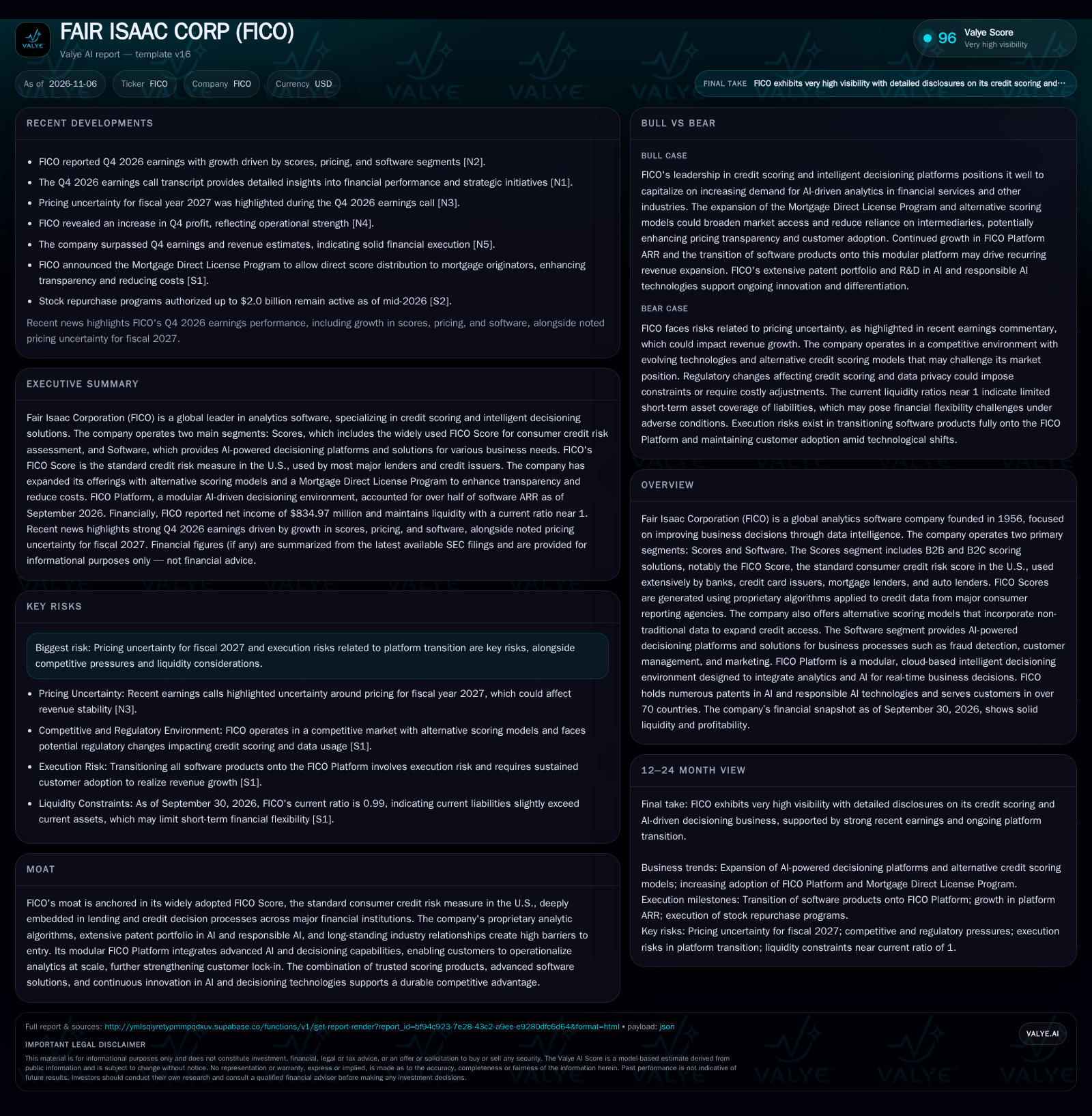
The launch of the Mortgage Direct License Program and strong ARR growth for FICO Platform signal strategy shifts toward transparency and modular AI decisioning. The central question is whether these innovations can outpace intensifying competition and regulatory headwinds while managing near-term potential financial flexibility. [S1] [N2] [N3]
Fair Isaac Corporation’s (FICO) entrenched position as the U.S. standard in consumer credit scoring continues to generate robust profitability and recurring revenue. Yet as the company expands its modular, AI-powered software platform and launches programs to reshape score distribution, it faces meaningful execution, competitive, and regulatory challenges. Q4 2026 results show operational strength, but a current ratio just shy of 1 and explicit management caution on FY27 pricing highlight a business in transition. Whether FICO’s platform and alternative data initiatives can sustain its moat as digital lending and regulatory scrutiny grow will define its next chapter.
Platform ARR Growth and Direct Licensing: The State of Play in 2026
FICO reported Q4 2026 results with growth in both its Scores and Software segments. Notably, FICO Platform annual recurring revenue (ARR) reached $452.6 million, representing 53% of total software ARR as of September 30, 2026 [S1]. This signals continued traction for its modular, cloud-based decisioning environment as more clients migrate from legacy on-premises solutions. The newly introduced Mortgage Direct License Program allows third parties to calculate and distribute FICO Scores directly to mortgage originators, aiming to increase price transparency and reduce intermediary costs [S1].
Financially, FICO ended September 2026 with $217.6 million in cash and equivalents, current assets of $911.7 million, and current liabilities of $919.7 million, yielding a current ratio of 0.99 [S1]. While net income was strong at $834.97 million for the fiscal year, the near-parity of current assets and liabilities puts a spotlight on short-term liquidity management. Additionally, management highlighted pricing uncertainty for fiscal 2027 during the Q4 earnings call [N3].
How FICO Makes Money: The Mechanics of Scoring and Decisioning
FICO’s business model is anchored by two primary revenue streams: the Scores segment and the Software segment. Scores revenue is largely recurring, driven by per-use or per-inquiry licensing of the FICO Score to U.S. banks, lenders, and increasingly to consumers via subscription platforms like myFICO.com [S1]. This model benefits from high operating leverage—once algorithm development and integration are complete, incremental score delivery costs are minimal, so volume growth or price increases flow directly to margins.
The Software segment encompasses both traditional license/maintenance and growing SaaS/ARR models. FICO Platform, as a modular, cloud-based environment, is designed to increase recurring revenue and customer lock-in by integrating multiple analytic and decisioning silos. This recurring model—especially as more clients migrate from on-premises to cloud—could further improve margin stability and predictability, albeit with near-term costs tied to migration and R&D.
Capital needs are modest for a software-driven company, but significant investment continues in R&D for AI, new scoring models, and platform enhancements. Stock repurchase activity is authorized up to $2B, but actual buybacks will likely depend on cash flows, liquidity management, and capital allocation priorities [S2].
Moat Under Pressure: Competitors, Substitutes, and Regulatory Shifts
FICO’s moat has historically been anchored in the ubiquity of the FICO Score across the U.S. lending ecosystem, deep relationships with major credit bureaus, and proprietary algorithms underpinned by an extensive patent portfolio [S1]. Its embeddedness in bank workflows and underwriting standards creates high switching costs for both lenders and borrowers, supporting pricing power.
However, competitive pressures are intensifying. Alternative credit scoring models—some leveraging alternative data (e.g., utility, rent, or transaction data)—are gaining traction, particularly as digital lenders and fintechs seek to serve underbanked populations. Regulatory scrutiny, especially around algorithmic transparency, data privacy, and fairness, could further erode FICO’s differentiation or require costly adjustments.
In the software arena, FICO competes with both established enterprise decisioning providers and cloud-native AI/analytics platforms. The shift to the modular FICO Platform is intended to defend share by offering integration, scalability, and continuous innovation, but execution risk remains if customers delay or resist migration.
If Platform Adoption and Alternative Models Gain Traction
The most favorable outcome is one where FICO successfully migrates a growing share of legacy software clients to its modular, cloud-based FICO Platform, driving up ARR and increasing customer stickiness. The Mortgage Direct License Program could materially improve pricing transparency and lower distribution friction, enabling FICO to capture a greater share of mortgage origination workflows and potentially defend or expand its pricing.
A second growth lever is the expansion of alternative scoring models, such as FICO Score XD or UltraFICO, which could address previously underserved populations and open new B2B and B2C markets. If regulatory changes ultimately favor multi-model or alternative data-driven approaches but FICO’s offerings are validated as accurate and fair, it could reinforce its leadership.
Confirmation of this scenario would come from accelerating FICO Platform ARR growth, increased adoption of alternative scores by lenders, and evidence that the Mortgage Direct License Program is gaining market share. Margin expansion or stable/high renewal rates would further validate successful execution.
Sustained Leadership, but with Margin and Growth Moderation
The most plausible trajectory is that FICO remains the dominant U.S. credit score provider while continuing its gradual shift toward ARR-driven software. Scores revenue remains resilient due to entrenched industry standards, but pricing growth moderates due to competitive and regulatory pressures, especially in areas where alternative data models gain some, but not overwhelming, traction.
Software revenue grows as more clients migrate to the FICO Platform, but the pace is steady rather than explosive, with some friction from legacy system integration and customer change management. The Mortgage Direct License Program expands but is offset by price competition and regulatory scrutiny that caps margin expansion.
Evidence supporting this scenario would include stable or modestly growing Scores revenue, continued but decelerating increases in Platform ARR, and maintenance of high renewal rates. Watch for management guidance that brackets pricing growth and customer migration rates within historical or modestly improving ranges.
What If Regulatory or Competitive Disruption Accelerates?
A more adverse scenario unfolds if regulatory mandates or industry shifts accelerate the adoption of alternative scoring models that materially erode FICO’s core franchise. If large lenders or government agencies mandate or strongly incentivize the use of multiple scores, or if open banking initiatives enable new entrants to bypass FICO’s distribution channels, the company could face both volume and pricing pressure.
Execution risk is another key downside—if the migration to FICO Platform is slower than expected, or if technical, integration, or customer resistance issues emerge, software ARR growth could stall or reverse.
Downside confirmation would include shrinking or flat Scores revenue, decelerating or negative Platform ARR growth, rising customer churn, or material guidance revisions tied to regulatory or competitive developments.
Testing FICO’s Moat: What Will Separate Resilience from Erosion?
FICO Platform ARR growth rate—acceleration or deceleration in quarterly and annual recurring revenue from the platform would indicate customer adoption momentum and pricing power.
Adoption rates of the Mortgage Direct License Program by major mortgage originators—a useful metric would be the share of U.S. mortgage originations processed via direct licensing, if disclosed.
Growth and renewal rates for alternative scoring models (e.g., FICO Score XD, UltraFICO)—would help test the thesis that FICO can defend or expand its market by serving new borrower segments.
Pricing movement in Scores contracts—watch for evidence of sustained or eroding pricing power, especially as competitive and regulatory pressures intensify.
Churn or migration rates for legacy software clients transitioning to FICO Platform—if disclosed, this would signal execution success or friction.
Regulatory developments related to credit scoring standards, data privacy, or mandated score usage—external policy shifts could reset the competitive landscape.
Disclaimer: This is research-only, informational analysis and not investment advice. It may include AI-generated interpretation and general industry context. Always verify important details using primary sources.

Comments