
Regency Centers: Retail REIT Resilience Tested by Debt Rollovers and Shifting Tenant Economics
Regency Centers posts solid 2025 NOI and FFO gains, but faces a pivotal period as $441.8 million in loans near maturity, inflation persists, and tenant health remains sensitive to macro shocks.
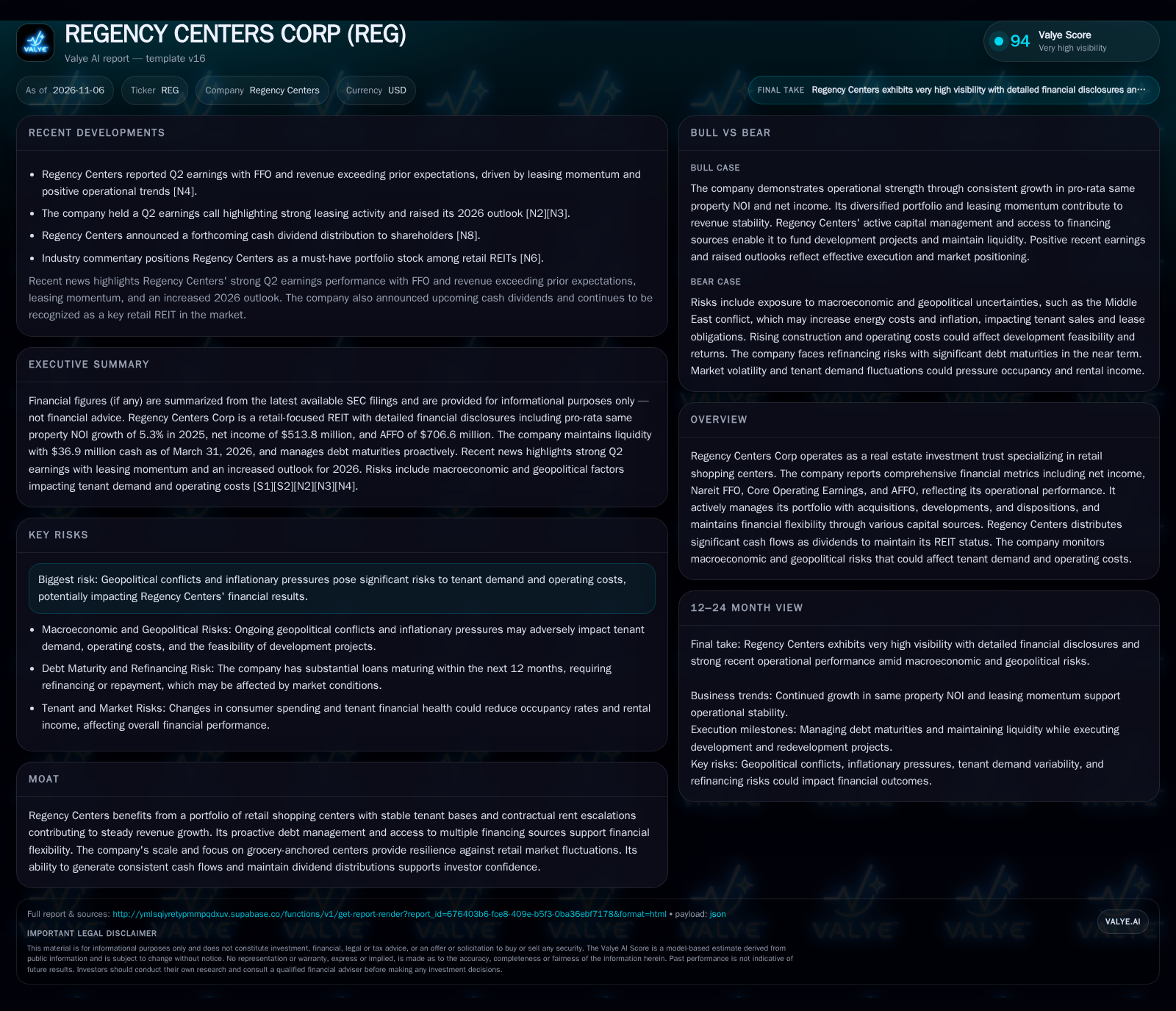
Regency Centers delivered 5.3% growth in same property NOI and higher net income for 2025, underpinned by leasing momentum and a stable retail tenant mix. However, $441.8 million in loans are due within 12 months, and inflationary pressures plus geopolitical risks could challenge tenant demand and operating costs. The next phase hinges on Regency’s refinancing strategy and its ability to maintain occupancy and rental growth in a volatile retail landscape. [S1] [S2] [N2] [N3] [N4]
Regency Centers Corp, a leading retail-focused REIT, continues to post robust operating performance, with 2025 seeing notable gains in same property NOI, net income, and FFO. The company’s portfolio of grocery-anchored shopping centers has helped secure a resilient cash flow base even as the broader retail environment faces ongoing volatility. Yet, Regency now confronts a critical test as nearly $442 million in debt approaches maturity amid persistent inflation and macro uncertainty. How Regency manages refinancing and tenant health will shape its ability to sustain dividends and development ambitions in the coming years. [S1] [S2] [N2] [N3] [N4]
Recent Operating Gains Meet Looming Debt Wall
Regency Centers reported a 5.3% increase in pro-rata same property NOI (excluding termination fees), reaching $1,092.9 million for 2025—a sign of resilient portfolio performance in a challenging retail environment. Net income attributable to common shareholders climbed to $513.8 million, and both Nareit FFO ($855.7 million) and AFFO ($706.6 million) showed healthy year-over-year improvement. However, the company faces a material near-term capital event, with $441.8 million in loans coming due over the next 12 months. Regency intends to address these maturities through refinancing, repayment, or potential property sales, but the process will unfold against a backdrop of inflationary pressures and geopolitical risk that could affect tenant stability and market rates [S1] [S2].
How Regency Centers Generates and Distributes Value
Regency Centers’ economics are rooted in contractual rent streams from a diversified tenant base, with grocery-anchored shopping centers providing relative stability versus other retail formats. The company’s revenue model relies on a mix of base rents, percentage rents, and recoveries for operating costs. Rent escalations and long-term leases offer visibility, but inflation and tenant turnover can pressure renewal terms and occupancy. Operating leverage is achieved through scale—incremental revenue growth typically outpaces fixed-cost increases, especially as property-level NOI rises.
The REIT model requires the distribution of the majority of taxable income as dividends, constraining internal capital retention but attracting income-focused investors. Regency funds development, redevelopment, and acquisitions through retained cash flows, asset sales, and external debt or equity. With $36.9 million in cash as of March 31, 2026, Regency’s liquidity is typical for a large REIT—sufficient for short-term needs, but reliant on access to capital markets for large obligations and new investments [S1] [S2]. Debt refinancing costs, interest rate exposure, and potential capex for repositioning underperforming centers are key variables shaping future margin and cash flow dynamics.
The interplay between Regency Centers’ lease structures and inflationary dynamics warrants closer examination. While contractual rent escalations provide some inflation protection, their effectiveness depends on the frequency and formula of escalation clauses, which may lag actual cost increases. In environments of accelerating inflation, tenants—particularly smaller operators with thinner margins—may struggle to absorb rising rents, potentially leading to increased concessions or turnover. Additionally, the mix of base rent versus percentage rent affects revenue sensitivity to tenant sales trends; a higher percentage rent component could align Regency’s income with tenant performance but also introduce volatility during economic downturns. Understanding the balance and flexibility within these lease terms is critical to projecting future cash flow stability.
Defensive Anchors, but Retail Shifts and Capital Markets Test Moat
Regency’s competitive positioning is anchored by its focus on grocery-anchored centers, which tend to deliver more stable traffic and lower e-commerce substitution risk than apparel or discretionary retail. The company’s scale enables access to prime locations and national tenants, supporting negotiating leverage. Contractual rent escalations and diversified tenant rosters help mitigate individual retailer distress.
However, the competitive landscape is evolving, with peer REITs, private real estate funds, and even non-traditional investors targeting similar assets. The risk of new supply is low given development headwinds, but tenant mix remains a moving target as consumer patterns shift. Regency’s ability to curate high-traffic, necessity-based centers is an advantage, but inflation and wage pressures could erode tenant profitability, raising the risk of vacancies or lease renegotiations. Access to low-cost capital and proactive asset management are increasingly critical as debt markets tighten and refinancing risk rises.
Regency’s moat is also influenced by its ability to adapt tenant mix in response to evolving consumer preferences and retail trends. The shift toward experiential retail and service-oriented tenants challenges traditional grocery-anchored centers to maintain relevance. If Regency can successfully integrate complementary uses such as health services, fitness centers, or specialty food providers, it may enhance foot traffic resilience and diversify income streams. Conversely, failure to anticipate or accommodate these shifts could accelerate tenant churn and vacancy risk. Moreover, competitive pressures from e-commerce and alternative retail formats underscore the importance of proactive asset management and tenant engagement to sustain occupancy and rental growth in a changing landscape.
Refinancing Success and Tenant Strength Drive Dividend Upside
If Regency can refinance or repay its $441.8 million in upcoming maturities at manageable rates, while maintaining or improving occupancy and rental spreads, the company may preserve its recent momentum in NOI and FFO growth. Continued leasing momentum—particularly among grocery and service tenants—could support rent escalations and limit turnover, even if consumer spending moderates.
Further upside could materialize if inflation stabilizes and energy costs moderate, reducing operating expense pressures for both Regency and its tenants. Evidence of new anchor tenant deals or successful project completions would further validate the bull case.
Steady Cash Generation with Heightened Sensitivity to Financing and Tenant Mix
The most plausible outcome is that Regency manages to refinance upcoming maturities at incrementally higher rates, causing modest interest expense headwinds but not fundamentally altering capital availability. NOI and FFO growth could moderate as inflation and consumer uncertainty weigh on leasing spreads and tenant renewals, but occupancy is likely to remain high for necessity-based centers.
This scenario would be confirmed by stable-to-slightly-rising occupancy, flat or slightly positive leasing spreads, and refinancing disclosures showing successful debt rollovers with higher but manageable rates. A lack of major tenant bankruptcies or project delays would further support this outcome. Falsification would come from sharp increases in vacancies, negative leasing spreads, or an inability to refinance debt without asset sales or dilutive equity raises.
Tenant Stress or Refinancing Friction Triggers Cash Flow and Dividend Risk
A more adverse scenario would unfold if macroeconomic or geopolitical shocks (such as energy price spikes or consumer downturns) weaken tenant sales, leading to higher vacancies, rent concessions, or outright tenant failures. In this context, Regency could face downward pressure on NOI and FFO, even as operating costs rise. If refinancing becomes challenging—due to higher rates, tighter credit conditions, or weaker asset values—the company may need to sell properties at disadvantageous prices or consider dilutive capital actions to preserve liquidity.
Evidence confirming this scenario would include declining occupancy, negative leasing spreads, missed or delayed refinancing, or reductions in dividend payouts. Early warning signs could manifest in rising tenant delinquencies or announcements of major retailer distress within the portfolio.
What Will Determine Regency’s Resilience in the Next Cycle?
Sustained or improved pro-rata same property NOI growth in future quarters would support operational momentum; a reversal would raise questions about tenant health and rent dynamics.
Occupancy rates, especially among anchor grocery and necessity retailers, will be crucial; if disclosed, watch for any uptick in vacancies or turnover.
Leasing spreads on renewals and new leases (if disclosed) will indicate pricing power—or lack thereof—in the current environment.
Successful refinancing of the $441.8 million in upcoming maturities, including disclosed rates and terms, will be a key test of capital market access.
Updates on development and redevelopment project completions, leasing pre-commitments, and incremental NOI contributions would help test the growth pipeline.
Trends in operating expenses, especially utilities and property-level labor, may signal margin pressure or relief depending on inflation and energy price trends.
External macro developments—especially continued inflation, interest rate moves, or shocks from geopolitical conflict—may shape both tenant performance and Regency’s access to refinancing.
Disclaimer: This is research-only, informational analysis and not investment advice. It may include AI-generated interpretation and general industry context. Always verify important details using primary sources.

Comments