
Drilling Tools International: Acquisition-Driven Growth Meets Margin Pressure in Volatile Energy Markets
Drilling Tools International’s expansion via Eastern Hemisphere acquisitions has lifted top-line growth, but operational headwinds—including inflation, rising interest expense, and a return to net loss—underscore the cyclical and capital-intensive reality of the drilling tools sector.
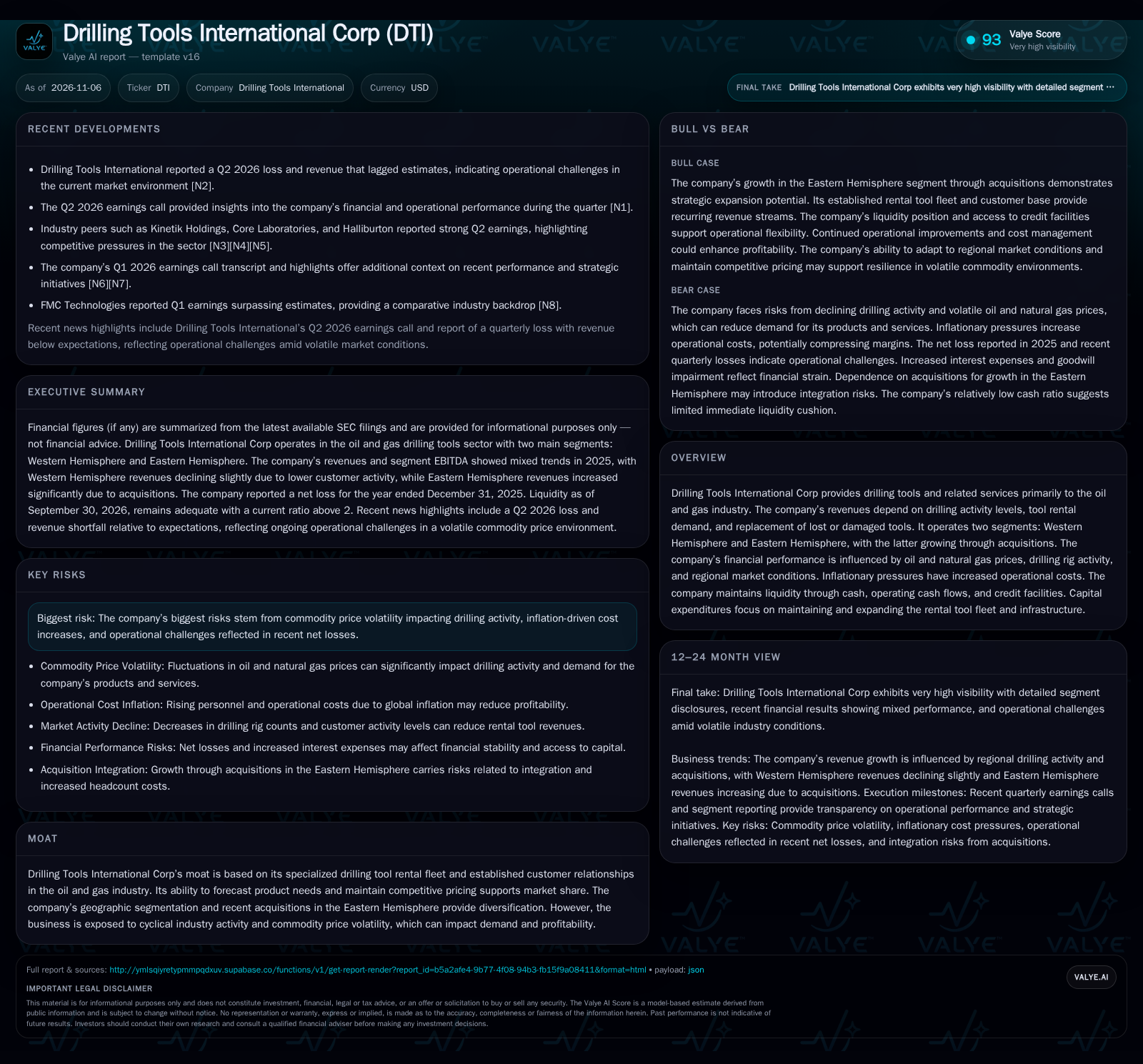
Drilling Tools International Corp grew total revenue 3% in 2025, with sharp Eastern Hemisphere gains offsetting Western Hemisphere softness, but reported a net loss as margins compressed and interest expense surged. Acquisitions fuel international growth, yet operational and financial pressures highlight the sector’s exposure to energy market cycles and cost inflation.
Drilling Tools International Corp is navigating a classic energy-sector tension: acquisition-fueled growth in select geographies meets intensifying margin pressure and operational volatility. While the company’s aggressive push into the Eastern Hemisphere through rental tool business acquisitions has driven significant revenue expansion, profitability has come under strain from inflation, increased interest costs, and a cyclical downturn in core Western Hemisphere markets. The latest financials reveal both the opportunity and risk inherent in a capital-intensive, commodity-linked business model—where top-line gains can be quickly offset by cost and integration headwinds. The central question is whether the company can convert its international growth into durable profitability amid the sector’s shifting fundamentals [S2] [N2].
Recent Results Highlight Geographic Divergence and Margin Compression
In 2025, Drilling Tools International achieved a 3% increase in total net revenue to $159.6 million, masking a sharp bifurcation between business segments: Western Hemisphere revenue declined 3% to $148.6 million due to lower customer activity, while Eastern Hemisphere revenue surged 78% to $23.5 million, primarily because of recent tool rental business acquisitions [S2]. Despite this top-line growth, segment EBITDA fell 5% year-over-year to $50.0 million, and the company swung to a net loss of $3.76 million from a $3.0 million profit in 2024 [S2]. The company reported a current ratio of 2.08 for the period. [S2] Recent news reports confirm continued operational challenges, with Q2 2026 results missing revenue expectations and posting a loss [N2].
Rental Model Dynamics and the Cost Structure Behind Growth Ambitions
Drilling Tools International’s economics are rooted in a capital-intensive rental model. The company generates revenue by renting specialized drilling tools and providing related services to oil and gas operators. Pricing is influenced by regional drilling activity, customer urgency, competitive alternatives, and the technical complexity of required tools. Volume is highly sensitive to rig counts and commodity prices, while mix is shaped by the proportion of high-value or specialty tools in the fleet.
The fixed-cost base includes significant capital expenditures for maintaining and expanding the rental fleet, as well as depreciation associated with tool wear, loss, and replacement. Variable costs include personnel, logistics, and direct operational expenses, all of which have been rising due to global inflation. Recent acquisitions have boosted fleet size but also increased depreciation and integration-related expenses. Operating leverage is present, but only when utilization rates are high—meaning that downturns in drilling activity can quickly erode margins and push the business into losses, as recent results demonstrate [S2].
The company reported cash and liquidity metrics for the period; these figures do not by themselves establish operating runway, investment capacity, financial flexibility, or financing capacity. Interest expense has risen sharply, reflecting the cost of acquisition financing and a higher debt load, which could constrain future investment or force further cost discipline if profitability does not recover [S2].
Competitive Landscape: Scale, Specialization, and the Challenge of Cyclicality
DTI competes with other providers of drilling tool rentals and related services, ranging from diversified oilfield services firms to specialized regional players. The company’s competitive strengths include an established customer base, a diversified fleet, and geographic segmentation, which provides some insulation from regional downturns. Recent Eastern Hemisphere acquisitions have expanded its footprint and could enable cross-selling or improved fleet utilization.
However, the sector is characterized by low switching costs for customers, price sensitivity, and exposure to abrupt shifts in rig activity. Larger, integrated oilfield service companies can bundle offerings or leverage global scale, potentially squeezing margins for mid-sized players. The rental model itself is vulnerable to substitution by operator-owned tools or technology shifts (such as automated or more durable drilling solutions), which could erode demand over time. While DTI’s ability to forecast customer needs and maintain competitive pricing helps sustain share, true pricing power is limited by the commoditized nature of many tool categories and the cyclical purchasing behavior of E&P customers.
Eastern Hemisphere Integration and Commodity Recovery Unlock Operating Leverage
A favorable scenario for DTI would see successful integration of its recent Eastern Hemisphere acquisitions, leading to improved fleet utilization, cross-regional customer wins, and better absorption of fixed costs. If oil and gas prices stabilize or rise, global drilling activity could recover, lifting both rental volumes and pricing. In this environment, DTI’s expanded fleet and geographic diversity would provide operating leverage, converting higher revenues into outsized EBITDA and a return to net profitability.
Confirmation would come from sequential improvements in segment EBITDA margin, reduced integration costs, and evidence of cross-selling between regions. A sustained uptick in global rig counts, coupled with higher tool utilization rates and improved cash flow conversion, would further validate the upside thesis. Conversely, if Eastern Hemisphere margin expansion stalls or integration costs persist, upside would be limited.
Steady-State Operations Amid Commodity and Cost Volatility
The most probable near-term outcome is that DTI continues to operate in a challenging, low-growth environment marked by commodity price volatility, inflationary cost pressures, and only modest improvement in drilling activity. Western Hemisphere revenue may remain flat or decline slightly, while Eastern Hemisphere gains from acquisitions offset some of the softness but do not fully restore overall margin health.
In this scenario, EBITDA margins remain under pressure from elevated personnel and operational costs, and interest expense continues to weigh on net income. Confirmation would come from stable or slightly improving segment revenues, persistent but narrowing net losses, and a lack of significant improvement in margin or cash conversion ratios.
Prolonged Drilling Slump and Cost Inflation Drive Deeper Losses
A negative scenario would see a sustained downturn in oil and gas prices, leading to further reductions in global drilling activity and lower demand for rental tools. Both Western and Eastern Hemisphere segments would experience falling utilization, pricing pressure, and rising competition for a shrinking customer base. Inflationary pressures on wages and logistics would further compress margins, while elevated depreciation and interest expense from prior acquisitions would amplify losses.
In this environment, DTI could face liquidity stress if operating cash flows turn negative, potentially forcing asset sales, layoffs, or restructuring. Confirmation would include a sharp drop in segment revenues, widening net losses, increased borrowing or covenant pressure, and signals of asset impairment or restructuring charges.
Milestones and Trends That Will Define DTI’s Next Chapter
Eastern Hemisphere segment EBITDA margin trends, particularly post-acquisition integration outcomes, would help test the thesis.
Quarterly tool utilization rates, if disclosed, would reveal whether expanded fleet capacity is translating into higher revenue productivity.
Net cash flow from operations relative to interest and capital expenditures will indicate the company’s ability to self-fund and service debt.
Tracking changes in interest expense and debt levels will signal whether acquisition-driven leverage is stabilizing or becoming a constraint.
Disclosures on customer retention rates and new contract wins, especially in new geographies, would validate cross-selling and market share gains.
Updates on inflationary cost impacts, such as wage or logistics expense trends, would clarify the persistence of margin pressure.
Any signals of asset impairments, restructuring, or divestitures would suggest worsening downside risk or a shift in strategic direction.
Disclaimer: This is research-only, informational analysis and not investment advice. It may include AI-generated interpretation and general industry context. Always verify important details using primary sources.

Comments