
Camden Property Trust: Portfolio Optimization, Occupancy Gains, and the Levers of Resilience in Multifamily REITs
Camden Property Trust continues to refine its multifamily portfolio through targeted acquisitions, development, and asset sales, while recent operational metrics suggest improved occupancy and cash generation. The company’s ability to balance capital deployment, manage debt, and adapt to shifting market conditions will be central to its performance as macroeconomic and regulatory risks intensify.
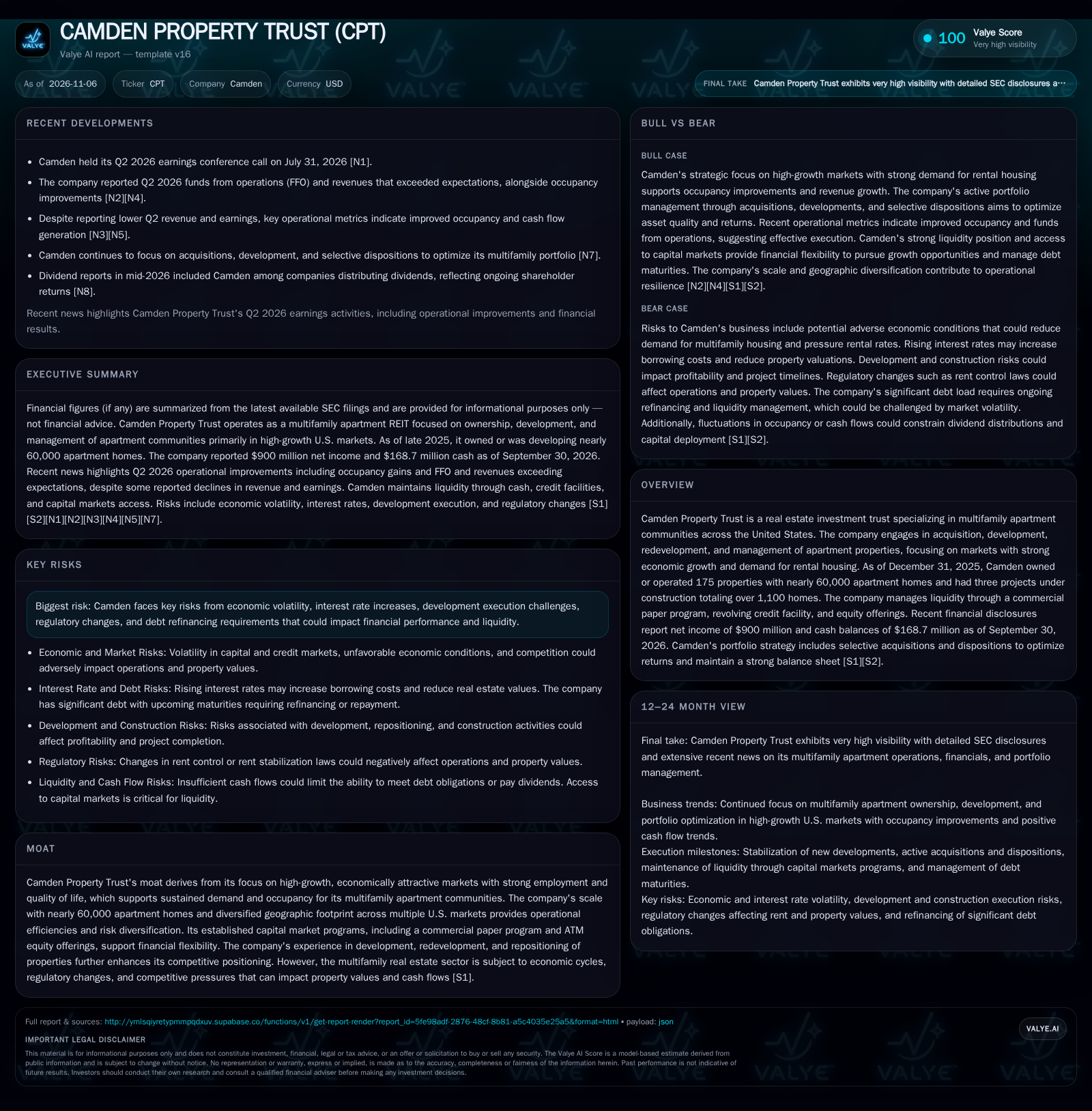
Camden Property Trust reported improved occupancy and outperformed FFO expectations in Q2 2026, despite lower headline revenue and earnings. The REIT maintained active portfolio management—acquiring, developing, and disposing of properties—and ended September 2026 with $168.7 million in cash and $900.4 million in net income. With a significant development pipeline and nearly $4 billion in unsecured notes payable, Camden’s future depends on its execution in growth markets, cost of capital management, and the resilience of rental demand in the face of economic and regulatory headwinds. [S1] [S2] [N2] [N3] [N4] [N5]
Camden Property Trust, one of the largest multifamily real estate investment trusts (REITs) in the United States, continues to navigate a dynamic landscape characterized by shifting rental demand, capital market volatility, and increasing regulatory scrutiny. In 2026, Camden’s active approach to portfolio optimization—balancing acquisitions, new developments, and strategic asset sales—has yielded operational improvements, notably in occupancy and funds from operations (FFO). Yet, with nearly $4 billion in unsecured notes payable and a pipeline of new construction, the company’s ability to sustain growth and defend margins will depend on its execution in high-growth markets, discipline in capital management, and adaptability to external risks.
Recent Portfolio Moves and Operational Performance: What’s Changed for Camden
Camden ended September 2026 with interests in 175 multifamily properties comprising 59,921 apartment homes, and reported net income of $900.4 million for the first nine months of the year. The company’s Q2 2026 funds from operations (FFO) and revenues exceeded expectations, with operational metrics showing improved occupancy—an important driver for REIT cash flows. However, total revenue and earnings for the quarter declined, reflecting either market softness or a shift in portfolio mix. During 2025, Camden acquired four properties for $422.9 million and disposed of five properties, recognizing $260.9 million in gains. The REIT also had three projects under construction (1,162 units) with $213.8 million in remaining costs at year-end 2025. Camden’s liquidity toolkit as of late 2026 included $168.7 million in cash, a $600 million commercial paper program (with $590 million drawn at 3.84%), and access to revolving credit and at-the-market (ATM) equity offerings. Unsecured notes payable totaled $3.92 billion, highlighting an ongoing reliance on capital markets for growth and refinancing. [S1] [S2] [N2] [N3] [N4] [N5]
How Camden’s Revenue Model and Capital Structure Shape Its Economic Outcomes
Camden’s core economics are driven by rental income from its portfolio of stabilized multifamily apartment communities. Occupancy rates, rent growth, and operating expense discipline are the principal levers for cash flow and FFO, the preferred REIT profitability metric. In periods of robust rental demand, Camden can increase effective rents and reduce concessions, amplifying revenue and operating leverage as fixed costs (property management, taxes, maintenance) are spread over more units. Conversely, market softness can compress margins if occupancy or rent growth falter. The company’s development pipeline—currently three projects totaling over 1,100 units—offers embedded growth, but requires significant upfront capital and exposes Camden to construction cost and lease-up risks.
Funding sources include retained cash flow, property-level debt, unsecured notes, commercial paper, revolving credit, and equity raised via the ATM program. The $3.92 billion in unsecured notes and active use of commercial paper suggest a moderate-to-high leverage profile, typical of large REITs seeking to optimize after-tax returns. However, this structure also adds refinancing risk and sensitivity to interest rate fluctuations. Asset recycling—selling stabilized or non-core properties to fund new acquisitions or developments—can help maintain portfolio quality and unlock gains, but may temporarily reduce income if proceeds are not promptly redeployed.
Assessing Camden’s Competitive Edge in the Multifamily REIT Arena
Camden’s scale—nearly 60,000 apartment homes—provides operational efficiencies, purchasing power, and geographic diversification across high-growth U.S. markets. This footprint helps mitigate regional downturns and supports steady rental demand. The company’s focus on markets with strong employment and quality-of-life attributes is designed to sustain occupancy and enable rent growth, especially as population migration trends continue to favor the Sun Belt and other growth corridors.
However, the multifamily sector remains highly competitive. Camden faces pressure from both other large, public REITs and smaller private operators, as well as potential substitutes such as single-family rentals and new apartment supply. The company’s ability to source attractive acquisitions, execute developments on time and budget, and maintain high resident satisfaction are central to defending its market share. Regulatory risk—particularly related to rent control or zoning restrictions—remains a persistent threat, especially in jurisdictions considering tighter tenant protections.
If Camden’s Market Selection and Asset Rotation Deliver Outsized Gains
In a favorable scenario, Camden’s disciplined market selection and ongoing asset recycling could deliver above-average rent growth and occupancy, translating into outsized FFO and NAV (net asset value) appreciation. If economic conditions remain supportive in Camden’s target metros—characterized by job growth, in-migration, and limited new supply—the company could achieve higher lease rates on new and renewing tenants, while stabilizing its development pipeline ahead of schedule. Asset sales at premium valuations would allow for accretive reinvestment in higher-yielding markets or developments.
Evidence for this scenario would include sustained or rising occupancy rates above 95%, same-property net operating income (NOI) growth exceeding peers, successful lease-up of new developments, and asset dispositions at cap rates below acquisition yields.
Operational Stability Amid Macroeconomic Crosscurrents
The most plausible outcome is that Camden continues to post steady operational results, with modest rent growth and strong, but not accelerating, occupancy in its core markets. Development projects are completed on budget and within expected lease-up periods, contributing incrementally to cash flow. Asset recycling supports portfolio optimization but does not materially change overall income, as gains on sales are offset by the time required to redeploy proceeds. Camden manages its debt maturities and capital needs through a combination of cash flow, credit facilities, and selective equity issuance, maintaining a stable leverage profile.
This scenario would be confirmed by stable FFO per share, occupancy rates in the low-to-mid 90% range, and no material deterioration in interest coverage or debt service metrics. Minor fluctuations in quarterly results would reflect normal seasonality and market dynamics rather than structural shifts.
How Economic Shocks or Regulatory Changes Could Pressure Camden’s Margins
A less favorable scenario could emerge if economic conditions deteriorate, leading to higher unemployment, reduced household formation, or increased tenant turnover. In this environment, Camden could face declining occupancy and weaker rent growth, forcing greater concessions or even rent reductions. If interest rates rise further or capital markets tighten, refinancing existing debt could become more expensive, squeezing margins and potentially limiting new investment. Regulatory shocks—such as new rent control measures or adverse tax changes—could directly impair cash flows and asset values, especially in key markets.
Delays or cost overruns in the development pipeline could further exacerbate financial strain.
Tracking the Factors That Will Shape Camden’s Performance and Resilience
Quarterly and annual occupancy rates, both portfolio-wide and by region, as a direct indicator of rental demand and potential pricing power.
Same-property net operating income (NOI) growth versus peer REITs, if disclosed, to assess operational efficiency and market strength.
Lease-up velocity and stabilization timing for new developments—actual versus projected occupancy milestones and rents achieved.
Net acquisition and disposition activity, including realized gains and reinvestment pace, to gauge portfolio optimization and capital recycling effectiveness.
Weighted average interest rate and maturity profile of debt, as well as refinancing activity, given the sensitivity to capital market conditions.
Any material regulatory developments or rent control proposals in Camden’s major markets, which could affect revenue predictability and asset values.
Construction cost inflation and supply chain issues affecting the timeline or economics of ongoing and planned development projects.
Disclaimer: This is research-only, informational analysis and not investment advice. It may include AI-generated interpretation and general industry context. Always verify important details using primary sources.

Comments