
York Water: Regulated Monopoly, Capital Demands, and the Challenge of Sustainable Growth
York Water’s long-standing monopoly in south-central Pennsylvania provides stability, but regulatory rate-setting, weather-driven usage swings, and ongoing capital projects shape both its upside and constraints. Recent insider buying and oversold shares highlight a market at odds with predictable utility economics.
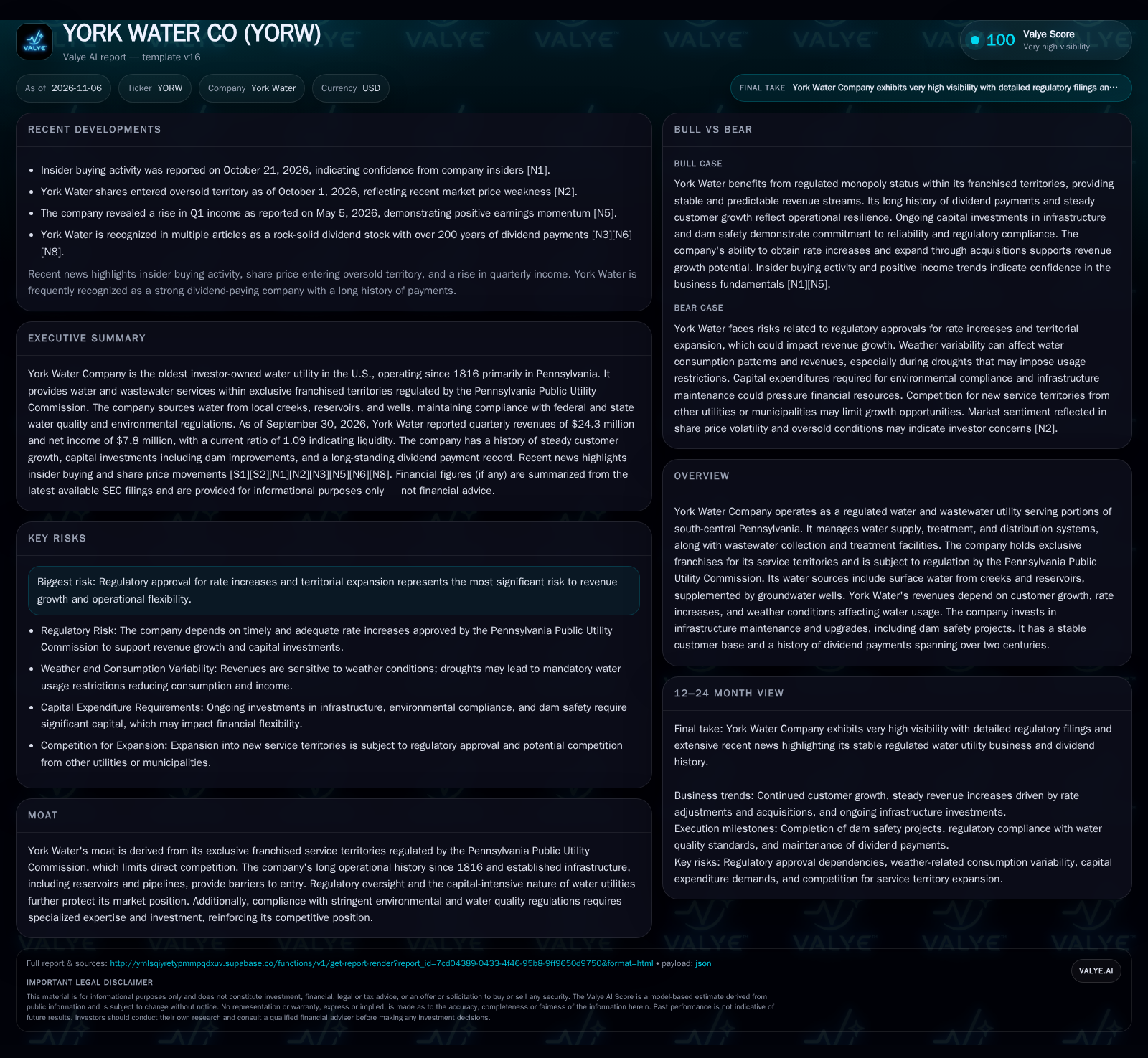
York Water’s exclusive, regulated service territory and long operating history underpin its stable revenues, but growth relies on regulatory approval for rate hikes and expansion. Recent customer and revenue growth reflect both organic gains and acquisition activity, though the capital-intensive nature of the business and weather-related demand variability remain key watchpoints. Insider buying offers a positive signal amid recent share price weakness. [S1] [S2] [N1] [N2]
York Water Company, the oldest investor-owned water utility in the United States, has built a reputation for stability through its regulated monopoly model and exclusive service territories across south-central Pennsylvania. While recent financial results show steady customer and revenue growth, the company’s prospects hinge on its ability to secure regulatory approval for rate increases and territory expansion. Ongoing capital projects and weather-driven demand variability add complexity to the outlook. With recent insider buying amid share price softness, investors are weighing the durability of York Water’s core advantages against the constraints of regulation and capital intensity. [S1] [S2] [N1] [N2]
Recent Developments: Customer Growth, Capital Projects, and Market Sentiment
York Water reported $24.3 million in operating revenues and $7.8 million in net income for the quarter ended September 30, 2026, with revenues for the first nine months at $67.9 million and net income of $20.2 million. Basic and diluted EPS were $0.48 for the quarter and $1.30 for the nine-month period. [S2]
The company’s customer base expanded from 79,771 to 81,292 in 2025, supporting a 3.4% revenue increase to $77.5 million. This growth reflects both organic gains and acquisition-driven expansion. [S1]
York Water continues to invest heavily in infrastructure, including major dam projects, with net utility plant assets totaling $598 million as of September 30, 2026. [S2]
Insider transaction activity was reported in the cited source; this activity does not by itself establish insider confidence. [N1] [N2]
How Regulated Utilities Generate Predictable Returns—And Where the Model Stretches
York Water’s core business model is built on providing essential water and wastewater services within exclusive, PPUC-regulated territories. Pricing is determined through rate cases, with the Pennsylvania Public Utility Commission (PPUC) setting allowable returns on invested capital. This enables York Water to recover its operating costs and earn a regulated return, typically resulting in low earnings volatility compared to unregulated businesses. [S1]
Revenue growth comes from two primary levers: customer expansion (organic or via acquisition) and successful petitions for rate increases. Base usage fees and minimum customer charges are designed to cover fixed costs, partially insulating the company from short-term weather-driven demand swings.
Capital intensity is a defining feature: the company must continually invest in reservoirs, pipelines, dams, and treatment facilities to meet regulatory standards and accommodate customer growth. Net utility plant assets approaching $600 million illustrate the scale of ongoing investment. [S2] The regulated model typically allows York Water to recover these investments over time, but the timing and magnitude of allowed returns depend on regulatory approval.
Operating leverage is moderate; while fixed costs are high, incremental revenue from new customers or rate hikes can drive margin expansion, provided the company can manage infrastructure and compliance costs.
Exclusive Franchise: Durable Advantage with Regulatory and Expansion Headwinds
York Water’s exclusive franchise rights create a local monopoly, effectively shielding it from direct competition within its service territory. Entry barriers are high due to the capital required to build infrastructure and the complexity of regulatory compliance. This entrenched position is reinforced by the company’s operational history and established relationships with regulators. [S1]
However, expansion outside existing territories is not automatic. Regulatory approval is required, and the company may face competition from other utilities or municipalities when bidding for new service areas. Although direct competitive threats are minimal within current borders, the company’s growth opportunities are therefore bounded by the pace and outcome of regulatory processes.
Substitution risk is low; potable water and wastewater services are essential, and alternative providers are generally not viable in the short term. However, long-term risks exist if municipalities seek to municipalize services or if regulatory bodies become less favorable to investor-owned utilities.
Pathway to Outperformance: Regulatory Support and Strategic Expansion
The most favorable scenario for York Water involves a virtuous cycle of regulatory approvals for both rate increases and territory expansion. If the PPUC continues to grant timely and robust rate hikes that reflect rising costs and capital investment, margins and returns could expand.
Growth through acquisitions or annexations of adjacent service areas, approved by regulators, could increase the customer base and leverage existing infrastructure, driving additional economies of scale. Successful execution of major capital projects—such as dam upgrades—without significant cost overruns or delays would further bolster returns by reducing risk and supporting regulatory credibility.
Confirmation of this scenario would be seen in continued customer growth above historical trends, regular and meaningful rate adjustments, disciplined capital spending, and consistent earnings improvement. Regulatory filings, acquisition announcements, and rate case outcomes would be the primary evidence.
Stable Returns Amid Regulatory and Weather Variability
The most plausible outlook is one of steady but modest growth, reflecting incremental customer additions, periodic rate increases, and ongoing capital investments required for compliance and maintenance. Revenue and earnings will likely track in line with approved rate cases and customer expansion in the existing service territory.
Weather remains a wild card: unusually wet or dry years could drive short-term fluctuations in water usage and revenue, though minimum charges help dampen the impact. Regulatory lag—delays between cost increases and rate approvals—may compress margins at times.
Supporting evidence for this scenario would include continued low-single-digit revenue and customer growth, stable operating margins, and the absence of major regulatory or capital shocks.
When Regulation and Capital Needs Collide: Compression Risk
The primary risk to York Water’s outlook is an unfavorable regulatory environment that limits the pace or magnitude of rate increases, especially in the face of rising operating or capital costs. If the PPUC becomes more stringent, or if political pressures grow to constrain utility rates, York Water could face margin compression and delayed recovery of capital outlays.
Unexpected cost overruns or delays in major infrastructure projects could further strain cash flow and necessitate external financing on less favorable terms. Adverse weather conditions, such as severe droughts triggering mandatory restrictions, could also reduce water usage and revenue beyond what minimum charges can offset.
Downside confirmation would come from rejected or reduced rate increase requests, escalating capital spending without corresponding revenue growth, or regulatory actions that challenge the company’s franchise rights.
Metrics and Events That Will Shape York Water’s Next Chapter
Customer growth rate—particularly from acquisitions or expansions into new territories—will indicate whether management is capturing available growth opportunities. [S1]
Outcome of pending or upcoming rate cases with the PPUC, including the level and timing of approved increases. [S1]
Progress, cost management, and regulatory approval for major capital projects such as dam safety upgrades and infrastructure expansions. [S1] [S2]
Trends in operating margins and return on equity, especially in relation to capital spending and regulatory lag; if disclosed, these would help test efficiency and regulatory alignment.
Weather-related consumption variability and the degree to which minimum charges offset usage swings; disclosure of drought impacts or restrictions would be informative.
Changes in regulatory stance or policy at the state level that could affect rate-setting or franchise protection—evidence from legislative or PPUC developments would be key.
Insider transaction activity was reported in the cited source; this activity does not by itself establish insider confidence. [N1]
Market sentiment as reflected in share price volatility and technical indicators, which could affect the company’s cost of capital or access to equity financing if needed. [N2]
Disclaimer: This is research-only, informational analysis and not investment advice. It may include AI-generated interpretation and general industry context. Always verify important details using primary sources.

Comments