
QCR Holdings: Hedging, Subsidiary Diversification, and the Next Phase of Regional Bank Performance
While these factors provide financial stability, future performance hinges on credit quality, regulatory shifts, and the effectiveness of its hedging strategies in a volatile rate landscape.
While these factors provide financial stability, future performance hinges on credit quality, regulatory shifts, and the effectiveness of its hedging strategies in a volatile rate landscape. Watch for loan portfolio trends, hedging outcomes, and competitive developments in core Midwest markets. [S2]
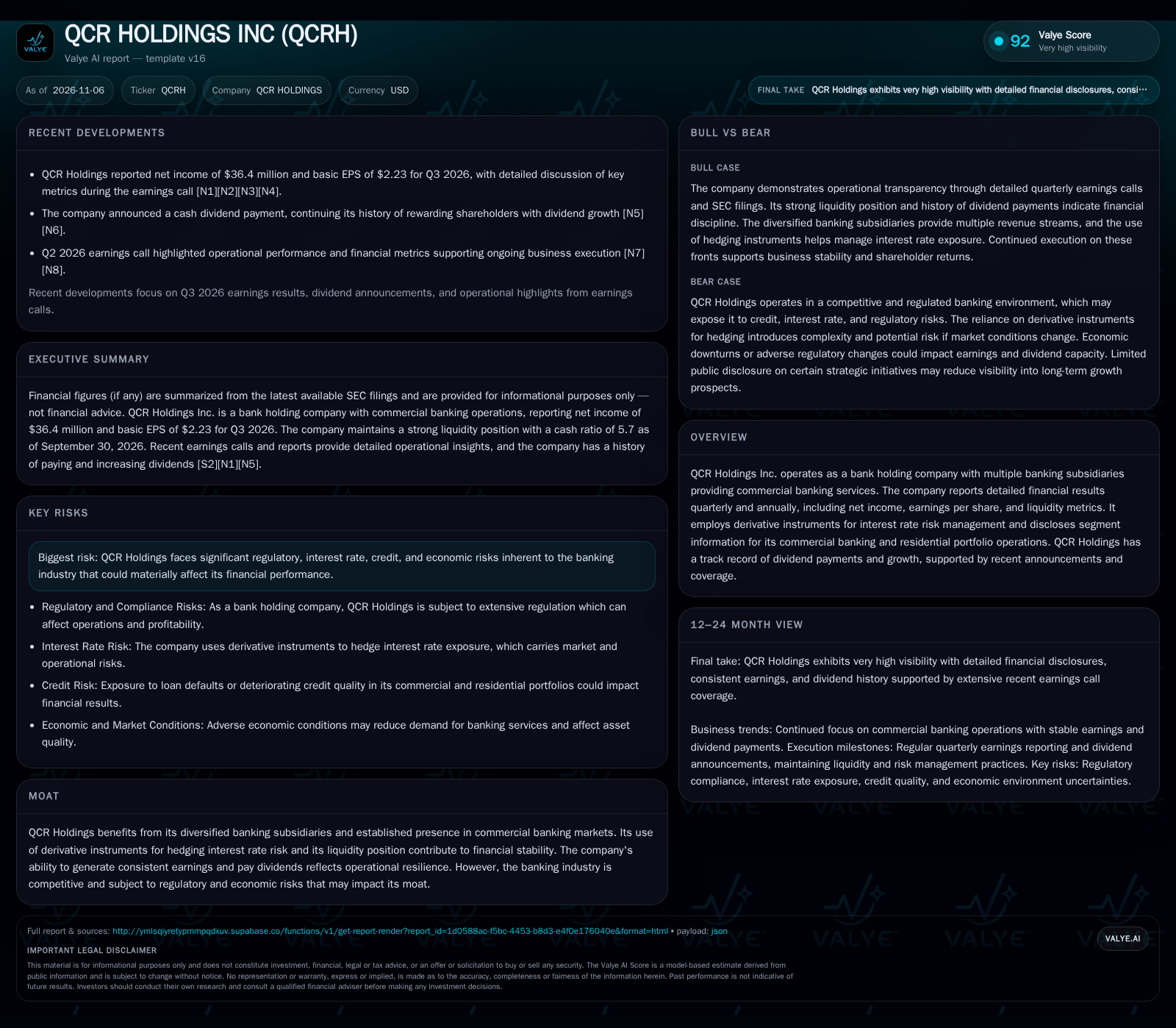
As of Q3 2026, the company reported $36.4 million in net income and a notable cash ratio of 5.7, underlining financial stability in a period of macroeconomic uncertainty. However, as competition intensifies and regulatory pressures mount, the company’s ability to leverage its diversified structure and risk management toolkit will shape its path forward. The central question: Can QCR’s hedging discipline and multi-subsidiary model deliver durable returns as the regional banking landscape evolves? [S2]
Recent Earnings, Liquidity, and Strategic Structure: The Current Snapshot
As of September 30, 2026, QCR Holdings reported net income of $36.4 million and basic earnings per share of $2.23, signaling continued profitability through a period of economic and interest rate volatility [S2]. [S2] QCR operates through multiple commercial banking subsidiaries—QuadCity Bank and Trust, Guaranty Bank, Community State Bank, and Cedar Rapids Bank and Trust—which provides operational diversification and access to a broader customer base [S2]. The company relies on derivative instruments, including interest rate swaps and floors, to hedge exposure to rate movements, a practice disclosed in its SEC filings [S2].
How QCR Holdings Makes Money: Revenue Streams, Costs, and Margin Levers
QCR Holdings generates revenue primarily through net interest income from its loan and deposit portfolios, supplemented by non-interest income such as fees, service charges, and gains (or losses) from financial instruments. The company’s multi-bank structure allows it to address diverse regional markets and client segments, potentially smoothing revenue cyclicality and diversifying credit risk. Pricing power is generally constrained in regional banking, with margins influenced by the spread between loan yields and deposit/funding costs. QCR’s use of derivatives to hedge interest rate risk can help stabilize net interest margin, but may also introduce volatility if hedging strategies are mismatched or if market conditions shift abruptly.
Operating leverage is attainable through fixed-cost infrastructure—branch networks, compliance, and technology—but is tempered by the need for regulatory compliance and risk management investments. The company’s capital needs are ongoing, driven by regulatory capital requirements, loan growth, and the need to maintain a liquidity buffer. The diversified subsidiary model may also enable selective capital allocation, shifting resources toward outperforming regions or business lines as market conditions dictate.
The interplay between QCR’s revenue streams and cost structure is further nuanced by its exposure to interest rate cycles and credit environment shifts. In periods of rising rates, the company’s ability to reprice loans faster than deposits can enhance net interest income, but the timing and magnitude of such repricing depend on portfolio composition and contractual terms. Conversely, in rate declines, hedging instruments like floors may provide a cushion but can also limit upside potential. Additionally, the non-interest income component, including fees and trading gains, is subject to competitive pressures and economic activity levels, influencing overall revenue stability. Understanding how QCR balances these dynamics through active asset-liability management and targeted fee initiatives is critical to assessing margin sustainability.
On the cost side, regulatory compliance and risk management represent significant fixed and semi-variable expenses, particularly as regional banks face evolving capital and liquidity standards. The multi-subsidiary structure, while beneficial for market segmentation, may introduce incremental overhead and complexity in governance, reporting, and technology integration, potentially constraining operating leverage. However, this structure can also enable selective investment and cost control by tailoring resources to each subsidiary’s scale and market opportunity. The company’s ability to leverage technology for process automation and digital delivery could materially influence expense trajectories and customer acquisition costs, impacting long-term profitability amid competitive pressures.
Where QCR Stands in the Regional Banking Landscape
QCR Holdings competes with other regional banks, credit unions, and non-bank lenders for commercial and residential clients in its core Midwest markets. Its multi-subsidiary approach provides local branding and relationships, which can foster customer loyalty and mitigate some competitive pressures. However, the regional banking sector remains highly competitive, with pricing for loans and deposits often driven by broader market rates and aggressive promotional strategies from peers.
Technology adoption, digital banking capabilities, and customer service differentiation are increasingly important, especially as fintechs and large national banks push into traditional community bank territory. QCR’s use of derivatives for interest rate hedging is a common practice among sophisticated regionals, but not a unique moat. The company’s competitive edge may thus depend on effective local execution, prudent risk management, and the ability to maintain asset quality while growing the loan book in a low-growth environment.
How Prudent Hedging and Regional Expansion Could Drive Outperformance
If QCR Holdings can continue to effectively hedge interest rate risk—preserving net interest margins even as the yield curve shifts—the company could sustain or expand profitability while peers struggle with margin compression. Successful execution of its multi-bank strategy could allow QCR to gain share in attractive local markets, leveraging cross-selling and operational synergies. Expansion of fee income and disciplined credit underwriting could further bolster returns.
Confirmation of this scenario would come from continued earnings growth, stable or rising net interest margin, and improving efficiency ratios relative to peers. Evidence of market share gains in core geographies, positive credit quality trends, and successful integration or expansion of subsidiaries would also support the upside case. Conversely, a breakdown in hedging effectiveness or deterioration in asset quality would challenge this thesis.
Sustained Profitability Amid Industry Pressures and Macro Uncertainty
The most plausible path for QCR Holdings is continued moderate profitability, with earnings supported by diversified banking operations and managed interest rate risk, but constrained by sector-wide pressure on net interest margins and rising regulatory costs.
In this scenario, QCR maintains stable asset quality and modest loan growth, using its multi-bank platform to offset regional volatility. Periodic adjustments to hedging strategies and incremental fee income initiatives help cushion margin pressure, but do not fundamentally alter the business model. Evidence supporting this outcome would include steady net income, relatively flat net interest margin, and manageable levels of non-performing loans. A sharp decline in credit quality, regulatory capital, or margin would signal a deviation from this base case.
Credit Deterioration or Hedging Missteps Could Erode Earnings Power
If credit quality in QCR’s loan portfolio deteriorates—due to regional economic weakness, sector exposures, or underwriting missteps—loan losses and provisioning costs could rise sharply, eroding profitability and potentially jeopardizing capital ratios. Alternatively, if the company’s derivative hedges prove ineffective or backfire in a rapidly changing interest rate environment, net interest income could fall more than expected, amplifying earnings volatility.
Regulatory actions, adverse economic shocks, or competitive deposit outflows could compound these pressures. Evidence for this scenario would be a spike in non-performing assets, rising loan loss provisions, negative trends in net interest margin, or regulatory interventions. Material adverse developments in any of these areas would challenge the company’s ability to sustain its current financial performance.
Milestones and Metrics That Will Reveal QCR’s Resilience and Growth Potential
Non-performing loan ratios and trends in provision for credit losses—if disclosed—will help assess asset quality and emerging credit risk.
Quarterly changes in net interest margin, especially relative to regional bank peers, will indicate hedging effectiveness and pricing discipline.
Loan and deposit growth rates by subsidiary or segment would clarify whether QCR is gaining share or facing competitive headwinds.
Efficiency ratio movements would reveal the company’s success in controlling costs and leveraging its multi-bank platform.
Updates on derivative positions and hedging outcomes—if disclosed—would provide insight into risk management effectiveness.
Regulatory capital ratios and any commentary on capital adequacy are important for assessing resilience in adverse scenarios.
Management commentary on competitive conditions, technology investments, or expansion initiatives would clarify future strategy and adaptability.
Disclaimer: This is research-only, informational analysis and not investment advice. It may include AI-generated interpretation and general industry context. Always verify important details using primary sources.

Comments