
Strategic Acquisitions Inc.: Digital Asset Lending Ambitions on Hold Amid Funding and Regulatory Pressures
With lending operations paused and proprietary platform development unfunded, Strategic Acquisitions faces a pivotal juncture. Its next phase hinges on capital access, regulatory clarity, and the ability to differentiate in a crowded, evolving digital asset lending landscape.
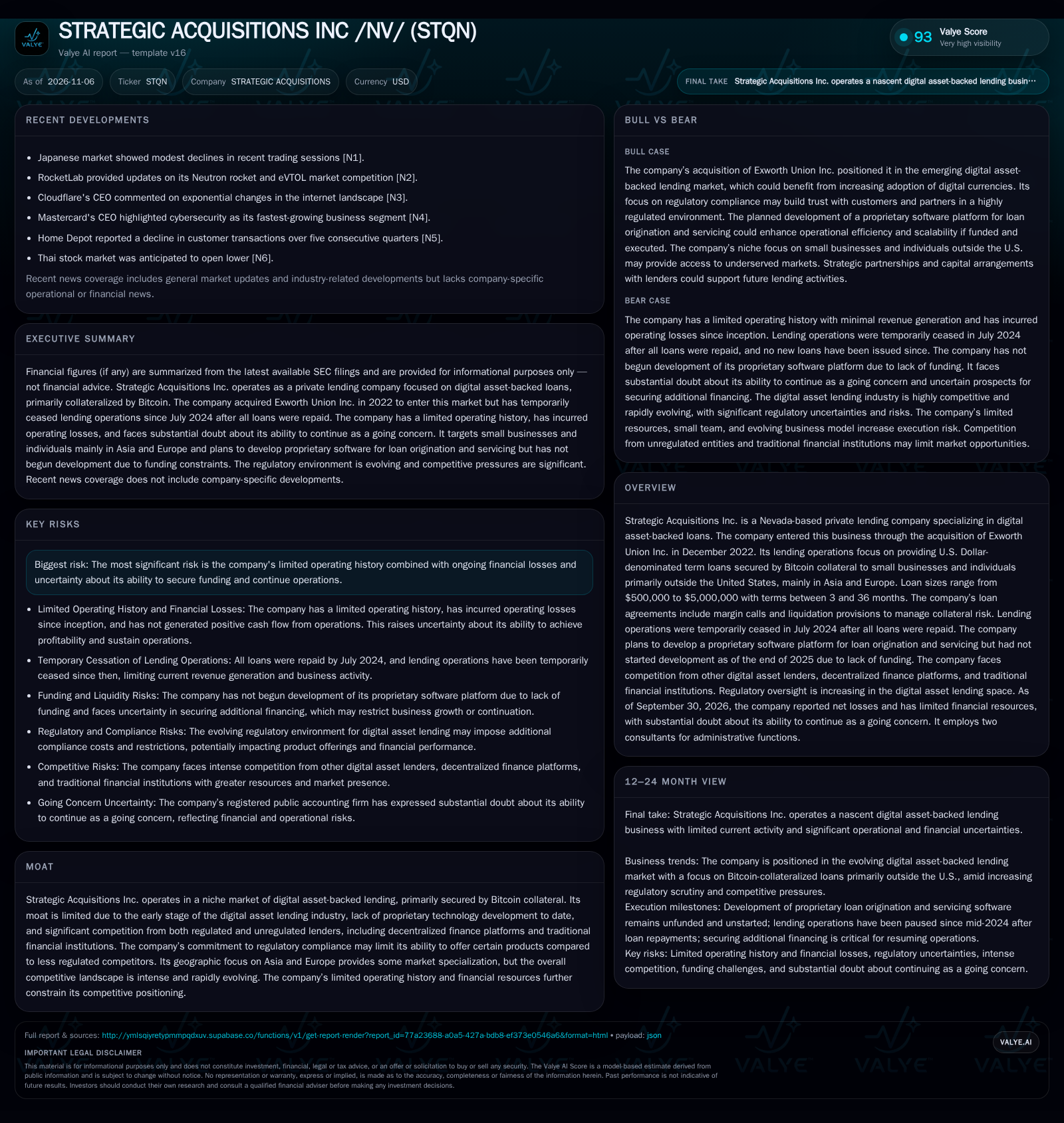
Strategic Acquisitions Inc. entered the digital asset-backed lending market via its 2022 acquisition of Exworth Union, offering Bitcoin-collateralized loans to clients primarily outside the U.S. However, all loans were repaid by July 2024, and lending operations have since been suspended. The company has not begun developing its planned proprietary loan platform due to funding constraints and continues to report operating losses, with substantial doubt cast on its ability to continue as a going concern. Its future depends on securing capital, navigating regulatory complexities, and building a sustainable, differentiated business model in a highly competitive sector. [S2]
Strategic Acquisitions Inc. stands at a crossroads after halting its digital asset-backed lending operations in mid-2024, following the full repayment of its outstanding loans. Despite prior ambitions to build a proprietary loan origination and servicing platform, the company has not commenced development due to ongoing funding constraints. Operating losses persist, and with no revenue since lending ceased, management has flagged substantial doubt about the company’s ability to continue as a going concern. The strategic imperative now centers on securing capital, clarifying regulatory positioning, and finding a viable business model in a rapidly evolving, intensely competitive sector.
Loan Portfolio Runoff and Uncertain Continuity Define the Present
Strategic Acquisitions Inc. has experienced a complete runoff of its digital asset-backed loan portfolio, with all loans repaid by July 2024 and no new originations since that time. As of the third quarter of 2026, the company reported no revenue and continued to incur operating expenses, resulting in a quarterly net loss of $12,882. The company has not generated positive cash flow from operations and continues to face substantial doubt about its ability to continue as a going concern. Planned development of a proprietary loan origination and servicing platform remains unfunded and unstarted. Management is actively evaluating the company’s business model, including the potential divestiture of its Exworth Union subsidiary, with the conclusion that such a move would not materially impact operations given the current inactivity. These facts underscore a period of strategic limbo and heightened uncertainty about the company’s future trajectory. [S2]
How Digital Asset Lending Can Generate Value—and Where the Frictions Lie
In principle, digital asset-backed lending monetizes the volatility and liquidity of cryptocurrencies—primarily Bitcoin—by offering loans against these holdings, generating interest income and origination fees. Typical economics hinge on three levers: pricing (interest rate and fees), volume (loan originations and repayments), and mix (collateral quality and geographic/customer segmentation). Strategic Acquisitions targeted loans sized $500,000 to $5,000,000 with terms of 3–36 months, collateralized by Bitcoin, and included margin call and liquidation provisions to manage credit risk.
However, real-world economics are complicated by several factors. The company’s fixed costs (professional fees, regulatory compliance, platform development) remain significant even in periods of no lending activity, while variable costs (custody, loan administration) scale with active loan volume. The absence of proprietary software limits scalability and cost efficiency—manual processes or third-party solutions typically increase per-loan administrative burden and error risk, especially across multiple jurisdictions.
Access to capital is a gating factor: without external funding or retained earnings, the ability to originate loans is sharply constrained. Regulatory compliance—especially as oversight increases—adds to baseline costs and may restrict product offerings versus less-regulated or decentralized competitors. Until lending resumes and/or a proprietary platform is built, Strategic Acquisitions’ business economics are characterized by high fixed costs, no revenue, and negative operating leverage.
Competitive Pressures from All Sides: Traditional, Decentralized, and Emerging Platforms
Strategic Acquisitions operates in a fiercely competitive segment where digital asset-backed lenders, decentralized finance (DeFi) protocols, online lenders, credit services organizations, and traditional financial institutions all vie for overlapping customer bases. Each category brings distinct advantages: DeFi protocols offer algorithmic, often borderless lending with minimal overhead and limited regulatory friction; established fintechs and banks leverage brand trust, larger balance sheets, and integrated compliance infrastructure.
The company’s initial focus on small businesses and individuals outside the U.S.—primarily in Asia and Europe—could have provided some access to underserved markets, but this advantage is neutralized by the global reach of both DeFi and major fintechs. The absence of a proprietary platform or unique underwriting approach further limits differentiation. Regulatory compliance, while potentially a trust builder, can also be a constraint: competitors willing to operate in regulatory gray zones may offer more flexible or attractive terms, especially in fast-moving markets.
Without active lending, a distinct customer acquisition channel, or proprietary technology, Strategic Acquisitions currently lacks clear sources of sustainable competitive advantage.
A Turnaround Hinges on Capital, Technology, and Regulatory Tailwinds
A favorable outcome for Strategic Acquisitions would require overcoming multiple hurdles in succession. First, the company would need to secure sufficient capital—either through equity, debt, or strategic partnerships—to resume lending operations and fund development of its proprietary origination/servicing platform. With a robust, automated platform, the company could scale originations, reduce per-loan costs, and offer a differentiated customer experience, particularly if it can integrate advanced risk management tools for digital asset collateral.
Regulatory clarity or harmonization in key markets could provide a more predictable operating environment, enabling the company to offer competitive products without incurring outsized compliance costs. If the company can re-enter the market with a compelling, compliant offering—targeting niches underserved by DeFi and larger banks—it could capture share as digital asset adoption grows globally.
Confirmation of this scenario would include announcements of new funding, commencement of platform development, resumption of lending activity, and early customer traction or originations. Any signs of regulatory alignment or strategic partnerships in Asia or Europe would further bolster the upside case.
Most Likely Path: Prolonged Inactivity and Business Model Reevaluation
The most plausible outcome, based on current facts, is an extended period of inactivity as Strategic Acquisitions seeks but does not quickly secure the funding or strategic clarity needed to resume operations. With all loans repaid and no new origination pipeline, operating expenses (primarily administrative and professional fees) will continue to erode the limited cash base. The company may pursue divestiture of its Exworth Union subsidiary, but management does not expect this to materially impact results given the lack of active business.
During this period, the company is likely to continue evaluating its market positioning, regulatory obligations, and potential pivots—possibly exploring partnerships, asset sales, or even a business model shift outside digital asset lending. Unless and until new capital or a transformative partnership is secured, Strategic Acquisitions will remain in a holding pattern, incurring losses and facing ongoing going-concern uncertainty.
This scenario would be confirmed by continued absence of lending activity, further delays in platform development, and lack of major funding or partnership announcements. Signs of strategic review or asset sales would reinforce the thesis.
Capital Exhaustion, Regulatory Burden, and the Risk of Dissolution
If Strategic Acquisitions fails to secure new capital or a viable operational pivot, the company could exhaust its remaining resources within the next several quarters. Continued negative cash flow from fixed operating expenses, combined with the absence of revenue and inability to scale back costs below a minimum threshold, would accelerate this timeline.
Mounting regulatory compliance costs—especially as oversight intensifies in both the U.S. and international markets—could further drain resources or prompt additional legal/accounting expenses even in the absence of active lending. If regulatory risks increase or the company is unable to meet evolving requirements, dissolution or delisting could become necessary.
This scenario would be confirmed by a further decline in cash and current assets, auditor or regulatory warnings, resignation of key consultants or board members, and public statements about exploring dissolution, bankruptcy, or delisting.
Testing the Strategic Acquisitions Thesis: What Could Validate or Refute a Turnaround
Announcement of new equity or debt financing, or a strategic partnership that provides operational runway for lending or platform development.
Commencement or progress reports on proprietary loan origination/servicing platform development, including hiring or technology vendor selection.
Resumption of digital asset-backed lending activity—evidence of new loan originations, customer onboarding, or pipeline growth (if disclosed).
Regulatory developments in key target markets (Asia, Europe) that either reduce compliance burden or create new barriers for digital asset lenders.
Changes in the competitive landscape, such as major new entrants, consolidation, or shifts in DeFi protocol adoption that impact addressable market.
Divestiture of Exworth Union or other asset sales, and their actual impact on cash flow, cost structure, and strategic direction.
Board or management changes, particularly the addition of executives with fintech or digital asset lending experience.
Updates on going-concern status from auditors or regulators, or new risk disclosures in SEC filings.
Disclaimer: This is research-only, informational analysis and not investment advice. It may include AI-generated interpretation and general industry context. Always verify important details using primary sources.

Comments