
Home BancShares: Acquisitive Expansion Meets Credit Discipline in a Shifting Regional Bank Landscape
Home BancShares’ recent asset growth, continued acquisition strategy, and focus on credit quality highlight a business model balancing scale, local empowerment, and exposure to commercial real estate cycles. The pending Mountain Commerce Bancorp merger, recent loan recoveries, and a solid deposit base position the company for further expansion—but also bring integration and sector-concentration risks into sharper relief.
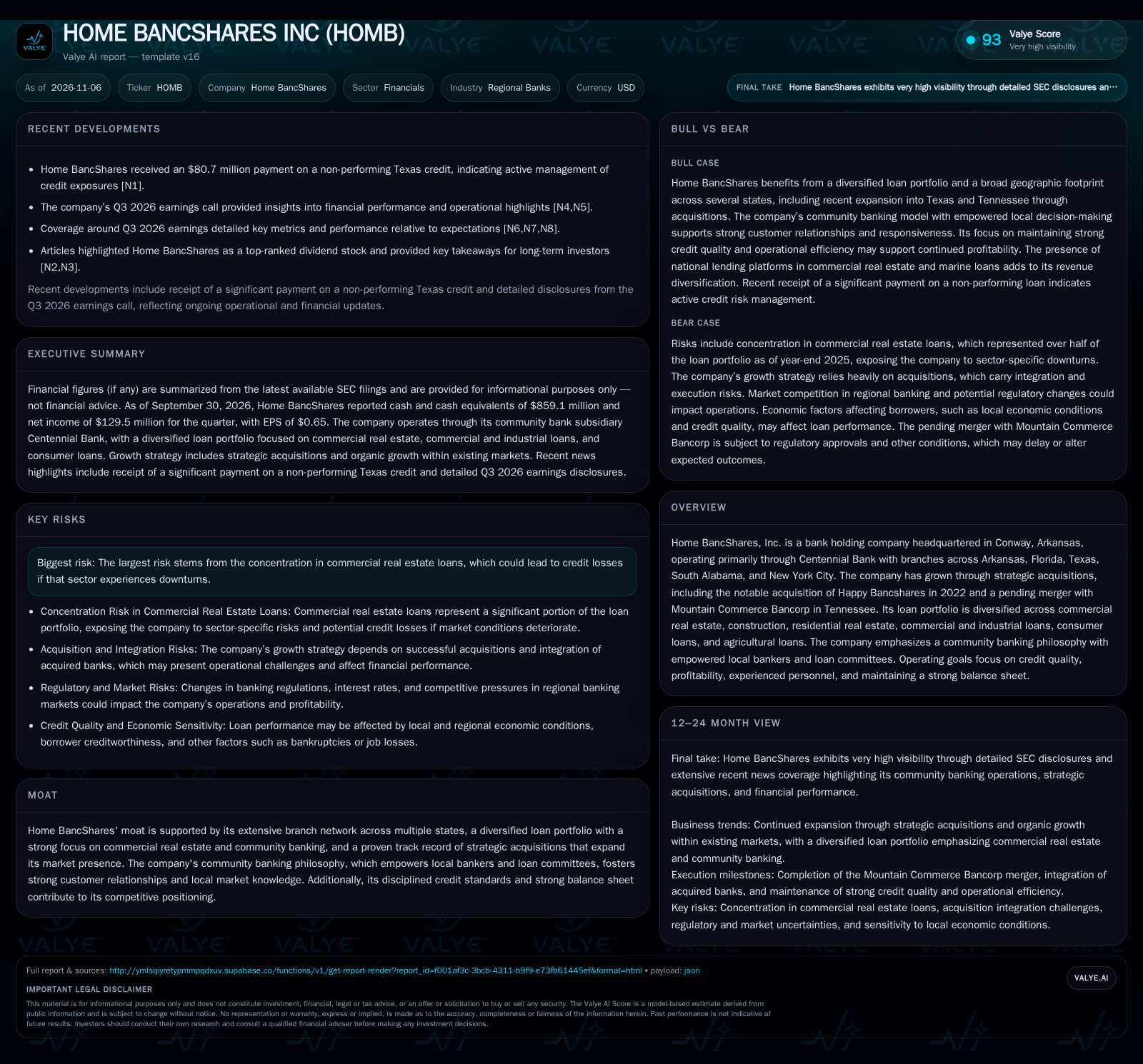
Home BancShares is executing a multi-state, acquisition-driven growth strategy, underpinned by a diversified loan book and a philosophy of empowered community banking. Recent results show robust asset growth, solid profitability, and active credit risk management, but the company remains exposed to commercial real estate cycles and integration risks as it pursues its next merger. The company’s ability to sustain credit quality, integrate new operations, and manage deposit funding costs will likely determine its trajectory over the next 12–24 months. [S1] [S2] [N1]
Home BancShares, Inc. has cemented its reputation as a formidable regional bank by leveraging a disciplined acquisition strategy and a diversified lending platform. As of Q3 2026, the company’s asset base and loan portfolio have grown significantly, aided by recent expansions into Texas and pending entry into Tennessee. While Home BancShares’ operating model—empowering local bankers and focusing on efficiency—supports customer intimacy and resilience, its heavy reliance on commercial real estate lending and ongoing integration of acquired entities introduce real risks. The company’s recent recovery of a large non-performing loan and strong quarterly earnings underscore both the opportunities and the challenges facing acquisitive regional banks in today’s evolving financial landscape. [S1] [S2] [N1]
Recent Acquisitions, Asset Growth, and Active Credit Management Shape the Current Landscape
As of September 30, 2026, Home BancShares reported total assets of $24.15 billion and a net loan portfolio of $16.58 billion, reflecting the impact of recent acquisitions and organic expansion [S2]. The company’s acquisition of Happy Bancshares in 2022 added scale in Texas, and a merger with Mountain Commerce Bancorp in Tennessee is expected to close in Q2 2026, involving the issuance of approximately 5.4 million shares [S1]. This ongoing M&A activity continues to expand the company’s geographic reach and customer base.
Home BancShares’ loan book remains heavily weighted toward real estate, with 74.1% of loans concentrated in commercial, construction, and residential real estate segments as of year-end 2025 [S1]. This concentration is a double-edged sword: it leverages local market knowledge but exposes the bank to heightened risk if commercial real estate markets weaken.
In a notable recent development, the company received an $80.7 million payment on a non-performing Texas credit, highlighting its proactive approach to credit risk management and recoveries [N1]. Such recoveries can provide earnings tailwinds, but also underscore the underlying exposure to credit cycles in its core lending markets.
How Scale, Deposit Funding, and Loan Mix Drive Home BancShares’ Profit Model
Home BancShares generates the bulk of its revenue from net interest income—primarily the spread between interest on loans/investments and the cost of deposits and wholesale funding [S2]. The company’s efficiency ratio is a core metric, reflecting management’s focus on controlling non-interest expenses relative to income. As the bank grows through acquisitions, scale effects may enable further efficiency gains, provided integration costs do not offset these benefits.
Deposit gathering remains crucial: total deposits of $18.76 billion as of Q3 2026 are the primary funding source, with a mix of core and brokered deposits [S2]. The bank manages funding costs via deposit pricing and can allow higher-rate deposits to run off in periods of limited loan demand. However, a rising interest rate environment or competitive deposit markets could pressure net interest margins if the company must pay up to attract or retain funds.
The loan portfolio’s composition—dominated by commercial real estate, with smaller shares in commercial & industrial, consumer, and agricultural lending—supports relatively high yields but can amplify credit risk and cyclicality. Fee income from service charges and mortgage banking provides some diversification, but is not the primary driver of profitability. The company’s capital levels remain above regulatory minimums, supporting both organic growth and further M&A activity [S1].
Community Banking Roots, Regional Scale, and the Challenge from Larger and Digital Players
Home BancShares’ competitive edge is built on its community banking philosophy—empowering local bankers and loan committees for responsiveness and market knowledge—combined with the scale and product breadth of a multi-state regional bank [S1]. This model supports customer loyalty and flexibility, especially in markets where large national banks may be seen as impersonal or less agile.
However, the regional banking sector is intensely competitive. Home BancShares faces pressure from other acquisitive regional banks, super-regionals, and increasingly from digital-first banks and fintechs that can offer attractive rates or convenience. As a result, deposit pricing and retention may become more challenging, especially in markets like Texas or Florida where competition for commercial real estate lending is particularly fierce.
The bank’s history of successful acquisitions provides a track record, but each new merger—such as the pending Mountain Commerce Bancorp deal—carries execution and integration risk. Regulatory changes, shifting customer preferences, and the threat of disintermediation via digital banking platforms all present ongoing strategic challenges.
If Credit Quality Holds and Integration Is Smooth, M&A-Driven Growth Could Compound
In an upside scenario, Home BancShares successfully integrates Mountain Commerce Bancorp, leveraging its expanded Tennessee presence to attract new commercial and consumer customers. Continued disciplined credit management—evidenced by recoveries like the recent $80.7 million Texas payment—keeps charge-offs low and supports stable asset quality, even amid broader commercial real estate volatility. [N1]
If the acquired loan books perform as expected and cost synergies are realized, the company could achieve further improvements in its efficiency ratio, expanding profitability. A stable or gently declining interest rate environment would support net interest margins, while the company’s empowered local bankers drive organic growth and cross-sell opportunities in new and existing markets.
Confirmation of this scenario would include low non-performing asset ratios post-acquisition, above-peer efficiency, minimal deposit runoff, and continued strong earnings growth relative to regional bank peers.
Sustained Growth, but Credit and Integration Headwinds Keep Performance in Check
The most plausible outcome is that Home BancShares continues to grow through a combination of organic expansion and the successful, if occasionally bumpy, integration of Mountain Commerce Bancorp. The company maintains its focus on efficiency and credit discipline, but faces periodic credit losses from its commercial real estate exposure, especially if sector fundamentals soften.
Deposit competition intensifies, requiring some upward repricing to retain or attract funds, which may compress net interest margins. Integration costs from the new merger offset some efficiency gains, resulting in steady but not accelerating profitability. The company remains solidly profitable, with capital levels above regulatory minimums, but does not materially outperform peers absent a benign credit environment.
Evidence for this scenario includes stable but not improving efficiency ratios, moderate loan growth, manageable increases in non-performing assets, and earnings growth in line with other regional banks.
Commercial Real Estate Weakness or Integration Stumbles Could Erode Earnings Power
In a downside scenario, a significant downturn in commercial real estate markets leads to rising delinquencies and charge-offs, particularly in the company’s Texas and Florida portfolios. The heavy concentration in commercial real estate loans amplifies this risk, potentially resulting in elevated credit costs and a deterioration of capital ratios.
If integration of Mountain Commerce Bancorp proves more disruptive than anticipated—due to technology mismatches, cultural clashes, or unexpected credit issues in the acquired book—operating expenses could rise, and customer attrition may increase. Difficulty attracting or retaining deposits in a more competitive or higher-rate environment could further compress margins and liquidity.
This scenario would be confirmed by a material uptick in non-performing loans, a spike in the efficiency ratio, declining net interest margins, and below-peer profitability and capital metrics.
Factors That Will Test Home BancShares’ Expansion and Credit Resilience in the Coming Year
The pace and quality of Mountain Commerce Bancorp merger integration, including cost synergies, customer retention, and any unexpected credit issues in the acquired portfolio.
Non-performing asset and net charge-off rates, especially within the commercial real estate segment, as a leading indicator of credit cycle risks.
Deposit growth or runoff trends, alongside changes in funding mix (core deposits versus brokered deposits), as a signal of franchise strength and liquidity flexibility.
Efficiency ratio trajectory (if disclosed) and whether expense discipline can be maintained as the company absorbs new acquisitions.
Net interest margin trends in the context of shifting interest rates and competitive deposit pricing pressures.
Organic loan growth rates by geography and product, with particular focus on performance in recently entered Texas and Tennessee markets.
Capital ratios relative to regulatory minimums and peer benchmarks, especially if credit costs rise or if the company pursues further acquisitions.
Updates on regulatory approvals and any conditions attached to the Mountain Commerce Bancorp merger, which could impact timing or integration costs.
Disclaimer: This is research-only, informational analysis and not investment advice. It may include AI-generated interpretation and general industry context. Always verify important details using primary sources.

Comments