
BXP, Inc.: Managing Debt, Environmental Risks, and Office Market Shifts
BXP, Inc. enters late 2026 with a high debt load, a substantial urban office portfolio, and strong disclosure around environmental and regulatory risks. The company’s ability to manage refinancing, occupancy trends, and regulatory costs will shape its resilience as the office sector faces structural headwinds.
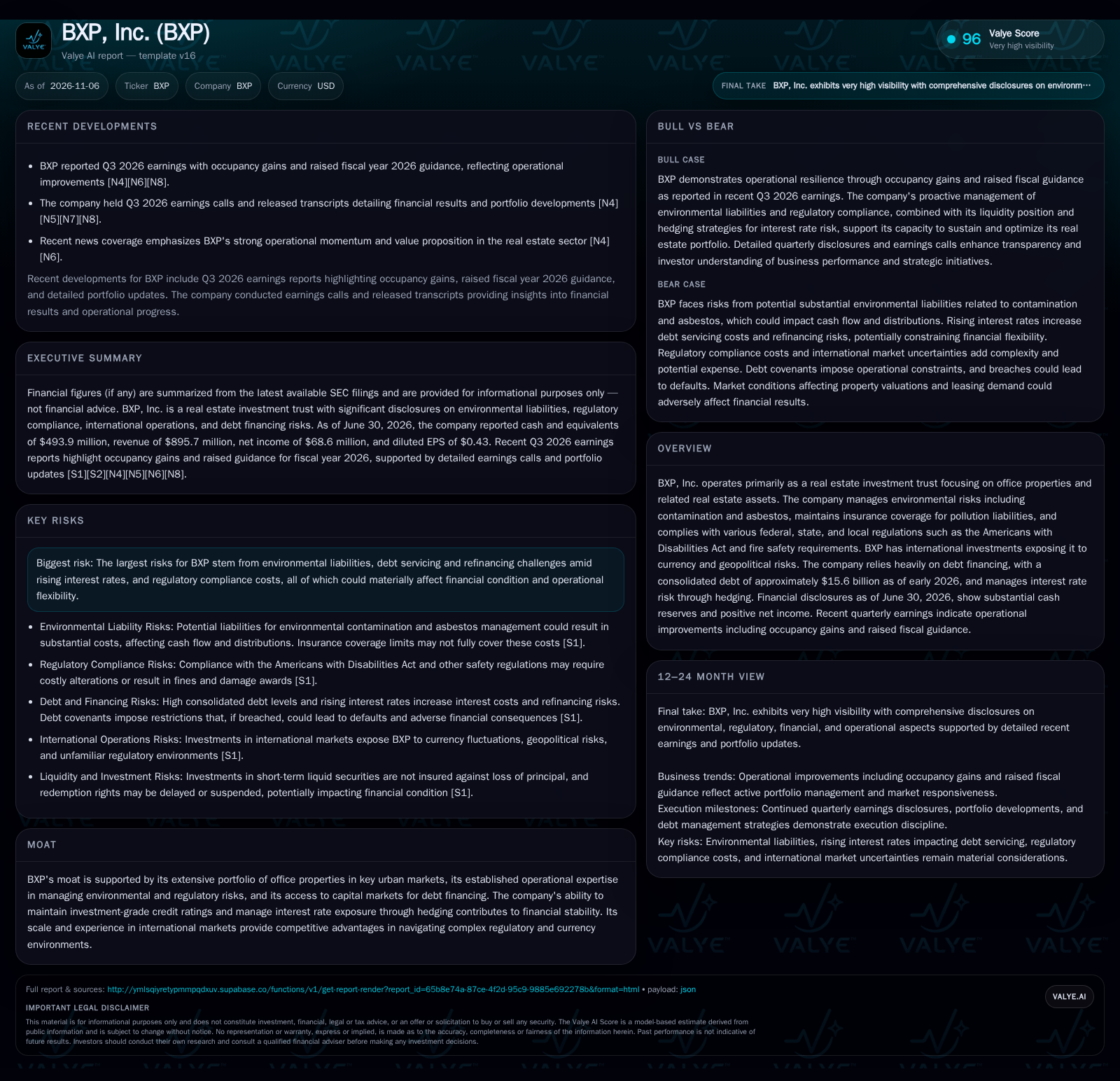
BXP, Inc. (BXP) operates as a real estate investment trust focused on office properties, reporting $896 million in revenue and $68.6 million in net income as of mid-2026. The firm’s $15.6 billion in consolidated debt and 59% debt-to-market-cap ratio highlight its dependence on debt markets, while environmental and regulatory risks remain material. Performance hinges on occupancy trends, interest rate exposure, and the company’s ability to manage compliance costs and refinancing needs. [S1] [S2]
BXP, Inc. stands as a bellwether for the high-stakes challenges facing urban office real estate investment trusts. With nearly $16 billion in consolidated debt and a heavy focus on office assets, the company’s financial structure and risk disclosures reveal both its operational discipline and its exposure to sectoral, regulatory, and macroeconomic pressures. The next phase for BXP will test its ability to offset high leverage and environmental liabilities with proactive asset management, debt strategy, and adaptation to evolving tenant needs.
2026 Risk Environment Shaped by Debt and Environmental Obligations
As of February 2026, BXP’s consolidated debt reached approximately $15.6 billion, resulting in a debt-to-market-capitalization ratio of about 59.1%—a level that signals substantial reliance on debt financing and heightens exposure to interest rate and refinancing risks. The company reported $494 million in cash and equivalents and $896 million in revenue for the fiscal year ended June 30, 2026, with net income of $68.6 million. [S1] [S2]
BXP’s risk disclosures emphasize potential liabilities tied to environmental contamination and asbestos, which could result in substantial costs exceeding the company’s $20 million per-incident pollution insurance coverage. Regulatory compliance, including the Americans with Disabilities Act and fire safety requirements, adds further cost and operational complexity. [S1]
Recent Q3 2026 earnings calls and news highlight occupancy gains and improved guidance, suggesting some near-term resilience in the face of industry headwinds. [N4] [N6]
The interplay between BXP’s debt profile and environmental obligations creates a complex risk matrix that requires nuanced management strategies. For instance, the timing of debt maturities relative to potential environmental remediation schedules could strain liquidity if multiple large obligations coincide. Additionally, evolving environmental regulations may increase compliance costs unpredictably, necessitating flexible budgeting and contingency planning. The company’s ability to integrate environmental risk assessments into its capital allocation and refinancing decisions will be a key determinant of its financial resilience in an uncertain regulatory landscape.
Revenue Streams and Leverage Impact on BXP’s Profitability
BXP generates revenue primarily through long-term leases of its office properties, with cash flows driven by rental income and ancillary services. The REIT structure channels most taxable income to shareholders as dividends, limiting retained earnings and increasing dependency on external capital for growth or major refurbishments.
The firm’s high fixed-cost base—including property maintenance, taxes, and debt service—means that occupancy rates and rental pricing are crucial levers for operating leverage. When occupancy and rents are stable or rising, incremental revenues flow disproportionately to the bottom line. However, high leverage amplifies both upside and downside scenarios: rising interest rates or falling occupancy can quickly erode profitability due to the company’s substantial debt service obligations.
BXP’s use of variable-rate debt, partially hedged with interest rate swaps, helps manage—but does not eliminate—interest expense volatility. Significant refinancing needs are likely to persist as large debt maturities approach, and the cost of new debt will depend on both market conditions and the company’s credit standing.
The cited source reports dividend-related activity; that disclosure alone does not establish dividend-policy continuity, management confidence, or a material constraint on capital flexibility. The sensitivity of profitability to occupancy rates implies that even marginal improvements in tenant retention or lease renewals can disproportionately benefit net income. Conversely, any sustained downturn in occupancy could trigger a negative feedback loop, where reduced cash flow hinders debt servicing, potentially leading to credit rating downgrades and higher borrowing costs. Therefore, the firm’s operational agility in adjusting lease terms and managing tenant relationships is critical to mitigating leverage-related risks.
Benefits and Challenges of BXP’s Urban Office Concentration
BXP’s competitive position is anchored by its portfolio of prime office assets in major urban markets. This scale provides some bargaining power with tenants and access to capital markets, while long-standing expertise in managing regulatory and environmental risks supports operational stability.
However, the structural demand for urban office space is under pressure from remote/hybrid work trends and tenant downsizing. Competing landlords, flexible space providers, and adaptive reuse developers represent credible threats. Market supply-demand dynamics, especially in gateway cities, could compress rents and increase vacancy, challenging the traditional value proposition of high-end office REITs.
BXP’s ability to navigate evolving tenant requirements—including sustainability, wellness, and flexible lease terms—will be pivotal in maintaining competitive differentiation. The company’s experience in international markets may offer modest diversification, but also introduces new regulatory and currency risks.
Value Potential Through Operational Focus and Prudent Debt Management
A favorable outcome for BXP would see occupancy rates stabilize or improve further, supporting rental growth and higher cash flows. If the company successfully refinances upcoming debt maturities at reasonable rates—leveraging its scale and credit history—interest expense could remain manageable, preserving distributions to shareholders.
Proactive environmental risk management, such as effective remediation and insurance optimization, could limit large, unexpected costs. Strategic asset recycling—disposing of non-core or underperforming properties—might enhance portfolio quality and reduce leverage.
Confirmation of this scenario would include continued occupancy gains, positive net absorption in quarterly disclosures, successful refinancing at spreads in line with or below recent averages, and limited material environmental expense events.
Office Market Changes Intersect with Debt and Regulatory Demands
The most plausible path for BXP involves a slow recovery or stabilization of office leasing demand, with occupancy and rental rates fluctuating close to current levels. Debt service will remain a substantial cost, with periodic refinancing at higher rates modestly reducing net income and cash available for distribution.
Environmental and regulatory compliance expenses are likely to be recurring but not catastrophic, with insurance absorbing all but the largest events. The company may continue modest asset dispositions or joint ventures to manage leverage and capital needs.
Evidence supporting this scenario would be stable-to-slightly-improving occupancy and rent metrics, continued adherence to debt covenants, and manageable environmental liability outflows, all detailed in quarterly filings and earnings commentary.
Leverage Pressures Intensified by Rising Rates and Environmental Events
In a negative scenario, a combination of rising interest rates, tightening credit markets, and falling office demand could compress BXP’s cash flows. Difficulty in refinancing debt at acceptable terms could force asset sales under pressure, potentially at discounts, eroding book value and market perception.
A significant environmental event—such as major contamination or an asbestos incident exceeding insurance limits—could lead to large, unplanned expenditures, regulatory penalties, or litigation, directly impacting liquidity and distributions.
This scenario would be confirmed by declining occupancy, rising vacancy rates, negative rent reversion, missed or renegotiated debt covenants, and disclosure of large environmental remediation costs.
Tracking BXP’s Flexibility via Occupancy, Refinancing, and Environmental Expenses
Quarterly occupancy rates and rent roll trends, especially net absorption in core markets, will be critical to assess ongoing demand and pricing power.
Debt maturity schedules and weighted-average interest rates on refinanced or new borrowings—if disclosed—would help gauge refinancing risk and future interest expense.
Disclosure of material environmental remediation expenses, insurance recoveries, and any uninsured incidents will signal the true cost of environmental risk management.
Updates on regulatory compliance costs, including expenditures related to the Americans with Disabilities Act or local fire/life safety upgrades, would clarify the magnitude of recurring compliance burdens.
Asset disposition or acquisition activity, particularly the realized gains/losses and impact on leverage, will indicate management’s flexibility and capital discipline.
Any changes in debt covenant compliance status, waivers, or amendments—if disclosed—would provide early warning of potential financial flexibility or stress.
Disclaimer: This is research-only, informational analysis and not investment advice. It may include AI-generated interpretation and general industry context. Always verify important details using primary sources.

Comments