
NorthEast Community Bancorp: Navigating Profitability Pressures and Capital Allocation in Regional Banking
NorthEast Community Bancorp posts consistent profitability and maintains a reported cash position, but recurring quarterly revenue and earnings shortfalls highlight mounting pressures in a competitive regional banking landscape. With an active buyback program and stable risk disclosures, the bank’s ability to drive organic growth and defend margins remains the central question.
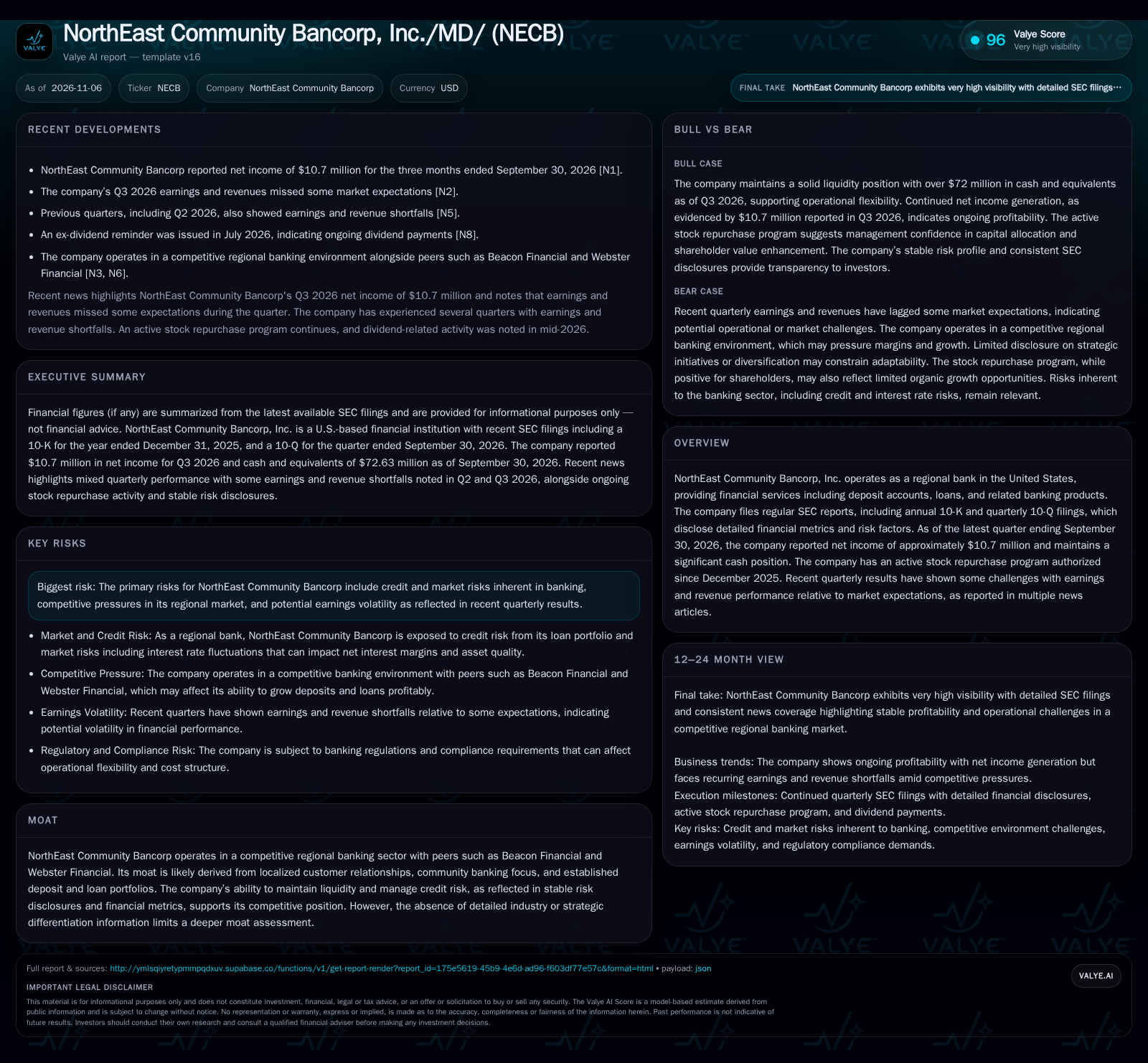
NorthEast Community Bancorp reported net income of $10.7 million for Q3 2026 and holds $72.63 million in cash and equivalents. Despite ongoing profitability, earnings and revenues have missed expectations for multiple consecutive quarters, reflecting both external pressures and possible operational challenges. The company’s active stock repurchase program signals capital allocation priorities amid constrained growth. Sustaining profitability will depend on NorthEast’s ability to manage margin compression, credit risk, and competitive intensity in its regional market. [S2] [N1] [N2] [N5]
NorthEast Community Bancorp, a U.S.-based regional bank, enters late 2026 with a mix of resilience and recurring challenge. Yet, for several consecutive quarters, both earnings and revenues have lagged market expectations—a signal that competitive intensity and margin compression are testing the bank’s traditional community-banking model. The company’s ongoing stock repurchase program suggests a focus on shareholder returns, but it also raises questions about organic growth prospects and long-term capital deployment. The coming quarters will test whether NorthEast can adapt to sector headwinds and defend its profitability in an evolving regional landscape.
Recent Financial Performance Signals Resilience and Underlying Strain
NorthEast Community Bancorp reported net income of $10.7 million for Q3 2026, with basic and diluted EPS of $0.81 and $0.79, respectively. The company’s cash and cash equivalents totaled $72.63 million as of September 30, 2026, providing a reported liquidity position base. However, Q3 results, along with Q2 and Q1, missed analyst expectations for both earnings and revenue. This recurring pattern points to operational or market-driven pressures, despite the bank’s continued profitability. The active stock repurchase program, with over 1.16 million shares still authorized for buyback, reflects a management focus on capital returns in a period of tepid organic growth. [S2] [N1] [N2] [N5]
How NorthEast Community Bancorp Makes—and Risks—Money
As a regional bank, NorthEast Community Bancorp’s core earnings engine is the spread between interest income (from loans and securities) and interest expense (on deposits and borrowings). The company’s profitability depends on net interest margin, loan growth, deposit cost control, and credit quality. Fee income from ancillary banking products may supplement earnings but typically represents a modest portion of total revenue for community banks.
Fixed costs—personnel, compliance, technology, and branch operations—create moderate operating leverage, with incremental revenue growth potentially boosting margins if costs are well managed. However, in a low or inverted yield-curve environment, net interest margins can compress, and competitive deposit pricing can further erode spreads. If loan demand stalls or credit losses rise, profitability can quickly deteriorate.
The company reported cash and liquidity metrics for the period; these figures do not by themselves establish operating runway, investment capacity, financial flexibility, or financing capacity. Capital requirements, regulatory constraints, and the need to reinvest in technology or compliance infrastructure are ongoing funding considerations. [S2]
In addition to traditional interest income and fee revenue, the bank’s profitability is also influenced by its balance sheet composition and asset-liability management strategies. For example, the duration and repricing characteristics of loans versus deposits critically affect sensitivity to interest rate changes. A mismatch can lead to either margin expansion or compression depending on the rate environment. Moreover, the bank’s ability to securitize or sell loan portfolios can provide liquidity and risk mitigation but may also limit long-term earnings potential if high-yield assets are offloaded. Effective management of credit risk reserves is another lever that impacts net income, as overly conservative provisioning can depress short-term earnings, while under-provisioning risks capital adequacy and regulatory scrutiny.
Competitive Landscape: Regional Peers Intensify Margin and Growth Pressures
NorthEast Community Bancorp operates in a crowded regional banking market, facing competition from established players such as Beacon Financial and Webster Financial. These peers vie for the same local deposits, loan customers, and small business relationships, often competing on rate, service, and product breadth.
In this environment, advantages may stem from deep local relationships, a reputation for community engagement, and responsiveness to customer needs. However, these strengths are increasingly challenged by scale advantages, digital offerings, and aggressive pricing from larger or better-capitalized banks. The lack of clear evidence of product or technology differentiation for NorthEast means that retaining and growing customer relationships may require concessions on pricing or increased marketing and service costs.
Substitutes for traditional banking—such as digital-first banks, credit unions, and fintech lending platforms—could further pressure both deposit and loan growth, especially if customer expectations shift toward digital convenience and lower fees.
The competitive dynamics are further complicated by evolving customer expectations around digital banking capabilities and personalized financial services. Regional banks like NorthEast often face challenges investing sufficiently in technology platforms to match the user experience offered by larger banks or fintech competitors. This technological gap can result in higher customer acquisition costs or attrition, especially among younger demographics. Additionally, regulatory compliance costs tend to disproportionately impact smaller institutions, potentially diverting resources from growth initiatives. In this context, the bank’s ability to leverage local market knowledge and community ties must be balanced against the necessity for operational efficiency and innovation to maintain competitive relevance.
What Could Drive a Positive Inflection: Margin Defense and Local Franchise Strength
The most plausible upside scenario is that NorthEast Community Bancorp stabilizes and gradually expands its net interest margin, either through disciplined loan pricing, improved funding costs, or a more favorable interest rate environment. If the bank leverages its community relationships to win high-quality loan business and attract low-cost core deposits, it could defend or even grow profitability despite sector headwinds.
An acceleration in non-interest income—through expanded fee-based services or new product introductions—would further diversify revenue streams and cushion against margin compression. Signs that would confirm this scenario include sequential improvement in net interest margin, above-peer loan growth, and a visible ramp in fee income (if disclosed). Falsification would come from continued earnings/revenue misses, rising credit losses, or evidence of deposit run-off.
Maintaining Profitability Amid Slow Growth and Margin Compression
The most likely outcome is that NorthEast Community Bancorp continues to generate profits, but at a level constrained by competitive pricing and modest loan demand. Net interest margin may remain under pressure, and non-interest income is unlikely to grow meaningfully without a shift in strategy or market conditions. The bank may continue to return capital via buybacks, reflecting limited high-return organic investment opportunities.
Confirmation of this scenario would be ongoing, but not improving, profitability, continued use of the share repurchase authorization, and stable but unexciting loan and deposit growth. Falsification would occur if the bank demonstrates a clear break—up or down—from recent performance trends, such as a sharp improvement in margin or a material deterioration in credit quality.
Earnings Deterioration If Credit Costs Rise or Competitive Pressure Intensifies
A negative scenario would see NorthEast Community Bancorp’s earnings decline due to a combination of rising credit losses, further net interest margin compression, or inability to compete for deposits without sacrificing profitability. If the regional economy weakens or credit quality deteriorates—manifesting in higher non-performing loans or charge-offs—the bank’s earnings could quickly erode.
Additional risk comes from intensified competition, leading to either deposit outflows or the need to pay higher rates for funding. Regulatory pressures or unexpected compliance costs could further squeeze margins. Warning signs would include rising provisions for loan losses, a spike in non-performing assets, a significant drop in net interest margin, or a sharp slowdown in loan/deposit growth.
Thesis-Testing Developments to Track for NorthEast Community Bancorp
Quarterly trends in net interest margin—any sequential improvement or further compression would be highly informative.
Loan growth rates vs. regional peers; above-market growth could indicate competitive strength.
Deposit cost trends, especially the average rate paid on interest-bearing deposits, if disclosed.
Credit quality metrics: non-performing loans, charge-offs, and provision expenses.
Utilization of the remaining share repurchase authorization—pace and volume can signal management’s confidence and view on growth opportunities.
Changes in non-interest income as a percentage of total revenue; a useful metric would be the launch or ramp of new fee-generating products.
Any disclosed digital banking initiatives or technology investments that could improve service delivery or operational efficiency.
Material changes in risk disclosures or regulatory findings, which would signal shifts in operational or compliance risk.
Disclaimer: This is research-only, informational analysis and not investment advice. It may include AI-generated interpretation and general industry context. Always verify important details using primary sources.

Comments