
USBC’s Blockchain Banking Pivot: Strategic Partnerships, Talent, and the Challenge of Commercializing Tokenized Deposits
USBC, Inc. has divested its legacy business and repositioned itself at the confluence of blockchain banking, tokenized U.S. dollar deposits, and a Bitcoin treasury strategy.
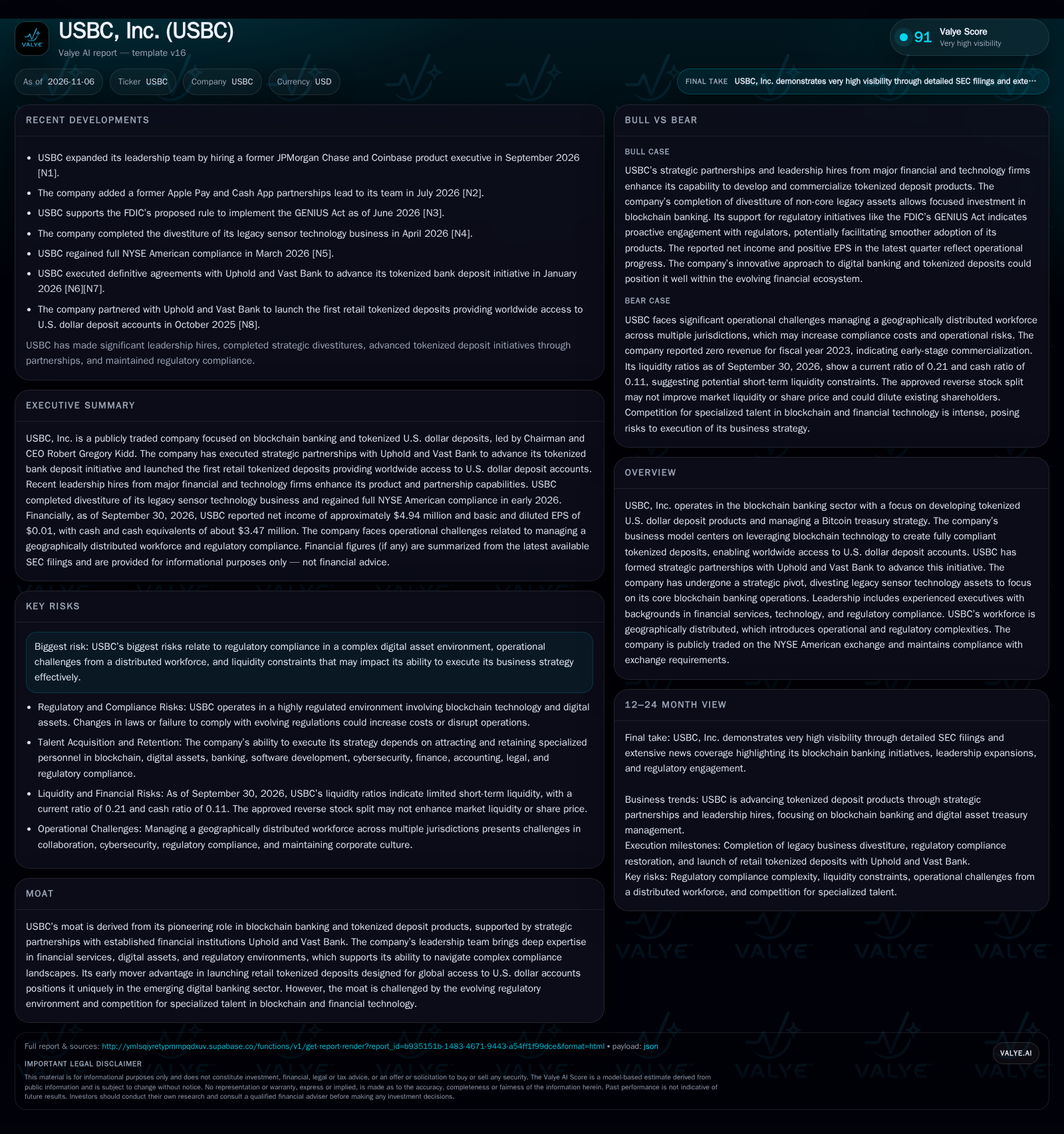
USBC, Inc. is pursuing a high-conviction pivot into blockchain-based banking, with a focus on tokenized U.S. dollar deposits and digital asset strategies. Strategic partnerships with Uphold and Vast Bank, plus the addition of talent from leading fintech and banking firms, have positioned USBC to pioneer globally accessible, regulated digital deposit products. However, the company faces significant operational and financial hurdles: distributed workforce management, compliance complexity, and a precarious liquidity position. The next phase will test whether USBC can translate its partnerships and vision into sustainable commercial traction and regulatory durability.
USBC, Inc. has executed a rapid strategic transformation, shedding its legacy sensor business to pursue a vision at the intersection of blockchain banking, tokenized U.S. dollar deposits, and Bitcoin asset management. Newly inked alliances with Uphold and Vast Bank, combined with a bolstered leadership roster from the world’s top financial and technology brands, have set the stage for USBC to become a first mover in retail tokenized deposits accessible worldwide.
Strategic Refocus, Partnerships, and Financial Stress Define USBC’s Current Landscape
USBC, Inc. has completed its exit from the legacy sensor technology sector, finalizing the divestiture in April 2026 to focus exclusively on blockchain banking and tokenized dollar deposit products [N4]. This strategic narrowing coincides with the launch of the first retail tokenized U.S. dollar deposits via partnerships with Uphold and Vast Bank, providing global access to U.S. dollar deposit accounts [N6] [N7] [N8]. The company has recruited senior talent from JPMorgan Chase, Coinbase, Apple Pay, and Cash App to strengthen its product and partnership execution [N1] [N2].
The company reported a current ratio of 0.21 for the period. [S2] The company did report net income of $4.94 million and EPS of $0.01 for the quarter, but the sustainability and drivers of profitability are not established in the current disclosures [S2].
Commercial Mechanics and Economic Leverage in Tokenized Banking
USBC’s business model is predicated on the creation and management of tokenized U.S. dollar deposits—digitally native, blockchain-recorded claims on fiat currency, likely targeting both retail and institutional users seeking regulated, globally accessible dollar accounts. The company’s economics could be shaped by a combination of deposit spread income (if it can intermediate or lend against deposits), transaction and custody fees, and ancillary digital asset services. However, the commercial structure—whether USBC earns net interest margin, charges per-transaction fees, or operates via a B2B/B2C SaaS model—remains undisclosed.
The company’s Bitcoin treasury strategy introduces additional potential for asset-driven returns or mark-to-market volatility, but unless these assets are actively managed or monetized, their contribution to operating leverage is likely limited. Fixed costs are expected to be high in the near term, given the need for compliance, cybersecurity, cross-jurisdictional legal work, and continuous investment in technology. Variable costs may be low for digital operations, but scaling will require substantial up-front investment in customer acquisition, regulatory approvals, and ecosystem integrations.
With zero revenue reported as recently as fiscal 2023 and persistent liquidity strain, USBC’s near-term capital needs are likely acute. The company’s ability to achieve operating leverage will depend on rapidly growing deposit volumes and/or fee-generating transactions, while containing compliance and operational costs.
First-Mover Ambition Meets Regulatory and Talent Headwinds
USBC’s early partnerships with Uphold and Vast Bank to launch globally accessible tokenized dollar deposits provide a first-mover narrative in an emerging segment. This positioning could allow the company to capture regulatory mindshare and build network effects among digital-native users, especially if regulatory clarity around tokenized deposits continues to progress.
However, the competitive field is highly dynamic. Large fintechs, neobanks, stablecoin issuers, and traditional banks exploring blockchain rails all represent potential substitutes or direct competitors. Established players may have deeper compliance resources, larger customer bases, and integrated product suites. The regulatory environment is fluid, with evolving standards for digital asset custody, AML/KYC, and cross-border transfer—all of which could raise barriers or favor incumbents with scale.
USBC’s ability to attract and retain specialized talent in blockchain, compliance, and digital banking is critical, but competition for such talent is intense and expensive. The company’s distributed workforce model, while potentially providing access to global expertise, also complicates operational cohesion and increases the risk of regulatory fragmentation.
If Tokenized Deposits Gain Regulatory Traction and User Adoption Accelerates
The most favorable scenario for USBC involves rapid regulatory acceptance of tokenized deposit products, allowing the company to scale globally accessible U.S. dollar accounts ahead of larger incumbents. In this outcome, partnerships with Uphold and Vast Bank could serve as distribution and credibility multipliers, driving significant inflows of deposits and transaction activity. Early success in attracting digital-first customers—retail or institutional—would validate the business model and could create network effects that deter competitors.
Upside confirmation would come from disclosed growth in deposit volumes, recurring transaction or custody fee revenue, expansion of commercial partnerships, and evidence that regulatory approvals are being secured in target markets. Additional validating signals would include the launch of new digital asset products, reduction in per-customer onboarding costs, and improved gross margins as scale is achieved.
Building the Foundation: Commercial Pilots, Regulatory Iteration, and Survival
The most plausible trajectory for USBC is an extended period of commercial pilot programs, regulatory engagement, and incremental user adoption. The company may secure initial deposit flows through its Uphold and Vast Bank channels but will likely face a slow ramp given the novelty of tokenized deposits and the complexity of cross-jurisdictional compliance. Revenue growth may lag operating expenses, necessitating further capital raises or cost containment.
Base case confirmation would include moderate but steady increases in active accounts and deposit balances, periodic regulatory approvals in new markets, and gradual expansion of the product suite. Falsification would come from persistent zero or negligible revenues, regulatory pushback, or visible attrition of key partnerships or personnel.
Acute Liquidity Pressure and Regulatory Setbacks Could Derail Execution
The most adverse outcome for USBC would be a failure to translate its partnerships and product launches into sustainable revenue streams before liquidity is exhausted. If regulatory authorities delay or deny approvals for tokenized deposit products, or if compliance costs escalate, the company could face a cash crunch forcing asset sales, dilutive financings, or strategic retrenchment.
Persistent zero or negative revenue, loss of exchange compliance, or board/executive departures would also signal mounting distress.
Milestones That Will Determine Whether USBC’s Blockchain Banking Bet Pays Off
Reported quarterly or annual revenue growth from tokenized deposit products and associated digital asset services, if disclosed, would provide direct evidence of commercial traction.
Trends in aggregate deposit balances and active account numbers would help gauge user adoption and the effectiveness of the Uphold and Vast Bank partnerships.
Regulatory approvals or licenses obtained in new jurisdictions, or updates on compliance with evolving digital banking standards, would indicate progress toward scalable operations.
Disclosure of customer acquisition costs and churn rates, if available, would illuminate the efficiency and stickiness of USBC’s business model.
Announcements of new commercial partnerships, integrations, or ecosystem collaborations would suggest momentum and network effects.
Retention of key executives and technical personnel, as well as additional high-profile hires, would signal organizational stability and talent competitiveness.
Updates on the performance and contribution of the Bitcoin treasury strategy, including realized gains/losses or risk management practices, would clarify the impact on USBC’s financials.
Disclaimer: This is research-only, informational analysis and not investment advice. It may include AI-generated interpretation and general industry context. Always verify important details using primary sources.

Comments