
Forrester Research: Navigating Thin Margins and Competitive Pressures in an Evolving Advisory Landscape
The path forward hinges on margin recovery, product innovation, and retention in a market where digital and AI-enabled insights are rapidly commoditizing.
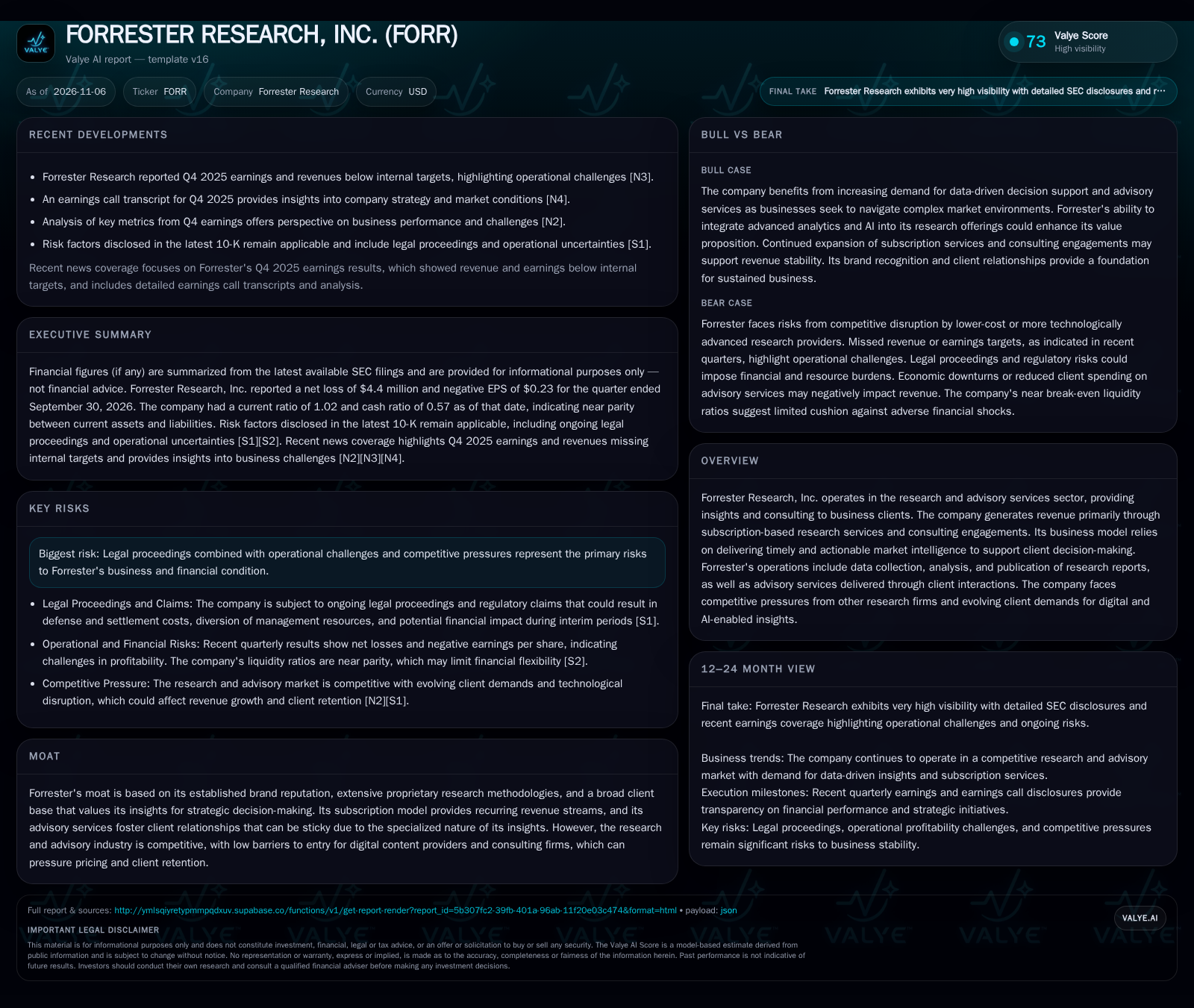
Forrester Research reported a quarterly net loss and operates with a thin liquidity buffer, reflecting ongoing struggles to convert its subscription and advisory strengths into sustainable margin. The company faces intense competition and operational uncertainty, with future performance reliant on its ability to innovate and retain clients amid shifting demand for digital and AI-driven insights. Legal and financial risks further complicate the outlook. Monitoring margin trends, customer retention, and product evolution will be essential for assessing the company’s trajectory. [S2] [N2]
Forrester Research, a long-established player in the research and advisory services sector, is at a crossroads. As the industry shifts toward digital-first, AI-enabled insights and more agile competitors intensify pricing and retention pressure, Forrester’s ability to innovate and sustain its value proposition will be tested. The next phase will likely be defined by margin recovery efforts and the company's response to evolving client expectations, all while legal and operational risks remain in play.
Recent Financials Illuminate Margin and Liquidity Constraints
Forrester Research reported a net loss of $4.4 million for the quarter ended September 30, 2026, translating to negative EPS of $0.23. This extends a pattern of profitability challenges and raises questions about the company’s ability to generate sustainable margins in its core business. Liquidity is also tight: with $54.1 million in cash and cash equivalents, current assets of $183.5 million, and current liabilities of $179.2 million, the current ratio sits at 1.02 and the cash ratio at 0.57. Legal proceedings and operational uncertainties, as disclosed in recent SEC filings, remain additional sources of risk. [S2] [S1]
How the Subscription and Advisory Model Drives (or Drags) Economics
Forrester’s revenue engine relies on a blend of subscription-based research products and consulting/advisory engagements. Subscription contracts, if structured with recurring annual or multi-year terms (as is typical in the industry), can provide a degree of revenue visibility and client stickiness. However, the company’s reported net loss and reported current ratio suggest that current pricing, volume, or cost structure is not yielding sufficient operating leverage. Variable costs likely scale with advisory engagement volume and report production, while fixed costs include analyst compensation, proprietary data infrastructure, and content platform investments.
The sector’s economics are susceptible to mix shifts: higher-margin subscription research versus more labor-intensive consulting projects. If client demand shifts toward bespoke advisory or if price competition intensifies, gross margins can compress. Capital requirements for the business are generally modest compared to heavy-asset industries, but maintaining proprietary data sources, analyst talent, and technology capabilities may necessitate ongoing investment—especially as digital and AI capabilities become table stakes. Without clear evidence of margin expansion or cost discipline, Forrester’s operating model may remain structurally challenged.
A critical dynamic influencing Forrester’s economics is the balance between client acquisition costs and lifetime value within its subscription model. If the cost to acquire and onboard new subscribers rises due to intensified competition or market saturation, the payback period on these investments could lengthen, pressuring near-term cash flows. Conversely, enhancing client lifetime value through upselling, cross-selling, or embedding insights into clients’ operational workflows could improve unit economics and justify higher acquisition spend. This interplay between acquisition efficiency and retention effectiveness is pivotal in determining whether Forrester can scale profitably in a commoditizing environment.
Brand and Methodology Offer Some Defenses, but Barriers Are Eroding
Forrester’s historic moat derives from its brand reputation, proprietary research methodologies, and longstanding client relationships. These factors can foster retention and justify premium pricing—especially with senior decision-makers who value trusted insights. Yet, the competitive landscape is shifting: digital-native research providers, AI-powered analytics platforms, and lower-cost consulting boutiques are eroding the traditional advantages of legacy research firms. The commoditization of market intelligence and proliferation of free or low-cost digital content create persistent pricing and retention pressure.
Switching frictions may exist where Forrester’s insights are deeply embedded in client workflows, but these are not insurmountable if alternative providers offer superior value or integration. The company’s ability to adapt its offerings—incorporating AI, automation, and more actionable digital content—will determine whether it can maintain relevance and pricing power. Without clear evidence of differentiated product innovation or structural client lock-in, Forrester’s competitive position appears increasingly vulnerable to disruption.
In addition to brand and methodology, the pace of technological adoption is a key determinant of competitive resilience. Firms that rapidly integrate AI and machine learning to automate data collection, generate predictive insights, and personalize client experiences may lower their marginal costs and improve client engagement. Forrester’s ability to invest in and operationalize such technologies at scale will influence its cost structure and differentiation. If competitors outpace Forrester in digital innovation, the company risks commoditization not only through pricing pressure but also through eroding perceived value, making retention and pricing power more difficult to sustain.
Moreover, the evolving buyer profile in the research and advisory market demands agility. Increasingly, clients seek real-time, easily digestible insights integrated within their decision-making platforms rather than traditional periodic reports. This shift favors providers with flexible delivery models and seamless digital interfaces. Forrester’s legacy content formats and sales cycles may face challenges adapting to these expectations. Success will depend on the company’s capacity to reconfigure product design, sales strategies, and client engagement models to align with changing consumption patterns, thereby preserving relevance in a rapidly evolving competitive landscape.
Margin Turnaround via Product Innovation and Retention Gains
A favorable outcome for Forrester would hinge on successful adaptation to digital and AI-driven client demands, enabling the company to differentiate its research products and advisory services. If Forrester can enhance its subscription offerings with proprietary analytics, actionable insights, and seamless digital delivery, it may be able to defend or even expand pricing. Improved client retention, perhaps through deeper integration with client decision processes or expanded enterprise contracts, could stabilize and grow recurring revenue. Operating leverage could be unlocked if cost discipline is paired with subscription growth, driving a return to consistent profitability.
Evidence of this scenario would include sequential margin improvement, visible adoption of new or upgraded digital offerings, and positive trends in client retention or expansion rates (if disclosed). Announcements of major contract renewals, new enterprise wins, or the launch of AI-enabled research platforms would further support the case for a turnaround.
Incremental Progress Amid Persistent Cost and Retention Challenges
The most plausible trajectory for Forrester is one of incremental improvement offset by ongoing competitive and operational headwinds. Modest subscription growth may be achievable if the company executes on digital transformation and selectively retains its core client base, but pricing pressure and client churn will likely persist. Consulting engagements could provide episodic revenue boosts but may dilute margins unless tightly managed.
In this scenario, Forrester would hover near break-even or low-single-digit margins, with limited room for financial error given its tight liquidity. Confirmation would come from stable or slightly improving revenue and margin trends, but persistent legal, operational, or competitive setbacks—such as continued net losses or unexpected client departures—would argue against sustained recovery.
Margin Compression and Liquidity Strain from Intensifying Disruption
The adverse scenario for Forrester involves accelerating client attrition, further pricing erosion, and continued inability to scale digital or AI-enabled offerings in line with evolving market expectations. If competitors capture share by offering equivalent insights at lower cost or with superior digital integration, Forrester’s subscription base could erode and consulting utilization may decline. This would pressure both topline and margins, potentially leading to deeper net losses.
Evidence confirming this scenario would include widening net losses, declining customer count or contract value (if disclosed), and any signal that cost containment measures are insufficient to offset revenue pressure. A deterioration in the company’s ability to meet short-term obligations or adverse legal outcomes would further exacerbate downside risk.
Testing Forrester’s Resilience: What Will Validate or Undermine the Thesis?
Quarterly trends in gross and operating margin: Sustained improvement would suggest margin recovery; further compression would signal deepening economic pressure.
Client retention and renewal rates, if disclosed: These would directly indicate the stickiness of Forrester’s subscription model and ability to defend its client base.
Growth or contraction in enterprise contract value and new business wins: A useful metric to gauge competitive positioning and sales execution.
Adoption rates and revenue contribution from new digital or AI-enabled research products: Would help test the effectiveness of product innovation and digital transformation.
Legal expense trends and outcomes of material proceedings: Any escalation or adverse resolution could materially impact potential financial flexibility and operating focus.
Cash flow from operations and changes in net working capital: These provide insight into underlying business health and liquidity trajectory.
Disclosure of cost-reduction initiatives or restructuring actions: Would indicate management’s response to ongoing profitability challenges.
Industry pricing trends and competitive moves: External signals of commoditization or disruptive entrants would provide context for Forrester’s performance.
Disclaimer: This is research-only, informational analysis and not investment advice. It may include AI-generated interpretation and general industry context. Always verify important details using primary sources.

Comments