
Array Digital Infrastructure: Tower-Focused Strategy Confronts Debt Load and Industry Evolution
Array Digital Infrastructure’s pivot to a tower-centric model has yielded strong site rental revenue growth and operational momentum in 2026, but its substantial long-term debt and sector concentration pose challenges as wireless infrastructure demand and competitive dynamics evolve.
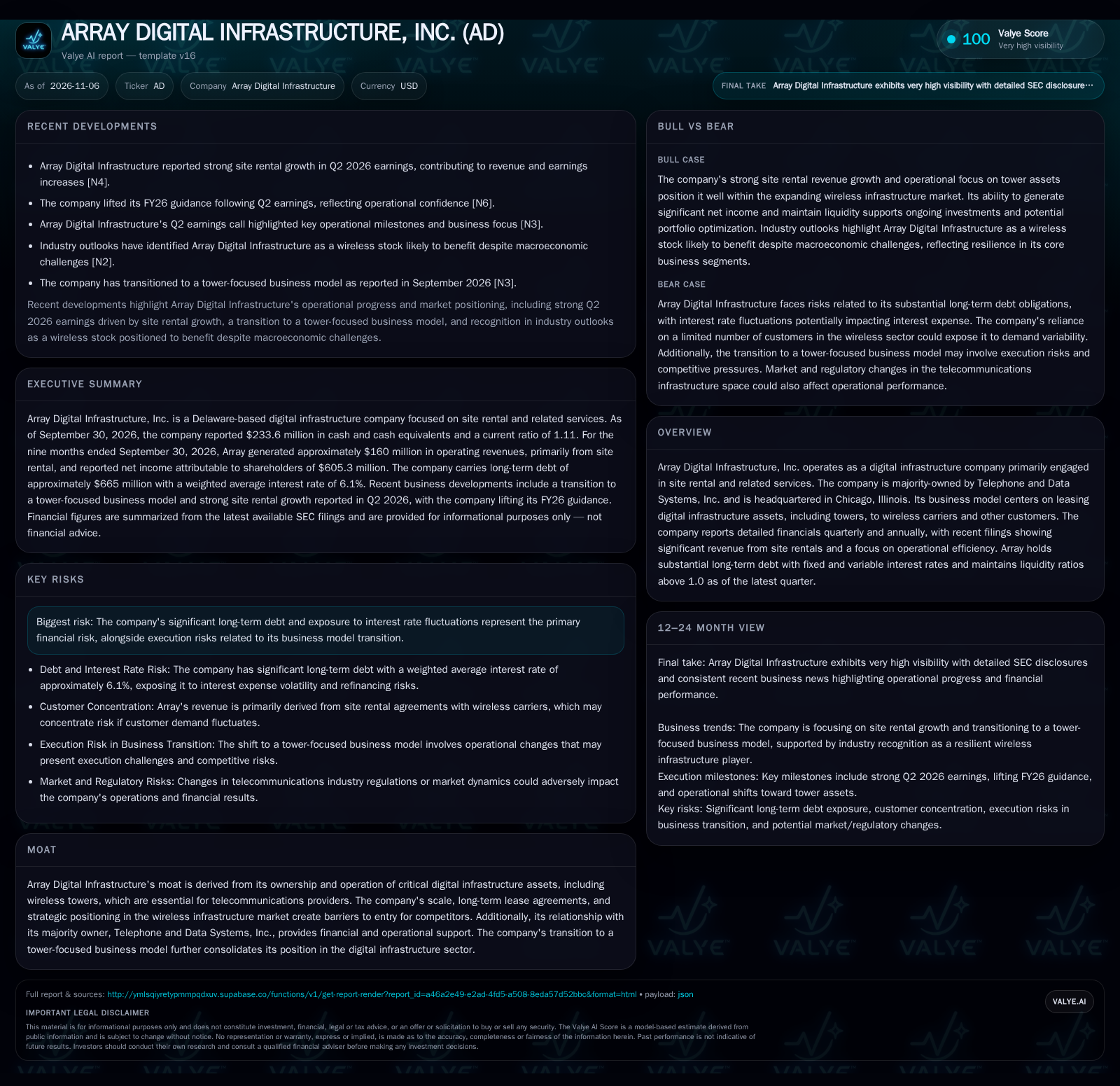
Array Digital Infrastructure reported $160 million in operating revenues—predominantly from site rentals—over the first nine months of 2026, supported by a shift to a tower-focused model and recognized operational milestones. While recent quarters saw revenue and earnings outperformance and an increase in FY26 guidance, the company’s $665 million long-term debt and reliance on a concentrated wireless customer base highlight ongoing financial and strategic risks. The next phase will test Array’s ability to sustain growth, manage leverage, and defend its market position amid industry shifts and macro uncertainty. [S2] [N3] [N4] [N6]
Array Digital Infrastructure, Inc. has emerged as a notable player in the U.S. digital infrastructure landscape, sharpening its strategy around tower assets and site rental services. Recent quarters have seen strong site rental growth, a boost in operational guidance, and substantial net income—outcomes supported by the company’s transition to a more focused business model. Yet, this momentum is juxtaposed with a significant long-term debt load and concentrated customer base, exposing the business to interest rate, refinancing, and sector-specific risks. As the market for wireless infrastructure continues to evolve, Array’s ability to balance growth ambitions with financial discipline will be central to its long-term trajectory. [S2] [N3] [N4] [N6]
Recent Performance: Revenue Growth, Business Model Shift, and Leverage
For the nine months ended September 30, 2026, Array Digital Infrastructure reported approximately $160 million in operating revenues, with $156.7 million attributable to site rentals and $3.3 million from services. The company delivered net income of $605.3 million, a result influenced by operating leverage and non-recurring gains on license sales and exchanges. Liquidity metrics as of September 30, 2026 included $233.6 million in cash and a current ratio of 1.11, while long-term debt stood at approximately $665 million with a weighted average interest rate of 6.1%. Notably, Array lifted its FY26 guidance after reporting strong site rental growth in Q2 2026 and completed a transition to a tower-focused business model, positioning itself more squarely within the wireless infrastructure segment. [S2] [N3] [N4] [N6]
How Array Monetizes Digital Infrastructure: Lease Economics, Capital Intensity, and Margin Structure
Array’s core revenue engine is the leasing of tower and related digital infrastructure to wireless carriers, a model characterized by recurring, contract-based cash flows. Site rental agreements typically offer multiyear visibility and potential for built-in escalators, but the report does not specify contract durations or escalation mechanics. The business is capital intensive: tower assets require significant upfront investment, but once deployed, incremental costs are relatively low, supporting operating leverage as tenant density increases. Depreciation is a major expense, and ongoing maintenance and compliance also weigh on margins.
The company’s cost structure divides into direct operating costs, SG&A, and non-cash depreciation. With operating income boosted by gains on license sales in the period, normalized margins may be lower in future quarters absent such events. The $665 million in long-term debt, with a 6.1% average interest rate, introduces substantial fixed financial costs and heightens sensitivity to interest rate cycles and refinancing risk.
Barriers, Counterforces, and the Wireless Infrastructure Chessboard
Array’s principal moat derives from ownership and operation of critical physical assets—towers required for wireless network deployment. These assets are difficult and costly to replicate, conferring a barrier to entry for new competitors. Long-term relationships with wireless carriers can create switching frictions, as relocating equipment is expensive and disruptive for tenants.
However, the sector remains competitive and exposed to counterforces. Peer categories include established tower REITs, regional infrastructure providers, and fiber or small cell operators as wireless densification strategies evolve. Technological substitution is a latent threat: as networks shift toward 5G and potentially beyond, the mix between macro towers, small cells, and alternative infrastructure could change the addressable market or pricing dynamics. Customer concentration is inherent, as a small number of major carriers dominate U.S. wireless, increasing Array’s exposure to customer churn or renegotiation pressure. The company’s majority ownership by Telephone and Data Systems, Inc. may provide strategic support but could also complicate capital allocation flexibility.
If 5G and Data Growth Drive Lease Expansion, Can Array Compound Returns?
In a favorable scenario, continued wireless traffic growth and carrier investment in network quality drive increased demand for tower sites and higher tenant density per asset. If Array successfully executes its tower-focused strategy, it could realize improved operating leverage as incremental tenants are added with limited marginal cost. Lease escalators, if present, would further support revenue and cash flow growth.
Evidence confirming this scenario would include sustained site rental revenue increases above industry averages, new multi-tenant or amendment announcements, and rising EBITDA margins (if disclosed). Upward revisions to guidance, as seen in FY26, would further validate the trajectory. A reduction in leverage through retained earnings or refinancing at lower rates would strengthen the case for compounding equity value.
Sustaining Growth in a Maturing Infrastructure Market
The most plausible outcome is that Array maintains moderate site rental growth, underpinned by stable carrier demand and slow but steady network densification. Operating leverage may be realized gradually as the company optimizes its tower portfolio, but competitive pricing and customer negotiations could limit margin expansion. Gains from license sales are unlikely to recur at the same scale, so future net income may normalize closer to steady-state rental economics.
This scenario would be confirmed by flat-to-modest sequential revenue growth, stable (but not rising) margin trends, and maintenance of current leverage and liquidity levels. Absence of major customer losses or contract renegotiations would support this path, as would continued investment in asset maintenance and incremental tower builds.
Debt, Customer Concentration, or Technology Shifts Could Derail Momentum
Adverse outcomes could emerge from several directions. A major carrier consolidates or renegotiates terms, leading to lower site rents or non-renewal of leases, exposing Array’s revenue concentration risk. A slowdown in wireless capital spending or a pivot toward alternative infrastructure (e.g., small cells, fiber-to-premises) could reduce new lease demand or pressure pricing. Rising interest rates or tightening credit markets would increase debt service costs or complicate refinancing of the company’s $665 million in obligations.
Confirmation of downside would involve sequential declines in site rental revenue, announcements of lost or renegotiated contracts, margin compression due to increased costs or lower occupancy, or liquidity stress evidenced by deteriorating coverage ratios or the need for dilutive equity raises. Regulatory or zoning changes could also impede new tower deployment or increase compliance costs.
What Will Determine Whether Array’s Tower Model Delivers Durable Value?
Site rental revenue growth rate—particularly compared to industry peers—will clarify whether Array is gaining share or merely riding sector trends.
Tenant concentration metrics (if disclosed) would help assess the risk of revenue loss from a major customer event.
Incremental EBITDA margin trends (if disclosed) would indicate operating leverage and efficiency gains from the tower-focused model.
Net debt to EBITDA or other leverage ratios (if disclosed) should be watched for signs of balance sheet risk or improving potential financial flexibility.
New site or amendment announcements would provide leading indicators of demand and future revenue visibility.
Interest coverage ratios or debt refinancing activity (if disclosed) would reveal vulnerability to interest rate or credit market shifts.
Updates on regulatory or zoning developments impacting tower deployment or compliance costs could materially affect expansion plans.
Disclaimer: This is research-only, informational analysis and not investment advice. It may include AI-generated interpretation and general industry context. Always verify important details using primary sources.

Comments