
Starwood Property Trust: Real Estate Cycles Tested by Diversification and Scale
Starwood Property Trust’s diversified lending and property portfolio, expanded by its recent Fundamental Income Properties acquisition, faces profitability headwinds amid real estate market volatility. Its REIT structure, external management, and broad asset mix create both resilience and complexity as it adapts to shifting credit, interest rate, and property market dynamics.
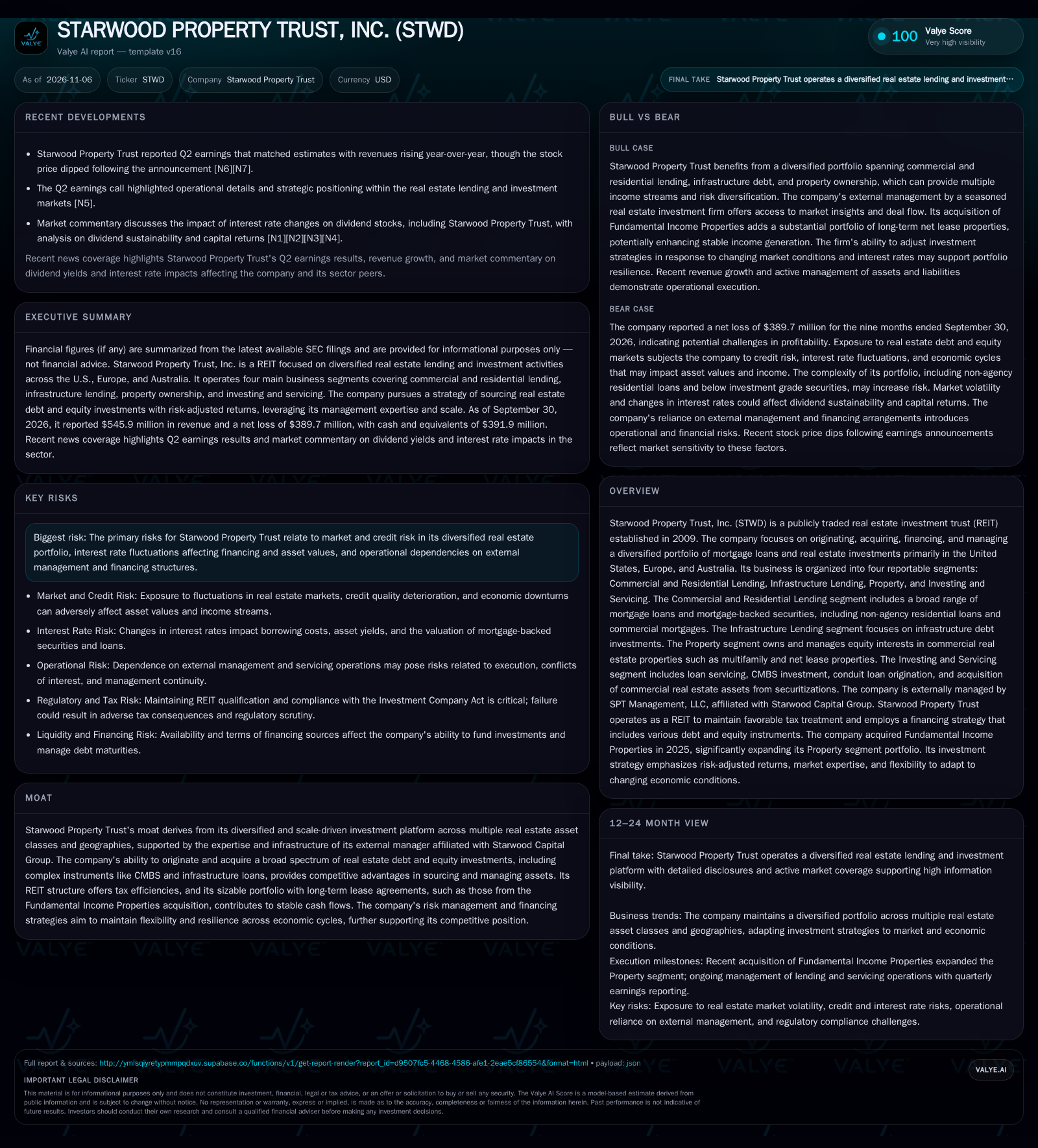
Starwood Property Trust operates a multi-segment real estate investment platform with exposure to commercial lending, infrastructure debt, and property ownership. While its Fundamental Income Properties acquisition added scale and extended lease duration, the company reported a significant net loss for 2026 YTD. The key questions now center on whether its diversified model and external management can deliver consistent returns through economic cycles and market disruptions. [S1] [S2]
Starwood Property Trust stands as one of the largest diversified real estate investment trusts, leveraging a four-segment model that spans commercial and residential lending, infrastructure debt, property ownership, and servicing. The 2025 acquisition of Fundamental Income Properties added hundreds of long-term, net-leased assets, further strengthening its property platform. However, the company reported a notable net loss for the first nine months of 2026, underscoring the challenges of navigating credit risk, interest rate volatility, and shifting real estate fundamentals. As Starwood adapts to economic cycles, the durability of its diversified approach and the effectiveness of its external management will be critical in determining its ability to generate stable returns and weather market headwinds. [S1] [S2]
Portfolio Growth Amid Profitability Challenges
Starwood Property Trust’s acquisition of Fundamental Income Properties in 2025 brought 468 net lease assets with a weighted-average lease term of 17.1 years, materially expanding its Property segment and providing additional long-duration rental income streams [S1]. As of September 30, 2026, the company reported $545.9 million in revenue during the first nine months but posted a net loss of $389.7 million and negative EPS of -$1.08, indicating that income growth has not offset costs, credit provisions, or asset value adjustments [S2]. Cash and equivalents stood at $391.9 million at quarter-end [S2]. Recent earnings calls reported year-over-year revenue growth, but stock price reactions have been negative, suggesting investor concern about profitability and outlook [N5] [N6] [N7]. These developments frame the central question: Can Starwood’s diversified model absorb market volatility and return to consistent profitability?
Cash Flow Dynamics Across Starwood’s Business Divisions
Starwood Property Trust’s business model revolves around originating and managing a broad mix of real estate loans, equity investments in properties, and servicing activities. The Commercial and Residential Lending segment generates interest income from first mortgages, mezzanine loans, and structured debt, with returns shaped by credit spreads, loan-to-value ratios, and borrower quality. The Infrastructure Lending segment focuses on debt tied to essential assets, typically seen as lower risk but with thinner spreads. The Property segment, especially after the Fundamental Income Properties acquisition, creates recurring rental income from long-term net leases, where tenants often cover taxes and maintenance, providing stable, inflation-protected cash flows if tenant credit holds up. The Investing and Servicing segment earns fees from special servicing of CMBS and trading gains/losses on securitized assets.
Operating leverage in this model is mixed: fixed costs are relatively low due to external management, but revenue sensitivity to credit events, impairments, or interest rate shifts is high. The company’s funding relies on a mix of secured and unsecured debt, securitizations, and equity, exposing it to refinancing and spread risk. Capital requirements are significant, especially for property acquisitions and loan originations, but asset sales and securitizations can recycle capital. The REIT structure mandates high payout ratios, limiting retained earnings and increasing dependence on capital markets for growth and liquidity. Profitability depends on credit performance, net interest margins, and the ability to manage through cycles of property valuation and loan loss provisions.
The Impact of Scale and Market Fragmentation on Competitiveness
Starwood Property Trust competes in a fragmented landscape alongside other mortgage REITs, private debt funds, commercial banks, and institutional property investors. Its advantages stem from scale, a diversified asset base, and the deal sourcing and underwriting capabilities of its external manager, SPT Management, affiliated with Starwood Capital Group [S1]. The breadth of its portfolio—including commercial loans, infrastructure debt, and a growing net lease property book—enables risk spreading and access to a wide range of opportunities. The recent expansion into long-duration net lease properties may provide more predictable income compared to pure lending peers.
However, these advantages come with complexity: managing credit risk across geographies and asset types, aligning interests with an external manager, and maintaining compliance with REIT and regulatory requirements. Competition for high-quality loans and assets remains intense, pressuring yields. Substitution threats come from direct lenders, insurance companies, and alternative asset managers who may offer more flexible terms or lower costs. Starwood’s ability to underwrite complex deals and manage problem assets is a potential differentiator, but the company’s recent net loss signals that scale alone does not guarantee resilience in challenging markets.
Credit Stability and Lease Performance as Drivers of Strong Returns
A favorable scenario for Starwood Property Trust would feature stabilization or improvement in commercial real estate values, benign credit conditions, and continued strong tenant performance, especially in the newly acquired Fundamental Income Properties portfolio. If interest rates stabilize or decline, funding costs could ease while asset yields remain attractive, supporting net interest margins. The long-term, triple net lease structure of many properties could insulate cash flows from inflation and operating cost pressures, assuming tenant credit holds up.
Successful asset management—limiting credit losses, recycling capital from mature or impaired loans into higher-yielding opportunities, and opportunistically acquiring distressed assets—could drive earnings recovery. Evidence confirming this scenario would include a return to positive net income, improved EPS, stable or rising book value per share, and high occupancy and rent collection rates in the net lease portfolio. Consistent dividend coverage from recurring cash flows would further validate the company’s ability to deliver on its REIT value proposition.
Resilience Through Diversification Despite Ongoing Cyclical Headwinds
The most plausible outcome is that Starwood Property Trust continues to generate solid revenue from its diversified lending and property holdings, but faces ongoing headwinds from credit events, asset impairments, and variable funding costs. The long lease terms and property diversification may dampen the impact of isolated tenant or asset issues, while special servicing and asset management capabilities help mitigate losses in the loan portfolio. However, the company’s ability to fully offset credit costs and maintain profitability is challenged by cyclical real estate market pressures and competition for high-quality assets.
Confirmation of this middle path would be continued revenue growth, modest improvement in net income, stable portfolio occupancy and loan performance metrics, and the ability to refinance debt without material equity dilution or distress sales. Signs of ongoing provisioning, negative EPS, or elevated credit losses would indicate that diversification is providing only partial protection against market volatility.
Risks from Credit Downturns and Funding Limitations
A negative scenario would involve a pronounced downturn in commercial real estate markets, rising tenant defaults, and widening credit spreads. In this environment, Starwood Property Trust could face material credit losses in its lending portfolio, write-downs on property values, and potential deterioration in rent collections from net lease tenants. Funding costs could rise or capital market access could tighten, forcing asset sales at unfavorable prices or dilutive equity issuance. The company’s externally managed structure may limit operational flexibility, and the REIT requirement to distribute most of its income could constrain the ability to rebuild capital.
Indicators confirming this scenario would include persistently negative net income, declining book value per share, rising non-performing loans, falling occupancy or rent collection rates, and ratings downgrades or adverse refinancing outcomes. If the company were forced to cut its dividend or sell core assets to raise liquidity, it would signal severe stress and possible erosion of franchise value.
Key Influences on Starwood’s Future Trajectory
Quarterly net income and EPS trends, especially any return to sustained profitability or further deepening of losses.
Occupancy and rent collection rates in the Property segment, specifically in the Fundamental Income Properties portfolio, if disclosed.
Credit performance metrics such as non-performing loan ratios, loan loss provisions, and realized losses in the lending segments, if disclosed.
Funding costs, debt maturities, and ability to access capital markets for refinancing and growth.
Book value per share trends, reflecting portfolio valuation and capital preservation.
Management commentary on market conditions, asset allocation, and strategic pivots in response to real estate cycles.
Disclaimer: This is research-only, informational analysis and not investment advice. It may include AI-generated interpretation and general industry context. Always verify important details using primary sources.

Comments