
Canopy Growth’s Turning Point: Acquisition Strategy Meets the Test of Internal Controls and Profitability
Canopy Growth’s recent transformative acquisition and ongoing financial restatement highlight both its ambition and persistent operational vulnerabilities.
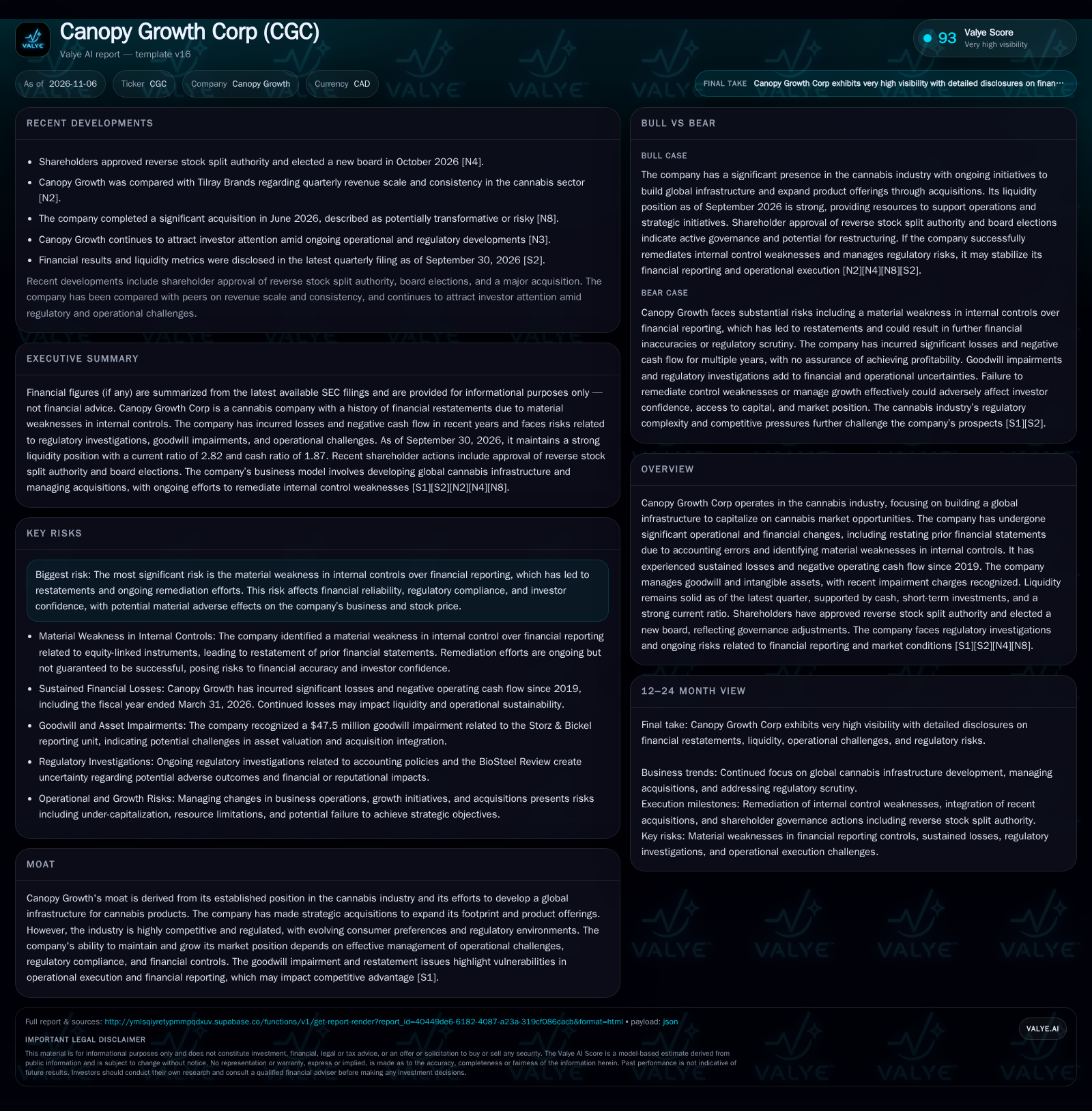
Canopy Growth is at a strategic crossroads: a significant June 2026 acquisition could reshape its business, yet persistent internal control problems and years of operating losses underscore the operational risks. Regulatory investigations and the need for credible financial reporting remediation add further complexity to the investment case. [S2] [N8]
Canopy Growth stands at a pivotal moment, balancing the promise of scale and global reach against a history of chronic losses, accounting restatements, and regulatory scrutiny. The June 2026 acquisition signals an ambition to reset its growth trajectory, but the company’s ability to turn such moves into sustainable, profitable operations is unproven. With a reported liquidity position cushion but ongoing internal control weaknesses, Canopy’s future will hinge on disciplined integration, credible financial reporting, and real operational leverage—none of which are guaranteed in the volatile cannabis sector. [S2] [N8]
Acquisition Moves and Control Challenges Shape Immediate Prospects
Canopy Growth’s operational landscape has shifted with a major acquisition completed in June 2026, described as potentially transformative or risky. The integration of this new asset could alter the company’s revenue profile, cost structure, and market positioning, but the true impact will depend on execution and synergy realization. Simultaneously, Canopy Growth has restated prior financial statements for fiscal years 2024 and 2025 due to material misstatements related to equity-linked instruments, reflecting a material weakness in internal controls that remains unresolved as of March 31, 2026. This ongoing internal control issue exposes the company to further regulatory scrutiny and potential future litigation. [S2] [N8]
The company reported a current ratio of 2.82 for the period. However, the company continues to incur significant losses and negative operating cash flow, with basic and diluted EPS at negative CAD 0.1 for the most recent quarter. [S2]
The company is also under regulatory investigation related to its accounting policies and the BioSteel Review, with uncertain outcomes. These factors collectively create a complex near-term environment where operational, financial, and reputational risks are tightly intertwined. [S2]
Canopy Growth’s Business Model Centers on Scale, Integration, and Capital Efficiency
Canopy Growth’s business model is built on developing global cannabis infrastructure, scaling production and distribution, and expanding its product portfolio through acquisitions. In theory, this approach could enable the company to drive top-line growth, capture share in regulated cannabis markets, and benefit from economies of scale in cultivation, processing, and logistics.
The company’s revenue mix likely includes bulk cannabis sales, branded consumer products, medical cannabis, and ancillary devices, though the financial statements do not break out unit economics. Pricing power in the cannabis industry is generally weak due to commoditization and regulatory price caps in some jurisdictions, placing a premium on volume growth and operational efficiency. Fixed costs—such as cultivation facilities, compliance infrastructure, and R&D—are substantial, so Canopy’s ability to achieve operating leverage depends on consistently growing sales and integrating acquisitions without material margin leakage.
Historically, the company’s negative operating cash flow and recurring losses suggest insufficient gross margin and/or high SG&A relative to revenue. The June 2026 acquisition could provide additional scale or new product lines, but its impact on cost structure and capital intensity remains to be seen. The company reported profitability for the period.
Pressure from Competitors and Regulations Limits Benefits of Scale
Canopy Growth operates in a highly competitive and fragmented global cannabis sector, where barriers to entry are shaped by regulatory licensing, scale of operations, and brand differentiation. Peer companies—including those with similar global ambitions and those focused on niche or regional markets—compete on price, product quality, regulatory compliance, and distribution reach. Recent news compared Canopy’s revenue scale and consistency to that of Tilray Brands, highlighting the challenges of achieving durable advantage even at larger scale. [N2]
The company’s moat is tied to its established infrastructure, product breadth, and international footprint. However, the cannabis market is subject to rapidly shifting consumer preferences, regulatory changes, and ongoing price compression. The goodwill impairment related to the Storz & Bickel unit signals potential challenges in extracting value from acquired assets—a warning sign for the integration of new acquisitions.
While Canopy’s liquidity and infrastructure may provide some strategic flexibility, persistent execution issues and financial reporting weaknesses undermine its ability to reliably outcompete peers or serve as a consolidation platform. Regulatory investigations and accounting restatements further erode trust with investors, partners, and customers, placing the company at a relative disadvantage until these are credibly addressed.
Successful Integration and Control Improvements Could Unlock Profitable Growth
The most optimistic scenario for Canopy Growth hinges on two parallel achievements: the successful integration of its June 2026 acquisition and the credible remediation of internal control weaknesses. If the new asset delivers on promised synergies—whether through increased revenue, product diversification, or cost savings—the company could finally unlock operating leverage from its global infrastructure. Margin expansion would be plausible if cost discipline is paired with volume growth in higher-value market segments or international markets with less price compression.
Remediation of internal controls would restore investor and regulator confidence, reduce the risk of further restatements or litigation, and potentially lower the company’s cost of capital. This could also open the door to strategic partnerships or further M&A activity under better terms.
Evidence confirming this scenario would include: sustained positive operating cash flow, margin improvement, a clean audit opinion, and clear disclosure of realized synergies from the acquisition. Early signs could be improved gross margin or SG&A leverage in the next two to four quarters, along with progress updates on internal controls from management and regulators.
Operational Gains May Be Limited by Integration and Control Fix Timelines
A more probable outcome is that Canopy Growth delivers incremental operational improvement but remains constrained by the complexity of integrating its latest acquisition and the time required to remediate internal control weaknesses. Revenue may grow modestly as the acquired business is absorbed, but margin expansion could be offset by integration costs, redundant overhead, or slower-than-expected synergy capture.
Internal control remediation is rarely quick or linear, especially for companies with a history of restatements. Regulatory investigations may linger, consuming management attention and resources, while investor skepticism persists until clear evidence of improvement emerges.
This scenario would be confirmed by continued negative but narrowing operating cash flow, gradual improvement in reported controls, and only modest changes in gross or operating margins over the next 12-18 months.
Ongoing Integration Issues and Reporting Weaknesses Heighten Risk to Value
The adverse scenario is that Canopy Growth fails to realize the promised benefits of its June 2026 acquisition, with integration challenges leading to further asset impairments, operational disruptions, or even revenue attrition. Simultaneously, if internal control remediation stalls or new issues emerge, the company could face additional restatements, regulatory penalties, or litigation, further damaging its credibility and raising its cost of capital.
Persistent negative cash flow would erode the company’s liquidity cushion, forcing difficult choices on cost cutting, asset sales, or dilutive capital raises. A failure to stabilize financial reporting could also lead to loss of major customer or partner relationships, or restrictions on access to key markets—particularly if regulators view the company as a higher compliance risk.
This scenario would be confirmed by new or expanded regulatory actions, further goodwill or asset impairments, continued or worsening negative operating cash flow, and management turnover or strategic retrenchment within the next year.
Upcoming Milestones Will Reveal the Strength of Canopy Growth’s Recovery Efforts
Progress updates and independent verification of internal control remediation—especially auditor opinions or regulatory statements confirming closure of material weaknesses.
Quarterly operating cash flow trends: persistent negative cash flow or a shift toward breakeven/positive territory would provide a clear test of operational improvement.
Gross margin and SG&A ratio evolution: meaningful improvement would suggest effective integration and cost discipline; stagnation or deterioration would signal ongoing inefficiency.
Disclosure of realized synergies, revenue growth, and integration milestones related to the June 2026 acquisition.
Updates on the status, scope, and outcomes of ongoing regulatory investigations and any associated litigation or settlements.
Evidence of asset impairments or further goodwill write-downs, particularly related to recently acquired units.
If disclosed, customer retention rates and new product adoption metrics—especially in key international markets.
Disclaimer: This is research-only, informational analysis and not investment advice. It may include AI-generated interpretation and general industry context. Always verify important details using primary sources.

Comments