
10x Genomics: Expanding Multiomics Platform Meets Profitability and Integration Tests
10x Genomics’ raised revenue guidance and expanding multiomics capabilities highlight operational momentum, but persistent net losses and integration risks from recent acquisitions keep the spotlight on execution and sustainable economics.
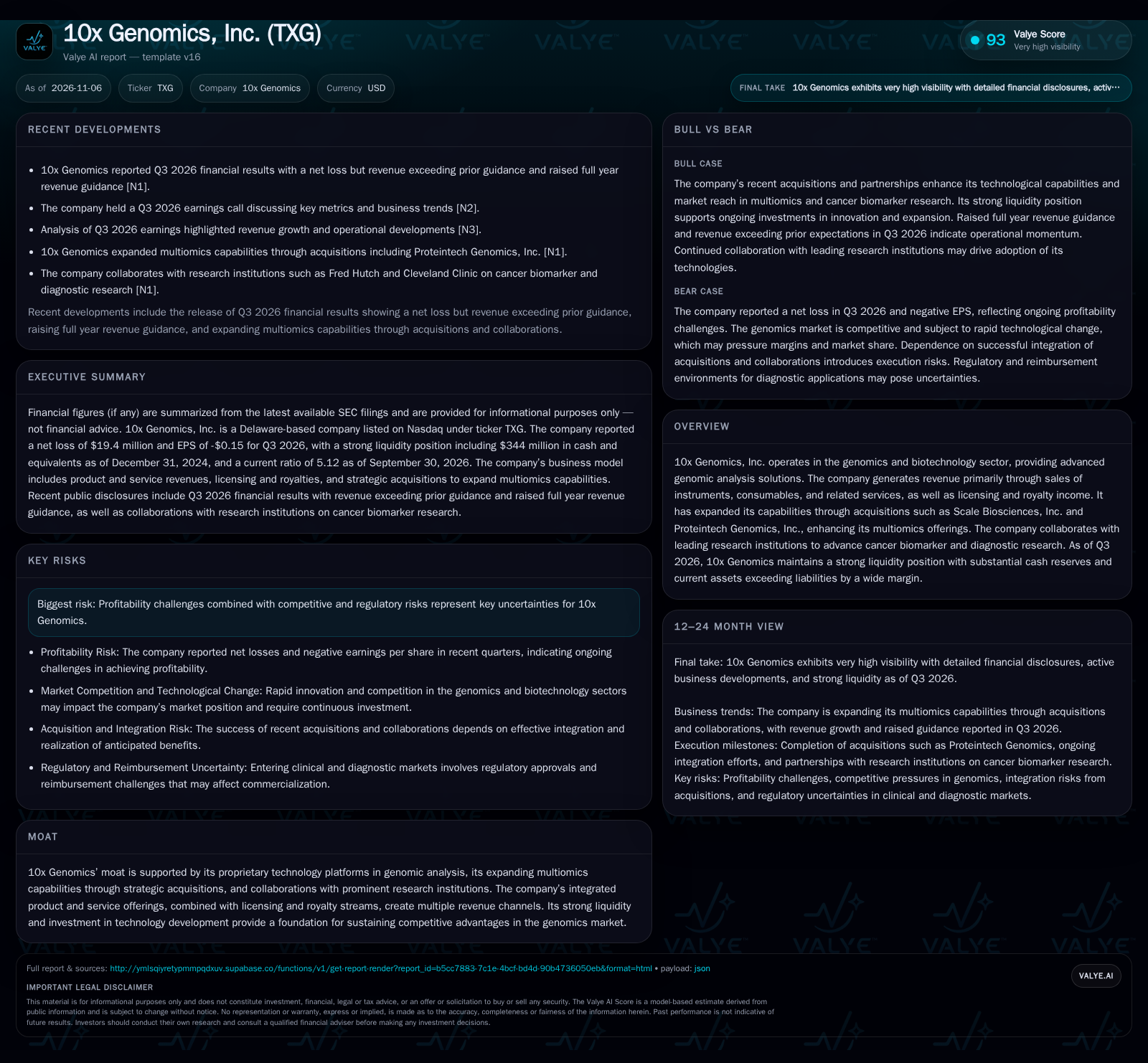
10x Genomics reported Q3 2026 revenue above prior guidance and raised its full-year outlook, underpinned by reported liquidity position and recent acquisitions expanding its multiomics platform. However, net losses persist, and the company’s ability to translate technology leadership and research partnerships into durable, profitable growth remains unproven. Integration of acquisitions and competitive pressures in genomics are central to the thesis.
10x Genomics is at a strategic inflection point. The company’s Q3 2026 results show revenue momentum—exceeding guidance and prompting an upward revision for the full year. Recent acquisitions have expanded its multiomics platform, and collaborations with top research institutions signal market relevance. Yet, net losses persist and the complexity of integrating new businesses looms large. The next phase for 10x Genomics will hinge on its ability to convert technological and commercial breadth into sustainable, profitable growth while navigating a fiercely competitive genomics landscape.
Recent Results Signal Growth but Not Yet Profitability
10x Genomics reported a net loss of $19.4 million for Q3 2026, with basic and diluted EPS of -$0.15 for the period [S2]. While the company remains unprofitable, revenue exceeded prior guidance, leading management to raise its full-year revenue outlook as of November 6, 2026 [N1]. This reflects operational momentum and possibly stronger-than-expected demand for its genomic analysis solutions.
The company completed acquisitions of Scale Biosciences and Proteintech Genomics, enhancing its multiomics capabilities and expanding its addressable markets [S1] [N1]. 10x Genomics also maintains collaborations with institutions such as Fred Hutch and Cleveland Clinic, reinforcing its relevance in cancer biomarker and diagnostic research [N1].
As of September 30, 2026, 10x Genomics reported $344.1 million in cash and equivalents (as of 2024-12-31) and a current ratio of 5.12 [S2].
Beyond headline liquidity and cash balances, a deeper understanding of 10x Genomics’ working capital dynamics and capital expenditure requirements would clarify the sustainability of its operational runway. Additionally, the timing and scale of capital expenditures related to scaling manufacturing or integrating acquired technologies could materially influence free cash flow and profitability trajectories in coming quarters.
How 10x Genomics’ Multi-Channel Model Could Drive Margin Expansion
10x Genomics generates revenue through a combination of product sales (instruments and consumables), services, and licensing/royalty streams [S1] [S2]. The core economic engine is typically driven by a razor/razorblade model: capital equipment sales seed installed base growth, while consumables generate recurring, higher-margin revenue as customers run more experiments. This dynamic can create operating leverage if the installed base expands and consumable pull-through increases.
The company’s recent acquisitions—Scale Biosciences and Proteintech Genomics—extend its offering into broader multiomics, potentially increasing average revenue per customer and cross-selling opportunities. However, integration costs and R&D spending are likely to remain high in the near term, as evidenced by persistent net losses.
If 10x Genomics can drive greater adoption of its platforms, especially in high-throughput research and clinical markets, improved consumables mix and scale could support margin expansion. Conversely, high fixed costs, ongoing investment requirements, and pricing pressure from competitors could constrain operating leverage.
The interplay between product mix evolution and margin profile is critical to watch as 10x Genomics expands multiomics offerings. If consumables increasingly represent a larger share of revenue, the company could benefit from higher gross margins typical of reagent sales relative to instruments. However, this assumes successful customer adoption and retention, as consumables revenue is inherently tied to repeat usage. Moreover, licensing and royalty income streams, while potentially lower in absolute scale, might offer high-margin, low-capital intensity contributions that enhance overall profitability if scaled. Balancing investment in R&D innovation with disciplined SG&A spending will be essential to translating top-line growth into operating leverage, especially given competitive and pricing pressures.
Technology Leadership Faces Intense Genomics Competition and Substitution Risk
10x Genomics’ competitive position is anchored in its proprietary technology platforms for single-cell and spatial genomics, now broadened through multiomics. Its collaborations with leading research institutions suggest scientific credibility and early adoption. However, the genomics tools market is highly competitive, with established players and emerging startups vying for share in both research and translational/clinical settings.
Potential advantages include integration across multiple omics layers, breadth of product portfolio, and the ability to generate high-quality data for complex biological questions. Counterforces include rapid technological innovation, potential for platform obsolescence, and pricing pressure as customers weigh switching costs against alternative solutions.
A key question is whether 10x can create true ecosystem lock-in—through workflow integration, data standards, or proprietary reagents—sufficient to drive recurring revenue and defend margins. If not, commoditization and substitution risk could erode its market position.
The durability of 10x Genomics’ technology leadership may also hinge on its capacity to foster ecosystem stickiness through software and data analytics integration alongside hardware and reagents. If the company can develop proprietary data analysis pipelines or user-friendly interfaces that become standard in multiomics workflows, this could raise switching costs and create recurring revenue opportunities. Conversely, if competitors offer more open or interoperable solutions that integrate easily with diverse platforms, customers may gravitate toward more flexible ecosystems, undermining 10x’s market position. The pace of innovation in single-cell and spatial technologies means that sustaining differentiation requires continuous investment and rapid commercialization of next-generation capabilities.
From Platform Expansion to Profitable Growth: What a Winning Trajectory Would Require
A favorable scenario for 10x Genomics involves successful integration of recent acquisitions, accelerating multiomics adoption, and increasing pull-through of consumables across a larger installed base. If collaborations with research institutions translate into influential publications and clinical validation, the company could see increased demand from both academic and translational markets.
This scenario would be confirmed by sustained double-digit revenue growth, sequential improvement in gross and operating margins, and evidence that new product launches or acquired technologies are driving incremental sales. A visible shift toward profitability—such as narrowing net losses or achieving breakeven on a trailing twelve-month basis—would further validate the upside thesis.
Signs of ecosystem effects, such as rising recurring revenue share or customer retention rates (if disclosed), would support the notion that 10x is achieving defensible scale and customer lock-in.
Balancing Expansion with Persistent Integration and Margin Pressures
The most plausible near-term outcome is that 10x Genomics continues to grow revenue at a healthy rate, supported by new product introductions, expanded multiomics capabilities, and ongoing collaborations. However, integration of recent acquisitions and persistent R&D and SG&A expenses are likely to keep the company in a net loss position through the medium term.
Incremental gross margin improvement may be possible as consumables mix grows, but competitive pricing and the need for ongoing innovation will likely cap near-term margin expansion.
Progress can be tested by tracking sequential revenue growth, gross and operating margin trends, and qualitative updates on acquisition integration and customer adoption from future earnings calls.
Integration Setbacks or Market Share Loss Could Undermine the Expansion Thesis
The adverse scenario would be defined by failure to integrate acquired businesses, leading to operational disruptions, delayed product launches, or inability to realize anticipated synergies. If competitors outpace 10x Genomics in technology adoption or pricing, the company could lose share in key research or clinical markets.
Persistent net losses, stagnant or declining gross margins, or evidence of customer attrition would signal that scale and platform breadth are insufficient to overcome competitive and cost pressures. Regulatory setbacks in clinical applications or unsuccessful expansion into diagnostics could further erode growth prospects.
Confirmation of the downside thesis would come from missed revenue guidance, widening losses, or management commentary highlighting integration or demand challenges.
Milestones and Metrics That Will Define 10x Genomics’ Value Creation Path
Quarterly revenue growth relative to raised guidance, especially in segments most affected by recent acquisitions [N1].
Gross and operating margin trends, with particular focus on consumables mix and incremental profitability (if disclosed).
Progress updates on the integration of Scale Biosciences and Proteintech Genomics, including new product launches or cross-selling activity (if disclosed).
Collaborations translating into high-impact publications, clinical validation, or commercial partnerships with diagnostic or biopharma players (if disclosed).
Recurring revenue share and customer retention/churn statistics, especially as the platform expands (if disclosed).
Management commentary on R&D priorities, cost discipline, and capital allocation in future earnings calls [N2] [N3] [N4].
Regulatory or reimbursement milestones in clinical or diagnostic applications, if the company pursues these markets (if disclosed).
Disclaimer: This is research-only, informational analysis and not investment advice. It may include AI-generated interpretation and general industry context. Always verify important details using primary sources.

Comments