
BILL Holdings: AI-Driven Financial Automation for SMBs Faces Profitability Crossroads
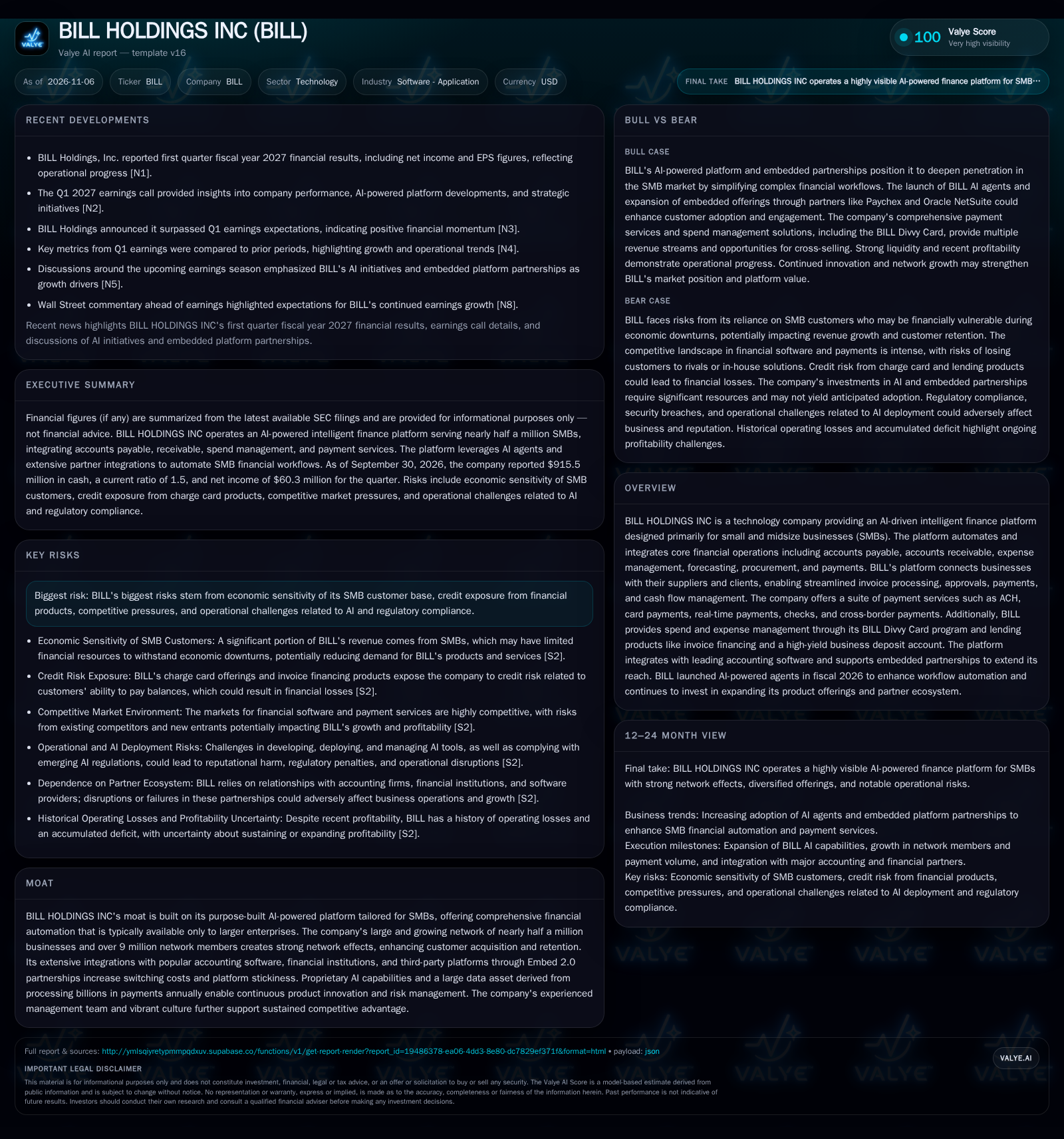
BILL Holdings operates an AI-powered finance platform for nearly half a million SMBs, integrating payments, spend management, and embedded partnerships. Recent profitability and network expansion highlight operational progress, but economic sensitivity of its customer base and credit risk from financial products pose ongoing challenges.
BILL Holdings serves almost 480,000 SMBs with an AI-driven financial automation platform, processing over $370 billion in payment volume. The company reported $60.3 million in net income for the recent quarter, but its accumulated deficit remains $2.3 billion. Embedded partnerships and AI initiatives underpin growth, while SMB exposure and credit risk remain material risks. Sustained profitability hinges on platform adoption, credit quality, and competitive differentiation. [S1] [S2]
BILL Holdings has emerged as a prominent provider of AI-powered financial automation for small and midsize businesses (SMBs), connecting nearly half a million firms and their accountants through a comprehensive platform. Recent profitability marks a turning point after years of operating losses, with $60.3 million in net income for the most recent quarter. However, the company’s accumulated deficit and dependence on economically sensitive SMBs highlight the ongoing tension between growth, risk, and sustainable margins. The interplay between AI adoption, embedded partnerships, and credit quality will shape BILL’s trajectory as it seeks to entrench itself at the center of SMB financial operations. [S1] [S2]
Profitability Milestone and Platform Scale Signal Inflection Point
BILL Holdings reported net income of $60.3 million for the quarter ended September 30, 2026, representing a meaningful shift after a history of operating losses. Despite this profitability milestone, the company still carries a $2.3 billion accumulated deficit, underscoring the challenge of sustaining and scaling earnings [S2]. BILL’s platform now serves approximately 479,300 businesses and processed $371.3 billion in Total Payment Volume (TPV) over the most recent annual period, with 9.2 million network members transacting electronically [S1]. The launch of BILL AI agents in fiscal 2026 and the Embed 2.0 initiative with major partners such as Paychex and Oracle NetSuite are intended to drive further automation and network growth [S1].
How AI Automation and Embedded Partnerships Could Reshape SMB Economics
BILL’s core economics are rooted in transaction-based fees, subscription charges, and interest or interchange income from spend management and lending products. The platform’s integration of accounts payable, receivable, payments, and expense management allows for cross-selling and potentially high customer lifetime value, especially as SMBs embed more workflows. If AI agents materially reduce manual workload and error rates, SMBs may be willing to pay a premium for automation, supporting higher ARPU (average revenue per user).
Payment volume drives the transaction-fee base, while the Divvy Card and invoice financing introduce credit risk and capital requirements. Underwriting standards, risk management, and loss provisioning become critical as lending and card balances grow. Embedded partnerships (such as with Paychex and Oracle NetSuite) may lower customer acquisition cost and increase distribution efficiency, but revenue share or integration costs could offset margin gains. Operating leverage is plausible if automation reduces support and processing headcount, but ongoing investment in AI, compliance, and partner integration creates a fixed-cost floor. Sustained profitability will depend on balancing growth investments with disciplined credit and operational risk management.
Network Effects and Integration Depth as Differentiators in a Crowded Field
BILL’s competitive strategy hinges on network effects, integration breadth, and workflow depth tailored for SMBs. The platform’s connectivity to nearly half a million businesses and millions of network members enhances switching frictions and data-driven risk management. Two-way synchronization with major accounting software (QuickBooks, NetSuite, Sage Intacct, Xero, Dynamics 365) and embedded partnerships extend BILL’s reach and raise the cost of displacement for customers.
However, the company faces intense competition from established financial software vendors, payment processors, neobanks, and vertical SaaS providers. Larger incumbents could bundle similar automation features, while newer entrants may target specific SMB verticals with specialized solutions. Proprietary AI capabilities and a growing data asset could create a feedback loop for workflow innovation and risk scoring, but these advantages must translate into demonstrably better outcomes for SMBs to maintain loyalty and pricing power.
AI-Driven Workflow Adoption Unlocks Margin Expansion and Embedded Revenue Streams
A bullish outcome depends on rapid adoption of BILL’s AI-powered automation and embedded platform capabilities. If SMBs increasingly delegate manual finance tasks to AI agents, the company could see higher ARPU, reduced churn, and greater share of wallet. Embedded partnerships may accelerate user growth by plugging BILL into the daily workflows of SMBs via third-party platforms, lowering acquisition costs and creating new upsell opportunities.
Confirmation would come from sustained double-digit growth in TPV, expansion in network members, increasing contribution from AI-enabled features, and improving gross and operating margins. Evidence of improved credit performance (low charge-offs, high payment rates) on Divvy Card and lending products would also support the upside case. The scenario could be falsified by stagnant user growth, limited AI adoption, or mounting credit losses that offset revenue gains.
Steady Expansion Tempered by SMB Volatility and Competitive Pressures
The most plausible trajectory involves continued, but moderate, expansion of BILL’s platform among SMBs, with incremental improvements in automation and network growth. Payment volume and network members rise modestly as embedded partnerships mature, but macroeconomic sensitivity among SMB customers creates churn risk and episodic headwinds.
Profitability remains positive but volatile, as investments in AI, compliance, and credit risk management absorb a significant share of incremental revenues. The base case would be confirmed by stable or gradually rising TPV, network size, and margin trends, with manageable credit losses and retention rates. It would be challenged by evidence of a sharp rise in SMB failures, competitive pricing pressure, or regulatory costs outpacing automation-driven savings.
SMB Stress and Credit Losses Overwhelm Automation Gains
A negative outcome could materialize if a macroeconomic downturn disproportionately impacts SMB customers, leading to elevated churn, lower payment volume, and higher default rates on charge card and lending products. If AI deployment or embedded partnerships fail to deliver expected efficiency or growth, operating costs could remain high relative to revenue, eroding recent profitability.
Downside confirmation would include declining TPV, shrinking network membership, rising credit losses or provisioning, and a return to operating losses. Regulatory or operational missteps—such as compliance failures, data breaches, or AI model errors—could further damage reputation and customer trust, amplifying competitive and financial pressures.
Benchmarks That Will Shape BILL Holdings’ SMB Automation Thesis
Growth in Total Payment Volume (TPV) and network members, especially the share of transactions processed via AI-driven workflows, would help test the depth of automation adoption.
Revenue and gross margin contribution from AI-enabled and embedded partnership features, if disclosed, would clarify the impact of new product initiatives.
Credit loss rates and delinquency trends on Divvy Card and invoice financing portfolios are crucial for assessing credit risk and potential drag on profitability.
Retention rates and churn among SMB customers, particularly in periods of economic stress, would indicate the platform’s stickiness and network effects.
Average revenue per user (ARPU) by customer segment and product mix, if disclosed, would illuminate cross-selling effectiveness and margin expansion potential.
Integration depth and revenue share from major partnerships (e.g., Paychex, Oracle NetSuite), if disclosed, would help evaluate the sustainability of embedded growth.
Operating expense trends as a percentage of revenue, especially R&D and compliance costs, would show whether automation is delivering scalable operating leverage.
Frequency and severity of operational incidents (e.g., compliance issues, AI errors, security breaches), if reported, would gauge execution and reputational risk.
Disclaimer: This is research-only, informational analysis and not investment advice. It may include AI-generated interpretation and general industry context. Always verify important details using primary sources.

Comments