
Invesco DB US Dollar Index Bullish Fund: Managing Currency Exposure Through Macro Volatility
As the US dollar experiences renewed strength on the back of shifting macroeconomic conditions, the Invesco DB US Dollar Index Bullish Fund (UUP) offers investors a liquid pathway to express views on the greenback. However, the ETF’s reliance on futures contracts, susceptibility to tracking error, and sensitivity to market structure changes introduce unique risks and operational dynamics.
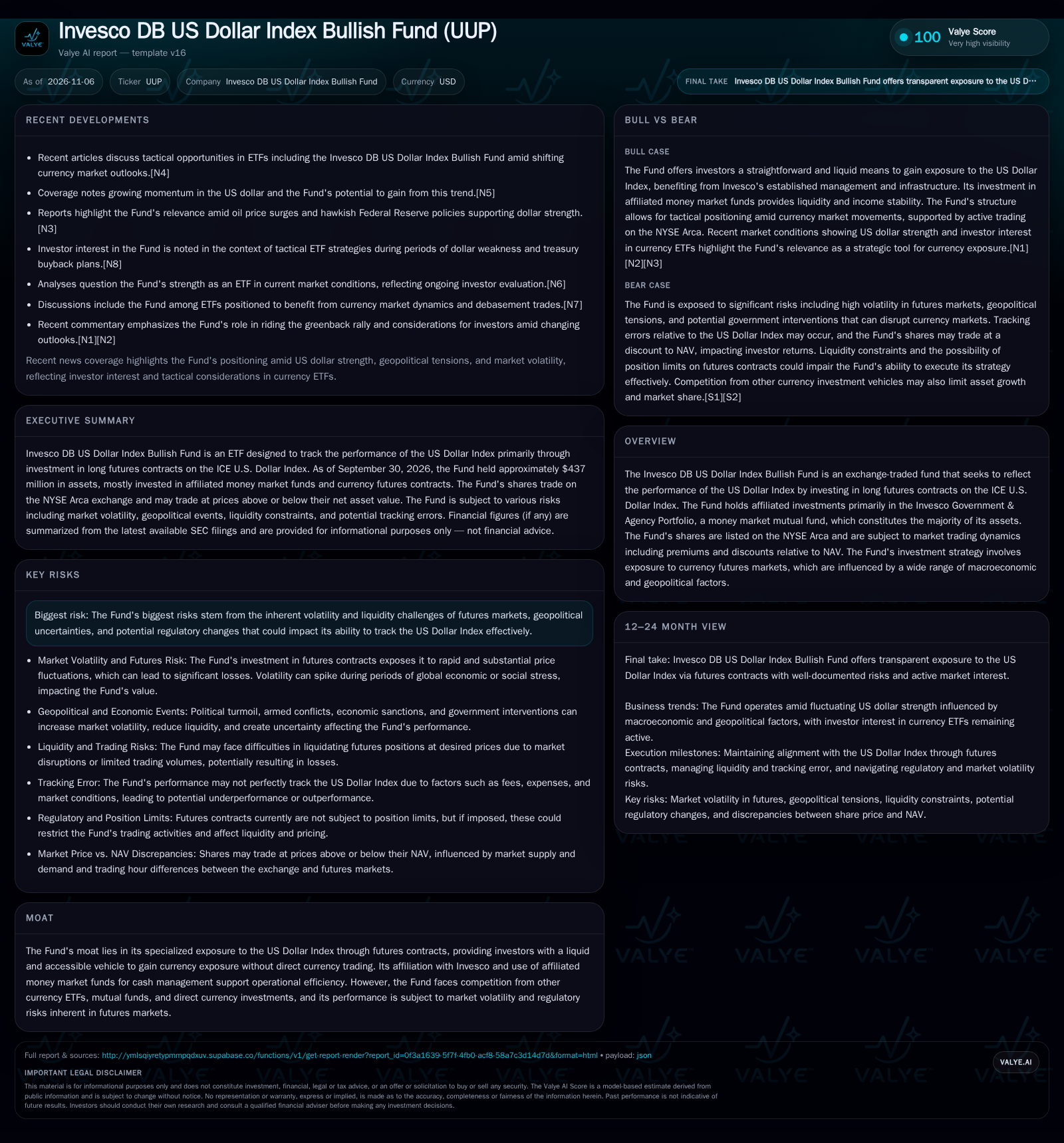
UUP delivers direct exposure to the US Dollar Index via long futures contracts, making it a popular tactical tool as the dollar strengthens. The fund’s $437 million asset base is largely held in affiliated government and agency portfolios, and shares trade near NAV on NYSE Arca. Investors must weigh the attractiveness of dollar exposure against these operational and structural complexities. [S2] [N2] [N3] [N5] [N6] [N8]
The Invesco DB US Dollar Index Bullish Fund (UUP) stands out as a specialized exchange-traded fund for investors seeking targeted exposure to movements in the US Dollar Index. With over $437 million in assets as of September 2026 and a structure built on ICE U.S. Dollar Index futures, UUP’s value proposition is its directness and liquidity. Yet, the mechanics of futures-based exposure, ongoing risk of tracking error, and the ever-present possibility of market or regulatory disruptions mean that UUP’s utility as a tactical or strategic currency play is tied to more than just the direction of the dollar. Understanding how these factors interact is essential for assessing both the upside and vulnerabilities of the Fund. [S2] [N2] [N3] [N5]
Dollar Strength Momentum Evident in Recent Asset Levels and Market Positioning
As of September 30, 2026, the Invesco DB US Dollar Index Bullish Fund reported total assets of approximately $437.4 million, with affiliated investments in the Invesco Government & Agency Portfolio constituting 97.6% of shareholders’ equity. The Fund’s 15.2 million shares traded at a net asset value per share of $28.77 and a market value of $28.78, indicating tight trading spreads but also highlighting the potential for NAV premiums or discounts. The Fund’s net investment income for the nine months ended September 30, 2026, reached $7.86 million. This operational snapshot comes amid heightened investor attention to dollar strength, driven by factors such as oil price surges and hawkish Federal Reserve policies, which have renewed interest in currency ETFs as tactical vehicles. [S2] [N2] [N3] [N5]
Revenue, Costs, and Investor Outcomes Influenced by UUP’s Futures-Based Approach
UUP’s economics are fundamentally a function of its ability to replicate the US Dollar Index through rolling long positions in ICE U.S. Dollar Index futures contracts. The Fund generates income from changes in the futures curve (potentially capturing roll yield if the curve is favorably shaped), income from affiliated government and agency portfolios, and net investment income. Its expense ratio is approximately 0.76% per year, encompassing management fees and brokerage commissions. Because the fund does not own physical currency but rather futures contracts, it is exposed to the cost of rolling contracts as they expire and potential slippage relative to the underlying index.
The Fund’s structure introduces tracking error risk, as realized returns can diverge from the US Dollar Index due to fees, timing differences in rolling contracts, and liquidity constraints. Unlike equity ETFs, the Fund’s underlying assets (futures and money market instruments) are influenced by short-term interest rates, futures market dynamics, and collateral yields. The simplicity of the model means operating leverage is modest—costs scale with assets under management, but the fixed cost base is low compared to active funds. However, sudden changes in futures market liquidity or regulatory structure (such as the imposition of position limits) could alter the cost and feasibility of maintaining exposure.
Evaluating Differentiation and Substitution Risks Among Currency Exposure Options
UUP’s primary differentiation lies in providing liquid, exchange-traded, and collateralized exposure to the US Dollar Index without requiring investors to trade currency directly. Its affiliation with Invesco supports operational efficiency and trust, while NYSE Arca listing ensures tradability. However, the fund faces competition from other currency ETFs, actively managed currency mutual funds, and direct currency trading platforms. Alternative vehicles may offer different fee structures, leverage, or exposure mechanisms, and some may seek to minimize tracking error through synthetic or basket-based strategies.
A key counterforce is the risk that investors migrate to lower-cost or more precise exposure tools, especially if tracking error or NAV discounts widen. Additionally, direct access to currency futures or OTC currency markets may appeal to institutional investors seeking tailored exposure or lower friction. If regulatory changes introduce position limits or increase capital requirements for futures-based ETFs, UUP’s structural advantage could erode. The fund’s ability to maintain relevance depends on its liquidity, transparency, and tracking discipline relative to peers and substitutes.
Asset Growth Supported by a Prolonged Dollar Rally and Stable Market Conditions
A favorable scenario for UUP would see continued US dollar strength, driven by persistent interest rate differentials, geopolitical turbulence, or global demand for dollar-denominated assets. In this environment, tactical and strategic investors could increase allocations to UUP, expanding assets under management, improving liquidity, and narrowing trading spreads. If futures market conditions remain stable—without the imposition of position limits or sudden liquidity shocks—the fund’s ability to mirror the US Dollar Index could remain robust.
Confirmation of this scenario would come from rising AUM, consistently tight bid-ask spreads, sustained or increasing net investment income, and minimal tracking error relative to the US Dollar Index. News of robust flows into currency ETFs, as well as continued commentary on the dollar’s strength and the fund’s utility for macro positioning, would also support this thesis. [N2] [N3] [N5]
Maintaining Operations During Cyclical Dollar Movements and Minor Tracking Variations
The most plausible trajectory for UUP is that it continues to serve as a liquid, transparent proxy for the US Dollar Index, with assets and trading volumes ebbing and flowing in line with macroeconomic narratives. The fund’s performance will likely track the index closely over time, subject to periodic deviations caused by fees, rolling costs, and transient market dislocations. Regulatory structure is assumed to be stable in this scenario, with no immediate imposition of position limits or capital requirements that would disrupt the model.
Evidence for this outcome would include steady or cyclical AUM patterns, NAV and market price alignment within historical norms, and tracking error that remains within acceptable bounds for futures-based ETFs. Minor periods of premium or discount to NAV may occur, but would be arbitraged away as market makers and authorized participants act. Persistent but manageable volatility is expected, in line with historical averages. [S2] [N6]
Fund Utility Challenged by Market Structure Disruptions and Increased Tracking Errors
Adverse developments could include a sudden imposition of position limits on ICE U.S. Dollar Index futures, either by the CFTC or the exchange, constraining the Fund’s ability to replicate index exposure. Liquidity shocks—perhaps triggered by geopolitical crises, central bank interventions, or macroeconomic turmoil—could widen bid-ask spreads, increase tracking error, and force the Fund to incur unfavorable roll costs or even liquidate positions at inopportune prices.
In this scenario, UUP could see pronounced NAV discounts, persistent tracking error, and a decline in AUM as investors lose confidence in the Fund’s ability to deliver intended exposure. Evidence would include public announcements of regulatory changes, disclosures of failed or partial contract rolls, or a sustained divergence between Fund performance and the US Dollar Index. Significant outflows or a spike in volatility well above historical averages would further confirm this adverse chain of events. [S2]
Factors Influencing UUP’s Ongoing Viability for Dollar Exposure
Tracking error between UUP’s NAV performance and the US Dollar Index, especially during periods of market volatility or contract roll dates.
Changes in assets under management (AUM), reflecting shifts in investor sentiment and the attractiveness of the ETF structure versus alternatives.
Bid-ask spreads and the frequency or magnitude of NAV premiums/discounts, which would indicate underlying market liquidity and arbitrage efficiency.
Regulatory developments, including any announcements from the CFTC or ICE regarding position limits or margin requirements for US Dollar Index futures.
News of significant inflows or outflows, particularly during macroeconomic events that impact the US dollar or global risk appetite.
Volatility spikes in the underlying futures contracts or disruptions in the money market instruments used for collateral management.
Changes in the Fund’s expense ratio, or any amendments to its fee structure, which could affect net investor returns.
If disclosed, breakdowns of roll yield or realized slippage versus the index, providing insight into the mechanics of futures-based tracking.
Disclaimer: This is research-only, informational analysis and not investment advice. It may include AI-generated interpretation and general industry context. Always verify important details using primary sources.

Comments